
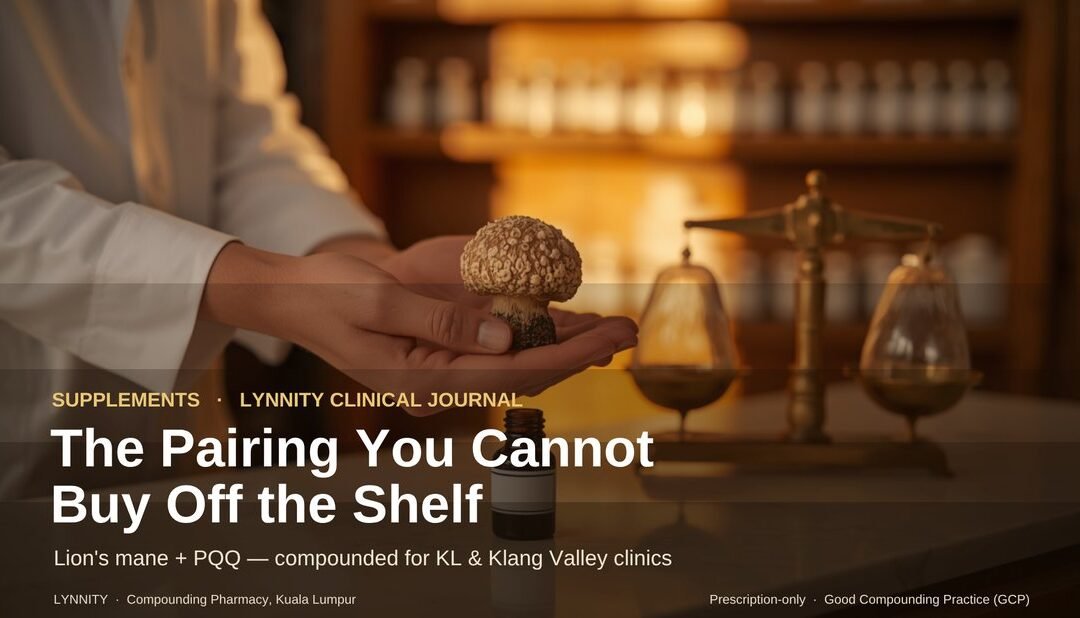
Short answer: Lion’s mane (Hericium erinaceus) is now on every pharmacy shelf and in every mushroom coffee — which is precisely why a solo lion’s mane product gives a prescriber nothing to work with. What a clinic cannot get at retail in Malaysia is the pairing: a verified, standardised lion’s mane extract combined with PQQ (pyrroloquinoline quinone) — a mitochondrial redox cofactor with its own randomised placebo-controlled trials at 20 mg/day, and an ingredient that is rarely formulated and rarely available in this market. Each half carries published human evidence: lion’s mane improved cognitive scores versus placebo in small trials of mild cognitive impairment and mild Alzheimer’s disease; PQQ improved attention and memory measures versus placebo in older adults. The combination itself has not been tested in a trial — the pairing is a formulation decision for a prescriber, built on two convergent mechanisms: nerve-growth-factor signalling and mitochondrial biogenesis. That is exactly the territory of prescription-led compounding: a doctor decides suitability, and Lynnity compounds both actives, verified and trial-dosed, into one capsule or a flavoured liquid for that one patient.
Why a pairing — and not another lion’s mane bottle
Patients in KL, the Klang Valley and Singapore already take lion’s mane, from imported capsules, gummies and coffees of unknown composition. The mushroom — “monkey head” (hóu tóu gū) in Malaysian Chinese cooking — is a commodity now, and a commodity is not a prescribing proposition: whatever a compounding pharmacy makes must offer something the shelf cannot. Here that is two things at once. First, verification — the retail lion’s mane category is chaotic underneath (more below), so a defined, certificate-backed extract is itself a clinical upgrade. Second, and decisively, the partner ingredient: PQQ is almost never formulated in this market, is absent from Malaysian pharmacy shelves, and carries its own randomised-trial record. A single prescription preparation holding both is something no retail product in Malaysia offers — the same logic as our combined nutritional compounding service, sharpened to a cognitive-support use case.
The nerve-growth half: what lion’s mane brings
Two compound families in Hericium erinaceus — hericenones (fruiting body) and erinacines (mycelium) — stimulate synthesis of nerve growth factor (NGF) in laboratory studies, and erinacine A reaches brain tissue in animal work. Universiti Malaya’s Mushroom Research Centre has published for over a decade on the neurotrophic properties of Malaysian-grown lion’s mane — a local research pedigree worth knowing. All of that is preclinical; the human record is small but placebo-controlled. In Mori and colleagues’ 16-week double-blind trial (Phytotherapy Research, 2009), 30 adults aged 50–80 with mild cognitive impairment took 3 g daily of powdered fruiting body or placebo: cognitive scores were significantly higher than placebo at weeks 8, 12 and 16 — and fell back when intake stopped, a washout reversal that argues the effect was real and intake-dependent. In Li and colleagues’ 49-week double-blind pilot in mild Alzheimer’s disease (Frontiers in Aging Neuroscience, 2020), three 350 mg capsules daily of mycelia standardised to erinacine A at 5 mg/g produced better CASI, MMSE and daily-function scores than placebo, well tolerated. Smaller trials point the same way — improved MMSE in healthy 55–65-year-olds on 3.2 g/day (Saitsu 2019) and quicker cognitive-task performance in young adults on 1.8 g/day of extract (Docherty 2023, with several null measures plainly reported). Small samples, early evidence, no disease-treatment claims — and every trial used a defined material at a defined dose.
The label problem retail cannot solve
Commercial “lion’s mane” is produced two ways, and the label rarely says which. Fruiting-body extracts — the material behind most of the trials — typically carry roughly 20–40% β-glucans on mushroom-specific assays. Mycelium-on-grain powders grind the culture and its grain bed together; analyses routinely find β-glucans under 10%, with grain starch making up half or more of capsule weight, and “total polysaccharides” claims that quietly count that starch. Independent testing of retail products spans under 5% β-glucan to filler-inflated figures. The nuance: standardised mycelium is legitimate — Li’s trial material was mycelial, defined by its erinacine A content. What fails is powder nobody has verified. Readers of our saffron and boswellia (AKBA) guides know the rule: the standardisation is the decision.
The mitochondrial half: what PQQ is — and why your patients have never seen it
Pyrroloquinoline quinone is a small redox cofactor first characterised in bacterial enzymes, present in trace amounts in foods such as nattō, green tea and kiwifruit, and not synthesised by the human body. Its pharmacological interest sits in two places. In cell and animal studies it activates the PGC-1α pathway that drives mitochondrial biogenesis — the making of new mitochondria — and, notably for this pairing, PQQ and its derivatives have been reported to stimulate NGF synthesis in vitro, the same growth-factor axis lion’s mane acts on. Preclinical, both points — and the human record, while small, is genuinely placebo-controlled at a consistent 20 mg/day: Itoh and colleagues’ 12-week randomised double-blind trial in 41 older adults reported improved attention and working-memory measures versus placebo, with near-infrared spectroscopy showing increased prefrontal blood flow; Shiojima and colleagues’ 12-week randomised double-blind trial in middle-aged and older adults with subjective forgetfulness reported improvements in composite memory and attention measures versus placebo. An earlier 8-week open-label study (Nakano 2012) reported better mood, fatigue and sleep scores — uncontrolled, so read it as supporting colour, not proof.
And the market reality that makes PQQ the right partner under our topic rules: it is rarely formulated and rarely available in Malaysia. It is not a registered medicine here, it is essentially absent from pharmacy shelves, and the few international products that carry it are seldom dosed and combined the way a prescriber would want. A pharmaceutical-grade 20 mg trial-matched dose, in the same capsule as a verified lion’s mane extract, is a compounding product in the truest sense — it does not otherwise exist in this market.
Why these two together — and what has not been shown
The pairing logic is mechanistic convergence: lion’s mane’s hericenones and erinacines act on NGF signalling; PQQ stimulates NGF synthesis in vitro from a second direction while separately driving mitochondrial biogenesis — growth signalling and the energy supply to use it. It is a coherent formulation hypothesis for a prescriber, and it must be stated as exactly that: no published trial has tested lion’s mane and PQQ together, and no claim of synergy, treatment or prevention of any disease can be made. What the prescriber gets is two actives, each with independent placebo-controlled human evidence, combined at trial-informed doses in one accountable preparation — instead of a patient stacking two marketplace bottles of unknown content on their own.
Where compounding earns its place
- The materials are defined. Pharmaceutical-grade, identity-verified lion’s mane extract with a stated fraction and a certificate of analysis for β-glucan and marker-compound content, plus pharmaceutical-grade PQQ disodium salt — not a starch-padded powder next to an unverified novelty ingredient.
- The doses follow the trials. Lion’s mane at a trial-informed level (the studies used 1.8–3.2 g/day of fruiting-body material or a defined standardised-mycelia dose) and PQQ at the 20 mg/day used in both randomised trials. The prescription states both strengths; the preparation delivers them.
- One preparation, not a pile of bottles. A single capsule — or a flavoured oral liquid for the older patient who manages capsules poorly, a real consideration in the age group the trials studied.
- Someone is accountable. Made for a named patient against a doctor’s prescription under Good Compounding Practice (GCP), labelled with directions and a beyond-use date under our dating framework, after a pharmacist’s medication-list review.
How it works in Malaysia
Neither active is a registered medicine in Malaysia, and Lynnity’s compounded preparations carry no MAL registration — every Lynnity preparation, supplements included, is made only against a registered doctor’s prescription, under Good Compounding Practice (GCP). The pathway mirrors the standard prescription route: the doctor decides suitability (cognitive concerns are medical concerns first — new memory symptoms deserve proper assessment, not a supplement); the prescription specifies materials, strengths and form (capsule or flavoured liquid); Lynnity compounds and labels the preparation with its beyond-use date; and review is scheduled, not assumed — the longest relevant trial ran under a year. For clinics building a cognitive-and-healthy-ageing service, this pairing sits beside our guides to ergothioneine, urolithin A and customised formulations for clinics — always matched to the patient, not the trend.
Who a prescriber might consider it for — and who not
Reasonable candidates, at the doctor’s discretion: patients already self-sourcing lion’s mane, safer on a verified, known-dose preparation with oversight; older patients in whom the prescriber judges a trial-informed cognitive-support adjunct worth a defined, reviewed period; patients whose current retail stack is of doubtful content. Cautions: mushroom allergy (skin and respiratory reactions to lion’s mane are reported, though uncommon); anticoagulant or antiplatelet therapy — laboratory work suggests lion’s mane may reduce platelet aggregation, so prescriber review and a pre-surgical pause are prudent; glucose-lowering therapy, worth monitoring on animal data; pregnancy and breastfeeding — no safety data for either active, avoid; and anyone expecting a dementia treatment. Tolerability in the trials was reassuring for both actives — largely mild digestive upset for lion’s mane, and PQQ well tolerated at 20 mg/day, though its long-term human safety record is shorter. The NIH LiverTox reference does not implicate lion’s mane in significant liver injury. Saying “this is not for you” is as much evidence-based practice as prescribing; so is “see a doctor about the memory concern first”. Our guide to Good Compounding Practice covers the quality framework behind every preparation.
Frequently asked questions
What is the lion’s mane + PQQ pairing, in one sentence?
It is a doctor-prescribed compounded preparation combining a verified, standardised lion’s mane (Hericium erinaceus) extract with PQQ (pyrroloquinoline quinone) at the 20 mg daily dose used in its randomised trials — two actives with independent placebo-controlled cognitive evidence, in one accountable formulation.
Why not just buy lion’s mane from the pharmacy?
Because the shelf cannot verify or complete it. Retail “lion’s mane” spans genuine fruiting-body extract (roughly 20–40% β-glucans) to starch-padded mycelium-on-grain powder testing under 10%, and no retail product in Malaysia pairs it with pharmaceutical-grade PQQ at a trial-matched dose. The compounded preparation supplies both the verification and the partner ingredient.
What is PQQ?
Pyrroloquinoline quinone is a redox cofactor found in trace amounts in foods such as nattō and kiwifruit and not made by the body. In cell and animal studies it drives mitochondrial biogenesis and stimulates nerve-growth-factor synthesis; in two 12-week randomised placebo-controlled human trials at 20 mg/day it improved attention and memory measures in older adults. It is rarely formulated and rarely available in Malaysia.
What doses have the human trials used?
Lion’s mane: 3 g/day powdered fruiting body (16 weeks, mild cognitive impairment), 3.2 g/day (12 weeks, healthy older adults), 1.8 g/day extract (28 days, young adults), and 3 × 350 mg/day erinacine-A-standardised mycelia (49 weeks, mild Alzheimer’s). PQQ: 20 mg/day in both 12-week randomised trials. A compounded preparation lets the prescriber match these trial-informed levels.
Has the combination itself been proven in a trial?
No. Each active has its own placebo-controlled human trials, but no published study has tested lion’s mane and PQQ together. The pairing is a mechanism-based formulation decision for a prescriber — nerve-growth signalling plus mitochondrial support — not a proven synergy, and no disease-treatment claim attaches to it.
Is the pairing safe? Who should be careful?
Both actives were well tolerated in their trials — largely mild digestive upset for lion’s mane; PQQ uneventful at 20 mg/day, though its long-term record is shorter. Caution applies for mushroom allergy, blood-thinning or antiplatelet medicines, glucose-lowering therapy, and pregnancy and breastfeeding, where safety data do not exist. A pharmacist reviews the full medication list before compounding.
How would a patient get it in Malaysia?
Through a doctor. All Lynnity preparations — including supplements — are compounded only against a registered doctor’s prescription, under Good Compounding Practice (GCP), and carry no MAL registration. The doctor specifies materials, strengths and form — a capsule or a flavoured liquid — and Lynnity prepares it for that named patient with a beyond-use date.
Reviewed by the Lynnity pharmacy team — registered pharmacists compounding to Good Compounding Practice (GCP) in Kuala Lumpur. Education for healthcare practitioners in Malaysia and Singapore; no claim that lion’s mane, PQQ or their combination treats, cures or prevents any disease. All Lynnity compounded preparations — including supplements — require a prescription from a registered doctor.