
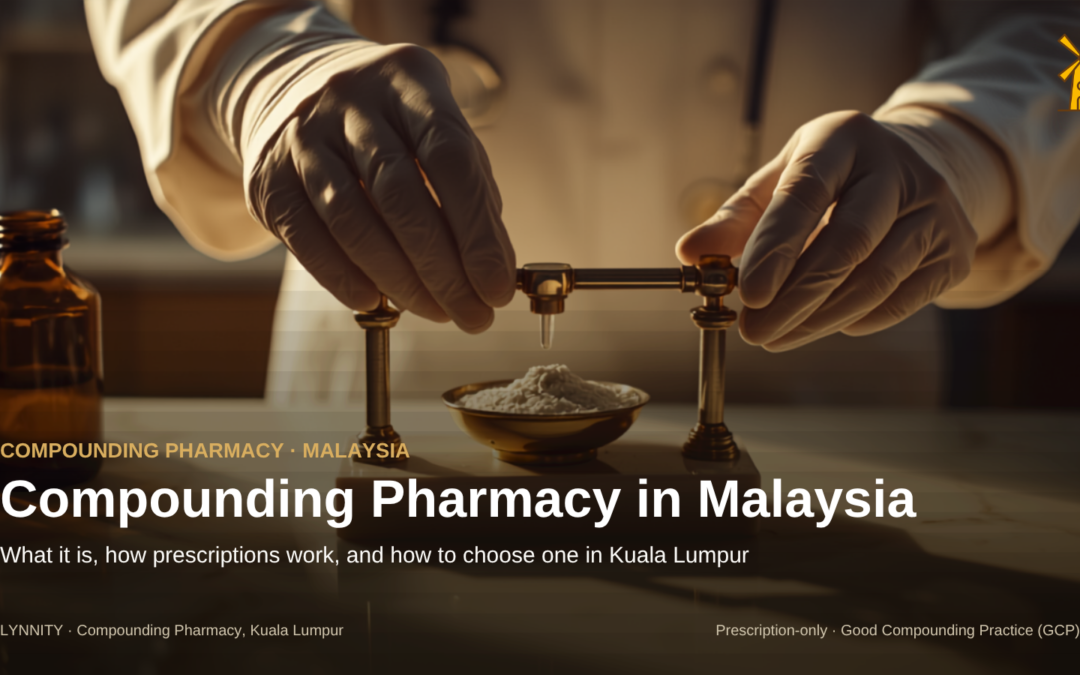
A compounding pharmacy prepares individualised preparations for a specific patient, on a doctor’s prescription, when a standard commercial product does not fit — a different strength, a different dosage form, an allergen removed, or a combination that is not sold ready-made. In Malaysia, compounding is carried out by registered pharmacists under the Poisons Act 1952 and the Ministry of Health’s Good Compounding Practice (GCP) 2018 guideline.
This guide explains what a compounding pharmacy in Malaysia actually does, how the prescription route works, how the practice is regulated, and what to look for when choosing a compounding pharmacy in Kuala Lumpur.
What is a compounding pharmacy?
A compounding pharmacy prepares medicines and pharmacist-formulated preparations from raw pharmaceutical ingredients, individually, for one named patient at a time. This is different from a manufacturer, which produces standardised batches for the open market, and different from a retail pharmacy, which dispenses those ready-made products off the shelf.
Typical reasons a doctor prescribes a compounded preparation include: a dose that is not commercially available (for example very low doses used in specific protocols), a patient who cannot swallow tablets and needs a flavoured liquid, an allergy or intolerance to a dye, preservative or filler in the commercial product, a discontinued or hard-to-source medicine, or a combination of actives the prescriber wants delivered in a single preparation.
How is compounding regulated in Malaysia?
Compounding in Malaysia sits inside the existing pharmacy law rather than a separate licensing regime. The key frameworks are:
- Poisons Act 1952 — the primary legal framework governing who may compound and supply scheduled substances, and under what supervision.
- Good Compounding Practice (GCP) 2018, Pharmaceutical Services Programme, Ministry of Health Malaysia — the national standard for facilities, documentation, raw-material control and quality checks in compounding.
- USP <795> — the internationally referenced standard for non-sterile compounding, used alongside the Malaysian guideline.
A compounded preparation is made for one patient on one prescription; it is not a registered mass-market product and is not advertised as one. That is why the prescription step matters — it is the legal and clinical basis of the whole practice. For a closer look at what GCP compliance involves in day-to-day practice, see our guide: Is a compounding pharmacy safe? Understanding GCP.
Do I need a prescription?
Yes. Compounded medicines in Malaysia are prepared on a doctor’s prescription. The usual route looks like this:
- Consultation — you discuss the problem with your doctor as usual.
- Prescription — if a standard product does not fit, the doctor writes a prescription specifying the active, strength and dosage form for you individually.
- Compounding — the pharmacy prepares that exact preparation under GCP conditions, with the formula, weighing records and checks documented.
- Dispensing and follow-up — the pharmacist counsels you on use and storage, and communicates with the prescriber where needed.
If you think a compounded preparation might suit your situation, the practical first step is to raise it with your doctor — or ask the compounding pharmacy which prescribers they already work with.
What dosage forms can a compounding pharmacy prepare?
Dosage forms vary by pharmacy and by what its facility is set up and approved to prepare. At Lynnity, preparations are compounded as capsules, liquids, creams, tonics and serums:
- Capsules — two-piece hard capsules filled to an individualised strength, including combinations.
- Liquids — flavoured solutions and suspensions, often used in paediatric compounding and for patients who cannot swallow solid forms.
- Creams — topical preparations for dermatology and pain applications.
- Tonics and serums — oral liquid concentrates and topical serums built around the prescribed actives.
Where absorption of the active is the limiting factor, Lynnity’s formulation work is liposomal-led — selected actives are prepared as liposomal concentrates. The science is explained in The Science of Liposomal Delivery.
How to choose a compounding pharmacy in Kuala Lumpur
Whichever pharmacy you or your doctor consider, these are reasonable questions to ask:
- Is a registered pharmacist responsible for compounding? Ask who supervises preparation and what their registration is.
- Does the facility follow GCP 2018? A compounding pharmacy should be able to describe its compliance with the Ministry of Health guideline and USP <795>.
- Where do raw materials come from? Look for pharmacopoeia-grade materials (USP / BP / JP specifications) from documented suppliers with certificates of analysis.
- Is every preparation documented? Formula records, weighing logs and batch documentation are the backbone of quality in compounding.
- Which dosage forms can they actually prepare? Match the pharmacy’s capabilities to what your prescription needs.
- How do they work with your doctor? Good compounding is a three-way relationship between patient, prescriber and pharmacist.
About Lynnity Compounding Pharmacy
Lynnity Compounding Pharmacy (Lynnity Sdn Bhd, 200701002964 / 760962-P) is a registered compounding pharmacy in Kuala Lumpur. Compounding is carried out under the Poisons Act 1952 and Good Compounding Practice (GCP) 2018, referencing USP <795>, in our GCP laboratory. Raw materials are sourced from JAKIM-HALAL and FDA-registered suppliers and screened against USP / BP / JP pharmacopoeia specifications. Compounding is led by registered pharmacist Vitthia Rama Murti (RPh 15632).
Prescribers and patients can reach the team at +60 12-661 8987 or info@lynnitypharma.com — 5 & 5-1, Jalan 2/33B, MWE Commercial Park, Off Jalan Kepong, 52000 Kuala Lumpur. Practitioner guides on specific compounded actives are published in The Clinical Journal.
Frequently asked questions
What is a compounding pharmacy?
A pharmacy where registered pharmacists prepare individualised medicines and preparations for a specific patient on a doctor’s prescription — a custom strength, form or combination that is not commercially available.
Is compounding legal in Malaysia?
Yes. Compounding by registered pharmacists is part of pharmacy practice under the Poisons Act 1952, carried out to the Ministry of Health’s Good Compounding Practice (GCP) 2018 guideline.
Do I need a prescription for compounded medication in Malaysia?
Yes — compounded medicines are prepared on a doctor’s prescription, for one named patient. Speak to your doctor first, or ask the pharmacy how to involve your prescriber.
What forms can be compounded?
This varies by pharmacy. Lynnity compounds capsules, liquids, creams, tonics and serums, including liposomal concentrate formulations of selected actives.
How is a compounding pharmacy different from a retail pharmacy?
A retail pharmacy dispenses ready-made, mass-produced products. A compounding pharmacy prepares the medicine itself, individually, from raw pharmaceutical ingredients against a prescription.
How do I find a compounding pharmacy in Kuala Lumpur?
Ask your doctor for a referral, or contact a compounding pharmacy directly and ask about its pharmacist registration, GCP compliance, raw-material sourcing and the dosage forms it prepares.