
Short answer: Pregnenolone is the first steroid the body makes from cholesterol — the single upstream reservoir that feeds progesterone, DHEA, cortisol and, in the brain, the neurosteroids allopregnanolone and pregnenolone sulfate. That position at the top of the cascade is exactly why it should never be a casual online purchase: whatever you take can be converted downstream into androgens or oestrogens, and no two patients convert it the same way. There is no registered pregnenolone product on Malaysian pharmacy shelves; what circulates locally is grey-market importation of one-size-fits-all 50–100 mg capsules from overseas supplement sites — while DHEA, one step downstream, is explicitly barred from import into Malaysia. For doctors who judge that a patient’s hormonal picture warrants it, the coherent route is the one used for every other hormone: a prescription, baseline labs, and a compounding pharmacy that prepares the exact low dose the prescriber wants. Lynnity compounds pharmaceutical-grade pregnenolone as precision capsules or a measured sublingual liquid, on a doctor’s prescription only, under Good Compounding Practice (GCP).
What pregnenolone is — the top of the steroid cascade
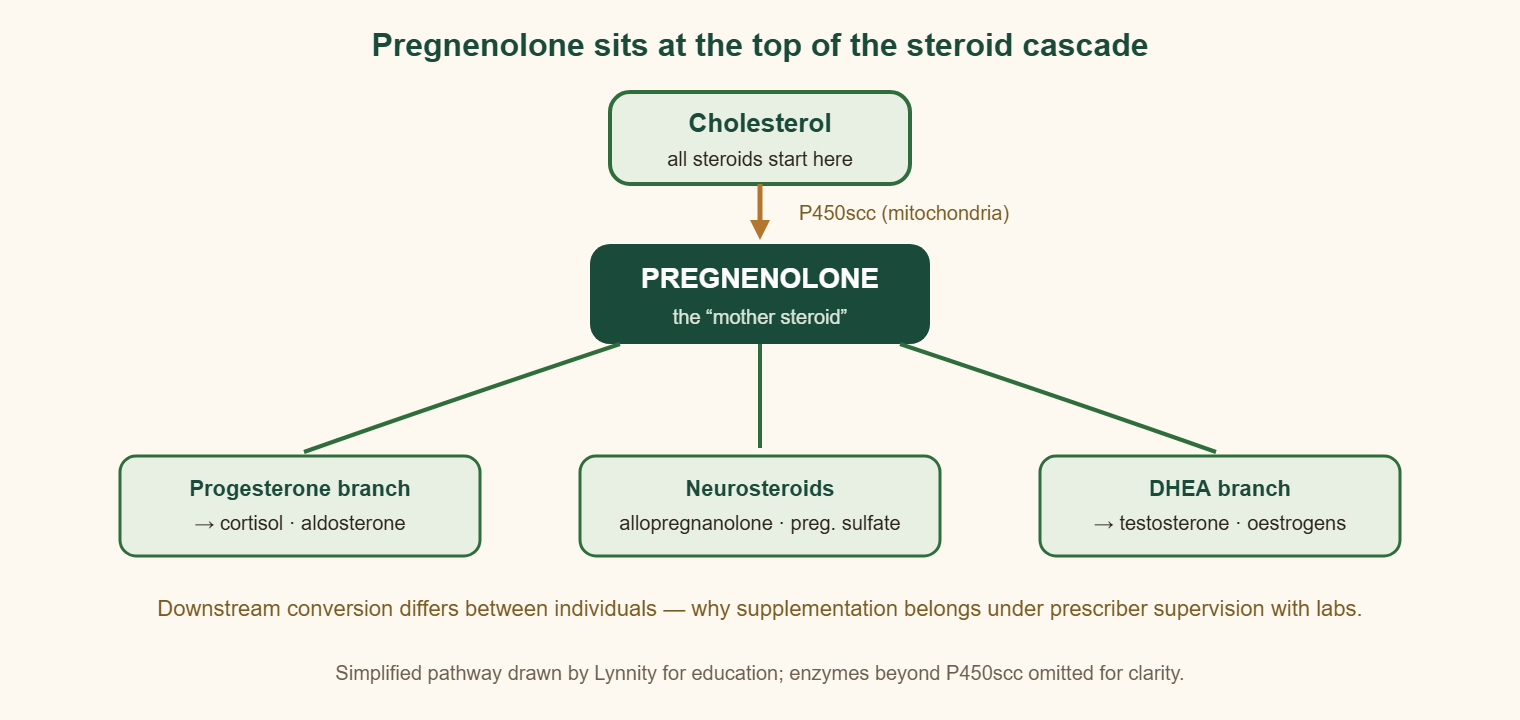
Every steroid hormone in the human body begins as cholesterol, and the first committed step — inside mitochondria, via the enzyme P450scc — produces pregnenolone. From there the cascade forks. One branch runs through progesterone toward cortisol, aldosterone and the calming neurosteroid allopregnanolone. The other runs through DHEA toward testosterone and the oestrogens. Endocrinologists have called pregnenolone the “mother steroid” for this reason: it is not one hormone with one action but the shared raw material for most of the others.
Pregnenolone also has direct actions of its own in the brain. Its sulfated form, pregnenolone sulfate, is a positive modulator of the NMDA glutamate receptor, while its metabolite allopregnanolone enhances GABA-A receptor signalling — the brain’s main inhibitory brake. This two-sided neurosteroid pharmacology is not fringe science: an intravenous formulation of allopregnanolone (brexanolone) was approved by the US FDA in 2019 for postpartum depression, and an oral successor followed in 2023. Those approvals belong to those drugs, not to pregnenolone supplements — but they establish that the pathway pregnenolone feeds is genuine, druggable neurobiology.
The clinical record a prescriber can check
Randomised trials exist — read them honestly
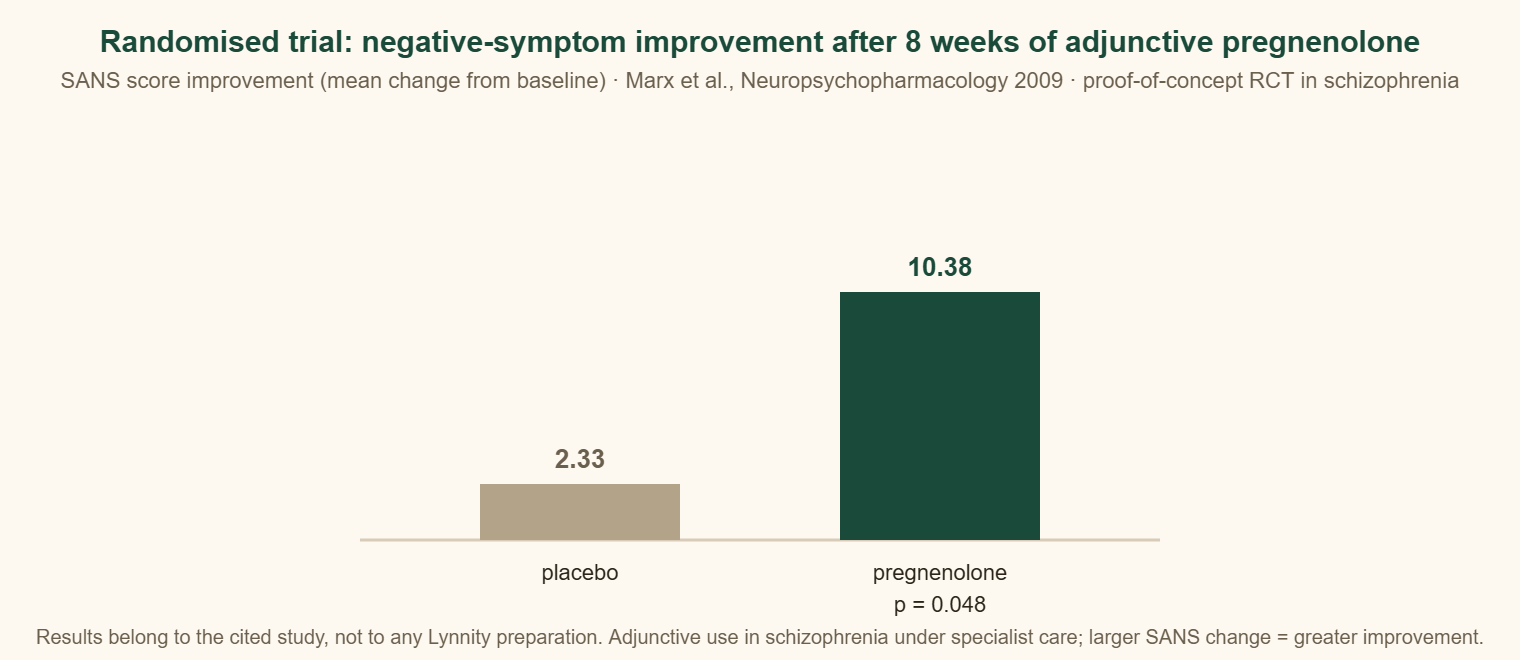
Pregnenolone has been taken into properly randomised, double-blind, placebo-controlled territory, mostly by the Duke University group of Marx and colleagues studying it as an adjunct in schizophrenia. In the 2009 proof-of-concept trial (Neuropsychopharmacology), eight weeks of adjunctive pregnenolone produced a significantly greater improvement in negative symptoms than placebo — a mean SANS score change of 10.38 versus 2.33 (p = 0.048) — and, tellingly, the rise in serum allopregnanolone and pregnenolone sulfate levels tracked the cognitive improvements. A larger follow-up randomised trial (120 participants, 8 weeks, published 2014) found improved functional capacity on pregnenolone but no significant difference on the primary cognitive composite — though again, the patients whose serum pregnenolone actually rose were the ones whose cognition scores improved. A registered US trial (NCT03505905) has since taken the neurosteroid approach into perimenopausal depression.
Studies suggest, in other words, a biologically coherent but modest and condition-specific signal — in psychiatric populations, at pharmacy-grade doses, under specialist supervision. None of this is evidence that pregnenolone treats memory loss, fatigue or “hormone imbalance” in the general public, and it must not be read that way.
What the evidence does not say. The randomised trials were small, short, adjunctive and psychiatric; the larger one missed its primary cognitive endpoint. Pregnenolone has not been shown to treat or cure any disease, reverse ageing, restore memory or “fix” hormones, and older claims about arthritis from the 1940s pre-date modern trial standards entirely. Nobody should stop a prescribed medicine to take it, and nobody with a hormone-sensitive condition should take it at all outside specialist care. Any compounded preparation from Lynnity is prescriber-directed support built around a treatment plan the doctor owns.
Why pregnenolone, of all supplements, belongs on a prescription
Three features make pregnenolone a poor fit for self-supplementation and a natural fit for the prescription-and-compounding route used for every other hormone.
It converts — unpredictably. Give the same pregnenolone dose to two patients and one may push it down the DHEA branch toward androgens (acne, oily skin, facial hair in women), the other toward oestrogenic activity. Reported side-effects include irritability, insomnia, mood changes and — in sensitive individuals — heart palpitations. Anyone with a hormone-sensitive condition (breast, uterine or ovarian cancer, endometriosis, uterine fibroids, prostate concerns) should not receive it outside specialist oversight, and its GABA-pathway activity means it can blunt benzodiazepine sedatives. This is precisely the risk profile prescriptions exist for.
The local supply is grey. There is no MAL-registered pregnenolone product in Malaysia. Overseas supplement sites ship 50 mg and 100 mg one-size capsules to the region, while iHerb’s own Malaysia shipping policy lists DHEA — pregnenolone’s immediate downstream neighbour — as barred from import. A hormone precursor arriving by parcel, of unverified grade, at a fixed dose nobody chose for the patient, is the opposite of how Malaysian practice handles hormones. Doctors here already prescribe compounded DHEA and compounded progesterone through exactly the pathway pregnenolone should use.
The sensible doses are ones retail never stocks. Prescribers who use pregnenolone typically start low — commonly 5–30 mg — and titrate against symptoms and follow-up labs, far below the 100 mg capsules dominating the import market. The research doses were higher still, but those belong to supervised psychiatric trials, not general practice. Either way, the dose the prescriber actually wants is rarely the dose in the imported bottle.
How Lynnity compounds pregnenolone
Under Good Compounding Practice (GCP), and only against a registered doctor’s prescription, Lynnity prepares pregnenolone from pharmaceutical-grade micronised material with a certificate of analysis, as: precision capsules at exactly the prescribed strength — 5 mg, 10 mg, 25 mg or whatever the titration plan calls for, not the fixed strengths of the import market; a measured sublingual liquid held under the tongue, useful when the prescriber wants finer titration steps or suspects first-pass metabolism is blunting response; or a combination capsule where pregnenolone is prescribed alongside partners such as DHEA within a single monitored plan — we can combine agents into one capsule to protect adherence. Sensible practice starts with baseline hormone labs — the logic our blood-test-versus-shelf article walks through — and every preparation carries a beyond-use date assigned under GCP. For the wider hormonal context, clinics can start with our guides to getting started with BHRT in KL and menopause and BHRT in Malaysia.
For clinics and practitioners
Lynnity is a prescription-only compounding pharmacy in Kuala Lumpur serving doctors, dietitians, nutritionists, pharmacists, hospitals and wellness clinics across the Klang Valley and Singapore. If pregnenolone belongs in a patient’s plan, send the prescription with the intended starting dose, titration schedule and preferred format (capsules or sublingual liquid), and our pharmacists will confirm grade, strength verification and beyond-use dating with you before we compound. Where the clinical picture actually points one branch downstream — to DHEA or progesterone — we compound those too, and the prescriber’s choice stays the prescriber’s.
Frequently asked questions
What is pregnenolone?
Pregnenolone is the first steroid the body synthesises from cholesterol — the shared precursor of progesterone, DHEA, cortisol and the neurosteroids allopregnanolone and pregnenolone sulfate. Because it sits at the top of the cascade, supplemental pregnenolone can be converted downstream into androgens or oestrogens, and the pattern differs between individuals.
Is pregnenolone available in Malaysia?
There is no registered pregnenolone product on Malaysian pharmacy shelves. What circulates is grey-market importation of fixed-dose capsules from overseas supplement sites — while DHEA, one step downstream, is barred from import into Malaysia. The practitioner route is a doctor’s prescription filled by a compounding pharmacy.
What human evidence exists for pregnenolone?
Randomised, double-blind, placebo-controlled trials — mainly as an adjunct in schizophrenia — found significantly improved negative symptoms in a 2009 proof-of-concept trial (SANS change 10.38 vs 2.33 on placebo, p = 0.048) and improved functional capacity, though not the primary cognitive endpoint, in a larger 2014 trial. The evidence is early, modest and condition-specific, not proof of general benefit.
Is pregnenolone safe?
It is a hormone precursor, not an ordinary nutrient. Reported side-effects include acne, hair changes, irritability, insomnia and palpitations, and it should be avoided entirely in hormone-sensitive conditions such as breast, uterine or ovarian cancer, endometriosis or fibroids, and in pregnancy and breastfeeding. It can also blunt benzodiazepine sedatives. These risks are exactly why Lynnity dispenses it only on a doctor’s prescription, ideally with baseline and follow-up labs.
Why compound pregnenolone instead of buying it online?
A compounded preparation gives the prescriber a verified pharmaceutical grade with a certificate of analysis, the exact low starting dose they chose (often 5–30 mg rather than the 100 mg import standard), clean titration steps, and a beyond-use date — none of which a grey import offers.
Which forms can Lynnity prepare?
Precision capsules at the prescribed strength, a measured sublingual liquid held under the tongue for finer titration, or a combination capsule where pregnenolone is prescribed alongside partners such as DHEA within one monitored plan.
Reviewed by the Lynnity pharmacist team · Lynnity Compounding Pharmacy, Kuala Lumpur · Prescription-only · Good Compounding Practice (GCP)