
Short answer: Ergothioneine (ET) is a naturally occurring sulfur-containing amino-acid derivative made by fungi and certain bacteria — humans cannot synthesise it and obtain it almost entirely from food, mushrooms above all. What makes it unusual is that the human body expresses a dedicated transporter for it, OCTN1, which pulls ergothioneine out of the gut, concentrates it in red blood cells, liver, eye and brain, and retains it for weeks — a physiological investment the body makes for almost no other food compound, which is why researchers have proposed it as a candidate “longevity vitamin”. Blood levels decline with age, and Singapore cohort studies associate low plasma ergothioneine with mild cognitive impairment and faster subsequent decline. Interventional evidence is early but growing: a 2025 randomised placebo-controlled trial in 147 older adults reported dose-dependent improvements in subjective memory and sleep initiation at trial doses of 10–25 mg per day, and a year-long NUS pilot RCT in mild cognitive impairment reported improved verbal learning and stabilised neurodegeneration markers. Ergothioneine is not on Malaysian retail shelves in any meaningful way, and the studied doses are precise — which is exactly where a compounding pharmacy fits. At Lynnity every preparation, supplements included, is made under Good Compounding Practice (GCP), for a named patient, on a prescription from a registered doctor. It is best framed as a doctor-led adjunct for healthy ageing, not a treatment for any disease.
Why longevity clinics are suddenly asking about ergothioneine
Every year one molecule jumps from the biochemistry literature into the longevity conversation, and in 2026 it is ergothioneine’s turn. Patients in Kuala Lumpur, the Klang Valley and Singapore arrive having read that it is “the longevity vitamin found in mushrooms”; overseas longevity clinics have added it to their protocols; and the ingredient press has followed a run of new human data. The phrase itself has a respectable origin: the late Bruce Ames proposed ergothioneine as a candidate “longevity vitamin” in a 2018 PNAS review, arguing that some dietary compounds are not needed for survival today but for staying well over decades. What separates ergothioneine from the usual antioxidant-of-the-month is pharmacology you can point to: the body treats this molecule as something worth keeping, and the strongest human signals come from cohort work done in Singapore — regional science, directly relevant to the patients Klang Valley and Singapore clinics actually see.
What ergothioneine actually is
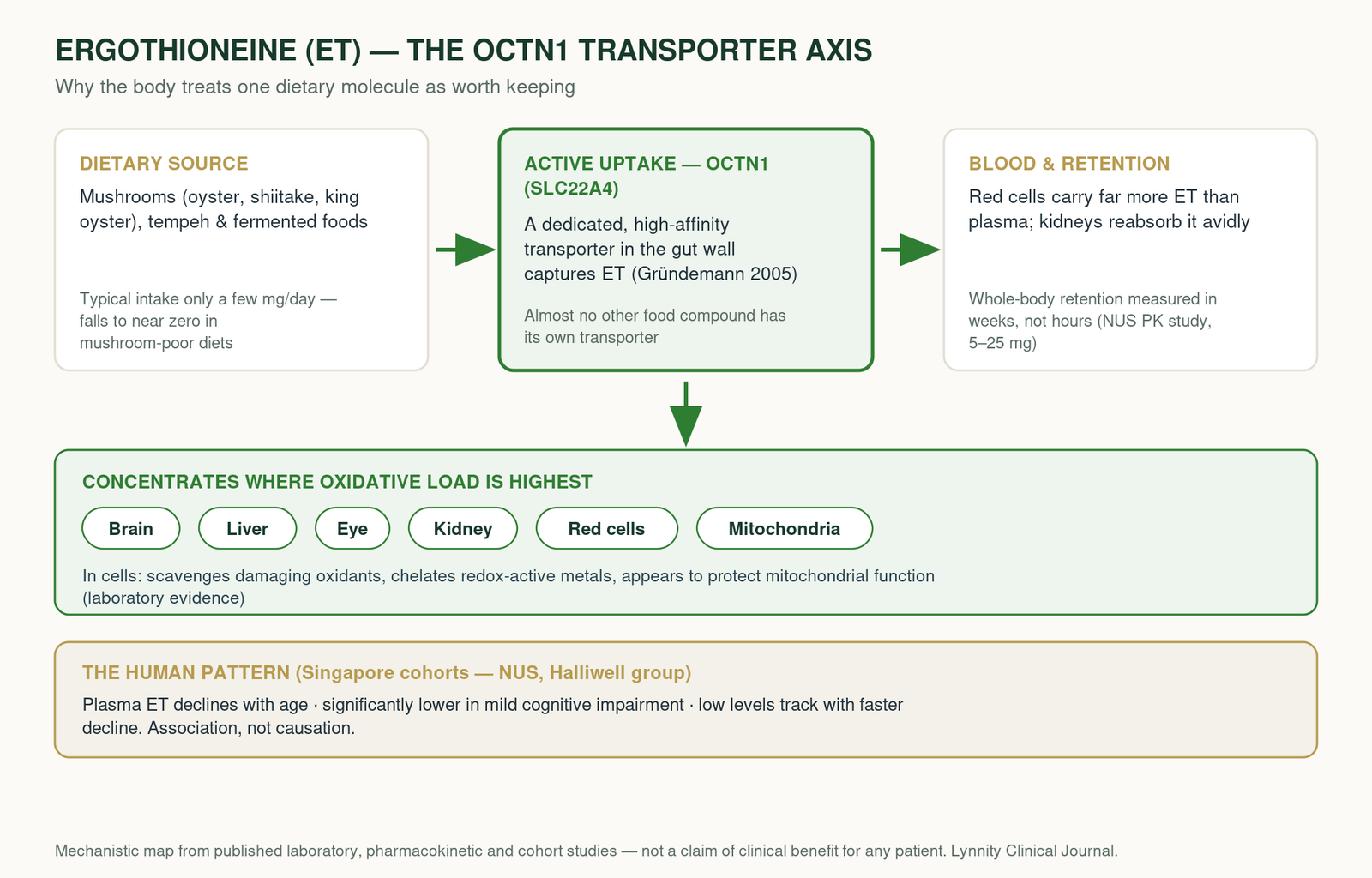
Chemically, ergothioneine is a thiourea derivative of histidine betaine — a small, highly stable, water-soluble molecule carrying an unusual sulfur group that makes it a potent and unusually durable cytoprotectant. No animal or plant makes it. It is synthesised by fungi (hence the name, from ergot) and by certain soil bacteria, and it moves up the food chain from there. The richest sources by far are mushrooms — oyster, shiitake and king oyster especially — with smaller amounts in tempeh and other fermented foods, some beans, and trace levels in meats. Estimated dietary intakes are modest, on the order of a few milligrams a day, and vary widely with mushroom consumption; a patient who rarely eats mushrooms may take in almost none. The trial doses — 10 to 25 mg of pure L-ergothioneine daily — are several times a typical diet, which is why the research uses a purified, standardised form rather than food.
The transporter is the story (pharmacology)
Most dietary antioxidants are absorbed passively, poorly, and cleared quickly. Ergothioneine is the opposite, and the reason is a membrane protein called OCTN1 (gene SLC22A4), identified as ergothioneine’s specific transporter by Gründemann and colleagues in 2005. OCTN1 is expressed in the intestine, where it captures dietary ergothioneine with high affinity; in red-cell precursors, which is why erythrocytes carry far higher concentrations than plasma; and in tissues with high metabolic and oxidative load — liver, kidney, the eye, and the brain. The kidney reabsorbs it avidly, so urinary loss is minimal and whole-body retention is measured in weeks, not hours: in a National University of Singapore pharmacokinetic study, a single oral course of 5–25 mg produced sustained rises in plasma and whole blood that persisted for weeks after dosing stopped. Inside cells, ergothioneine concentrates where oxidative stress is highest, including mitochondria, where it scavenges damaging oxidants, chelates redox-active metals and appears to protect mitochondrial function; links to NAD+ metabolism and neuroprotection are being explored in laboratory work. The evolutionary argument writes itself and should still be made carefully: the body has kept a dedicated, high-affinity uptake-and-retention system for this one dietary molecule, which strongly suggests physiological importance — but a transporter is evidence of relevance, not proof of clinical benefit.
The Singapore evidence — cohorts first
The human story is anchored, unusually for a supplement ingredient, in our own region. Barry Halliwell’s group at the National University of Singapore has spent a decade measuring ergothioneine in Singaporean adults. Their observational findings, replicated in other populations since: plasma ergothioneine declines with age, and elderly subjects with mild cognitive impairment carry significantly lower levels than cognitively healthy peers of the same age; in cohort follow-up, low levels track with faster subsequent cognitive and functional decline and higher risk of neurodegenerative outcomes. The signal is not confined to the brain: in a Swedish cohort of more than 3,200 adults followed for over 20 years, ergothioneine was the plasma metabolite most strongly associated with lower cardiometabolic risk and mortality. All of this is association, not causation — low ergothioneine may partly be a marker of a mushroom-poor diet or of the frailty it accompanies — but it is exactly the pattern that justified moving to trials.
What the interventional trials show
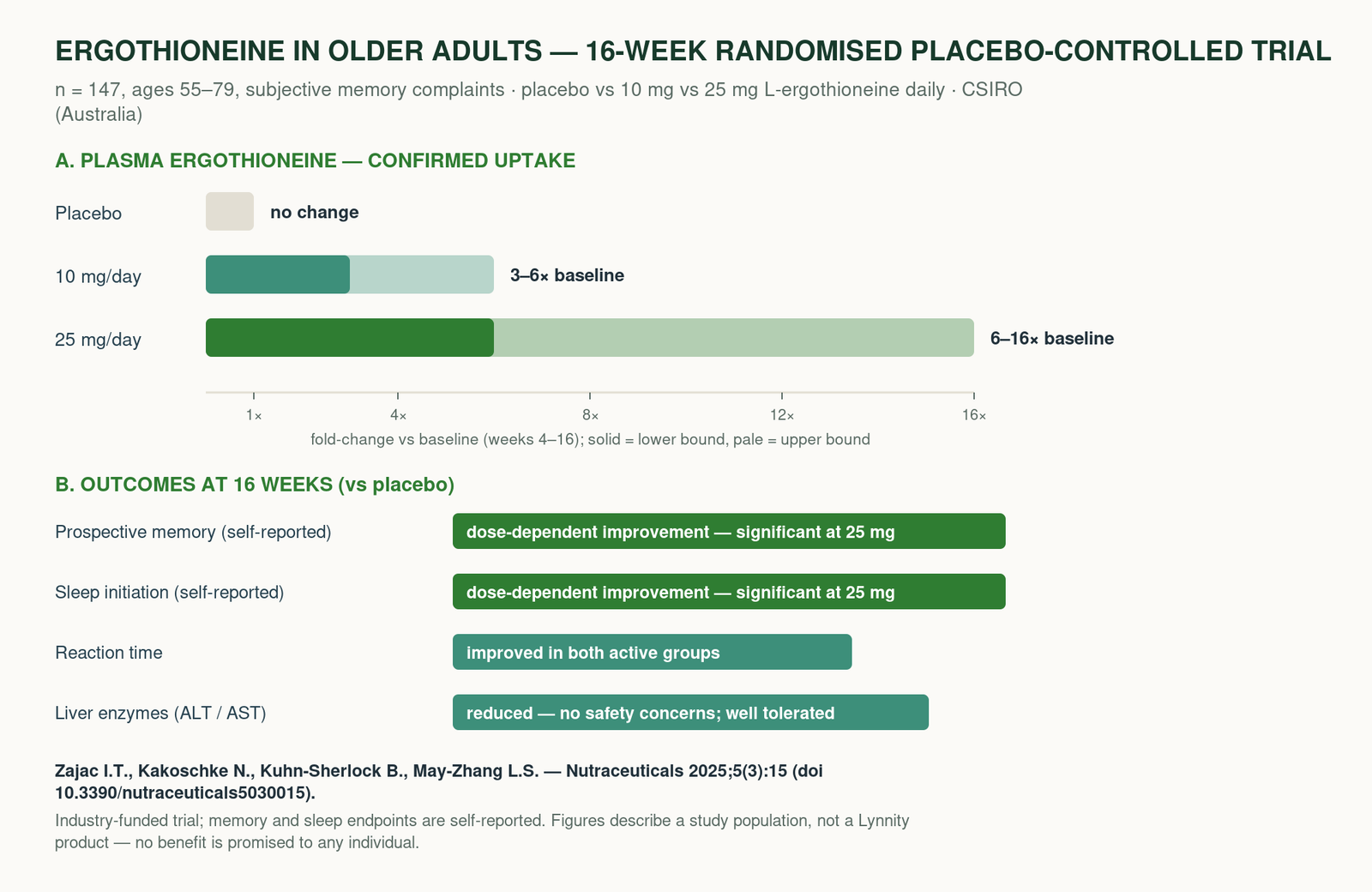
Two randomised, placebo-controlled studies now lead the field. The larger is a 2025 trial conducted at CSIRO, Australia’s national science agency (Zajac et al., Nutraceuticals 2025;5(3):15): 147 adults aged 55–79 with subjective memory complaints were randomised to placebo, 10 mg or 25 mg of ergothioneine daily for 16 weeks. Plasma ergothioneine rose three- to six-fold on the low dose and six- to sixteen-fold on the high dose. Subjective prospective memory and sleep initiation improved in a dose-dependent manner — positive trends at 10 mg, statistically significant at 25 mg — with improved reaction time in both active groups, an early within-group gain in composite memory at week 4 on 25 mg, and reductions in the liver enzymes ALT and AST. Safe and well tolerated throughout.
The second is closer to home: a year-long, double-blind pilot RCT at NUS (Yau, Cheah, Halliwell and colleagues) in 19 elderly Singaporeans with diagnosed mild cognitive impairment, given 25 mg ergothioneine or placebo three times a week for 52 weeks. The ergothioneine group showed enhanced learning on the Rey Auditory Verbal Learning Test and stabilised plasma neurofilament light chain — a blood marker of ongoing neuronal injury — while the placebo group showed no cognitive improvement and a significant NfL rise. No toxicity over a full year. Honest framing: a pilot of nineteen people, reported as a preprint — feasibility and signal, not efficacy. Earlier Japanese work reported improved verbal memory in a small trial, and a separate 2025 randomised study reported better sleep quality in healthy adults. Consistent direction, small numbers: promising, not proven.
An honest delivery note: this one does not need a liposome
For poorly soluble actives — curcumin, luteolin, quercetin — the delivery form decides everything. Ergothioneine is the instructive opposite: water-soluble, with its own high-affinity transporter, so plain oral dosing is well absorbed and a liposome would solve a problem that does not exist. Matching the delivery technology to the molecule, rather than applying one technology to everything, is the whole discipline of formulation. For ergothioneine the compounding value sits elsewhere: exact dose, clean excipients, and rational combination.
Where a compounding pharmacy fits
Purified L-ergothioneine barely exists on Malaysian retail shelves, and imported products come in fixed strengths. Compounding lets the prescriber specify the preparation instead: match the trial doses exactly (10 or 25 mg daily, or the NUS pilot’s 25 mg three-times-weekly rhythm); combine it rationally in one preparation alongside other doctor-selected longevity-focused actives such as urolithin A or NAD+ precursors (the pill-burden logic); choose a form the patient will take — a small capsule, or a measured oral liquid; exclude unnecessary excipients; and set a review plan suited to ergothioneine’s weeks-long retention.
Delivery forms Lynnity can prepare
An oral capsule at the exact milligram strength prescribed; a measured oral liquid or flavoured tonic; or a measured powder dispersed into liquid before use. We do not supply tablets or softgels, and we do not prepare troches, lozenges, gummies, suppositories or patches. Unlike a commercial softgel line with fixed strengths, a compounded capsule can be made at 5, 10 or 25 mg — whatever the prescription specifies.
Safety, cautions and interactions
Ergothioneine is a normal component of the human diet and human tissues; European regulators have accepted purified L-ergothioneine as a novel food after formal safety review; and across the trials — up to 25 mg daily for 16 weeks and 25 mg three-times-weekly for a year — no toxicity was reported, with the CSIRO trial observing reductions in liver enzymes. Cautions: limited data in pregnancy and breastfeeding (prescriber’s judgement); usual medicines review although no clinically significant drug interactions have been characterised; and memory complaints warrant proper assessment before any adjunct. Screening, suitability and dosing are decisions for the prescribing doctor.
A necessary caveat: none of this makes ergothioneine a treatment for dementia, ageing or any disease. The cohort data are associations; the two randomised trials are one industry-funded study with subjective primary endpoints and one nineteen-person pilot. Large independent confirmatory trials are still to come. Best framed as a doctor-assessed, prescription-led adjunct for healthy ageing — chosen for a defined reason, dosed precisely, reviewed over time.
The prescriber workflow in KL, Klang Valley and Singapore
Every Lynnity preparation — supplements included — is made only on a prescription from a registered doctor, for a named patient, under Good Compounding Practice. No MAL-registered product, no direct-to-patient purchase. Speak with our pharmacy team at https://www.lynnitypharma.com/ before writing the first prescription: sourcing of purified L-ergothioneine, achievable strengths, capsule vs measured liquid, review intervals and beyond-use dating.
FAQ
What is ergothioneine, in one sentence? A sulfur-containing dietary compound made by fungi — mushrooms are the main source — that the body actively absorbs through a dedicated transporter (OCTN1), concentrates in high-stress tissues and retains for weeks; proposed as a candidate “longevity vitamin”.
Why is it called the “longevity vitamin”? From Bruce Ames’ 2018 PNAS review: some dietary compounds matter for healthy ageing over decades rather than immediate survival. A research designation, not an approved vitamin classification, and not a treatment claim.
Is compounded ergothioneine available over the counter in Malaysia? No. At Lynnity every compounded preparation is made only on a registered doctor’s prescription, under GCP. No direct-purchase route.
What do the trials actually show? A 2025 RCT (n = 147) reported dose-dependent improvements in subjective prospective memory and sleep initiation over 16 weeks, significant at 25 mg daily; a year-long NUS pilot RCT (n = 19, MCI) reported improved verbal learning and stabilised neurofilament light chain. Early-stage evidence: promising signal, not proof, not a cure.
Does ergothioneine need a liposomal formulation? No — it is water-soluble with its own high-affinity transporter. Liposomal delivery earns its place with poorly soluble actives like curcumin, luteolin or quercetin; here the compounding value is exact dosing, clean excipients and rational combination.
What delivery forms can Lynnity prepare? Capsule at the exact prescribed strength (e.g. 5, 10 or 25 mg), measured oral liquid, or flavoured tonic. No tablets, softgels, troches, lozenges, gummies, suppositories or patches.
How does a KL clinic start prescribing through Lynnity? Visit www.lynnitypharma.com and ask to speak with a pharmacist — sourcing, strengths and forms, review intervals and beyond-use dating before the first prescription.
Reviewed by the Lynnity pharmacy team — registered pharmacists compounding to Good Compounding Practice (GCP) in Kuala Lumpur. General information for healthcare practitioners; not medical advice; no disease-treatment claim. Prepared only on a prescription from a registered doctor.
Sources: Zajac et al., Nutraceuticals 2025;5(3):15 (doi 10.3390/nutraceuticals5030015, CSIRO RCT n=147) · Yau/Cheah/Halliwell et al., medRxiv 2024 (NUS pilot RCT n=19, doi 10.1101/2024.07.08.24310085) · Cheah & Halliwell BBRC 2016 (MCI plasma ET) · Ames PNAS 2018 · Smith et al., Heart 2020 (Swedish cohort) · Gründemann et al., PNAS 2005 (OCTN1) · Proc Nutr Soc 2025 review (PMID 40968729) · 2025 sleep RCT (PMID 40475978).