
Short answer: GlyNAC is not a single ingredient — it is glycine and N-acetylcysteine (NAC) given together. The point of the pairing is glutathione, the cell’s master antioxidant, which the body assembles from three amino-acid residues: glutamate, cysteine and glycine. With age both glycine and cysteine tend to run short, so glutathione synthesis falls; GlyNAC restores both substrates at once (glycine directly, cysteine by way of NAC). Small human trials — most from one Houston research group — report that this raises glutathione and improves oxidative stress, inflammation, mitochondrial function and several physical and cognitive measures in older adults. Because GlyNAC is a two-substrate combination taken at gram-level doses, it is a natural compounding job: a pharmacy can set the exact glycine-to-NAC amounts a clinician wants, in one preparation, and mask NAC’s sulfurous taste in a flavoured liquid. At Lynnity every such preparation is made under Good Compounding Practice (GCP), for a named patient, on a prescription from a registered doctor — there is no over-the-counter or “no prescription needed” route. It is best framed as a doctor-led adjunct for healthy ageing, not a treatment for any disease.
Why Klang Valley clinics keep getting asked about GlyNAC
GlyNAC has jumped from the gerontology literature into the longevity conversation, and patients across Kuala Lumpur, the Klang Valley and Singapore now bring it up by name. The interest traces to trials from Baylor College of Medicine and Houston Methodist reporting that glycine and NAC together “reversed” a striking list of ageing markers in older adults — a framing that travels fast on social media and usually arrives in clinic stripped of its caveats. The molecule’s logic is attractive because it is specific: it names a measurable deficiency (falling glutathione) and a way to correct it, rather than a vague “antioxidant” pitch. The useful posture is to take the biochemistry seriously while being candid that the human trials are still small, largely single-centre, and not yet the large confirmatory studies that would settle the question.
What GlyNAC actually is
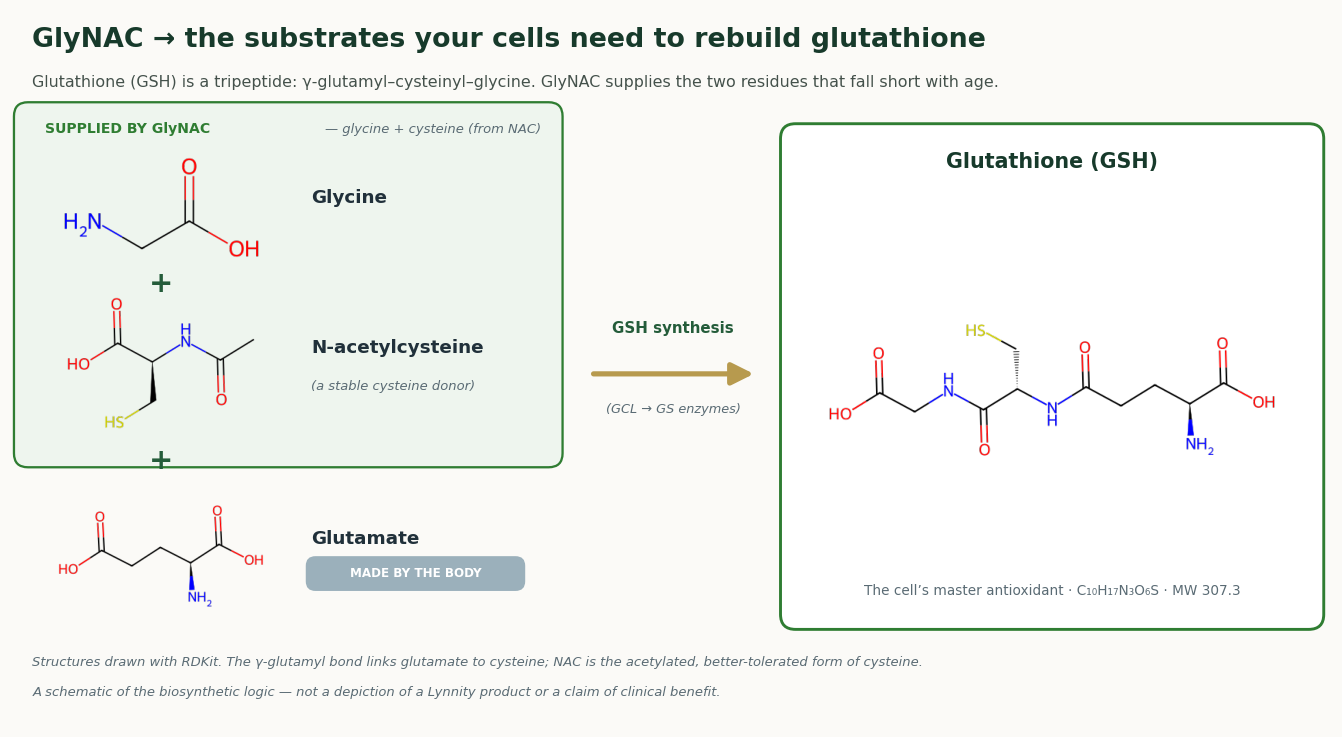
GlyNAC is shorthand for the combination of glycine and N-acetylcysteine. Glycine is the simplest amino acid and one of glutathione’s three residues. NAC is the acetylated, more stable and better-absorbed form of cysteine; once absorbed it is deacetylated to supply cysteine, normally the rate-limiting residue for glutathione synthesis. Glutathione itself (γ-glutamyl-cysteinyl-glycine) is the body’s principal intracellular antioxidant and a key protector of mitochondria. The insight behind GlyNAC is that in ageing it is not one but two of those building blocks — cysteine and glycine — that fall short, so supplying only a cysteine donor may not be enough; providing both lets the cell rebuild glutathione. That is why GlyNAC is better understood as a rational substrate pair than as a branded molecule, and why the exact ratio and dose is the interesting prescriber question.
How GlyNAC works (pharmacology)
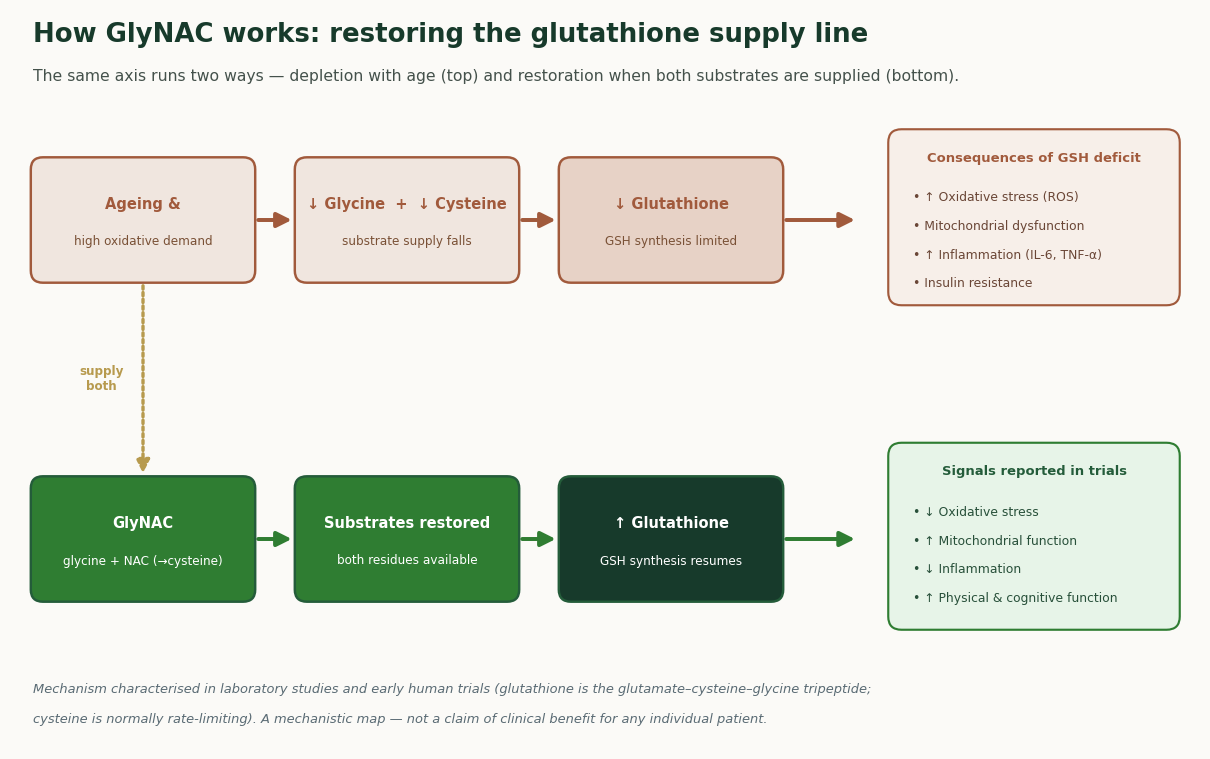
The mechanism is clean and well described. Glutathione is synthesised in two enzyme steps — glutamate-cysteine ligase (GCL) joins glutamate to cysteine, then glutathione synthetase (GS) adds glycine — and the availability of cysteine normally sets the pace. In older adults, red-cell and tissue glutathione is characteristically low, which studies attribute to reduced availability of both cysteine and glycine rather than a broken enzyme; restoring the substrates lets synthesis resume. Because glutathione is central to quenching reactive oxygen species and to healthy mitochondrial function, a rise in it is proposed to ripple outward: less oxidative damage, better mitochondrial fatty-acid oxidation, lower inflammatory signalling (interleukin-6, TNF-α), and improved insulin sensitivity. NAC contributes the cysteine; glycine completes the tripeptide and has its own roles in one-carbon metabolism and neurotransmission. These mechanisms explain why GlyNAC is studied; they are not a guaranteed outcome for any individual.
What the trial evidence actually shows
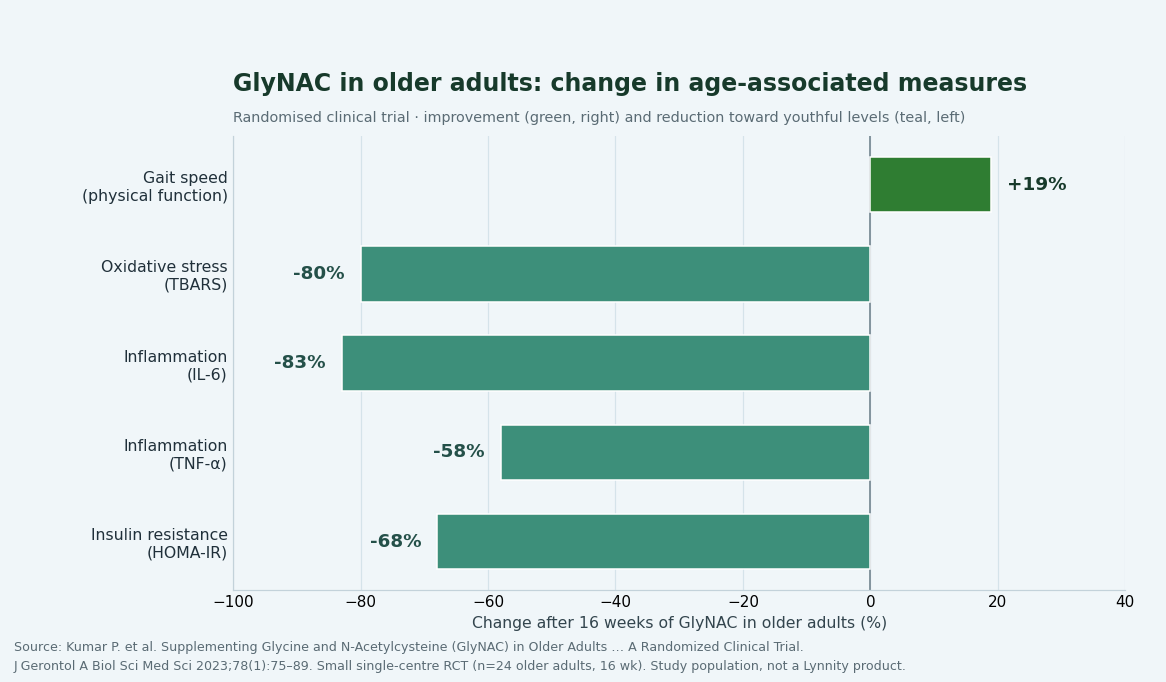
The most developed human evidence sits in healthy ageing, and it comes largely from one group. An early open-label pilot in older adults reported that 24 weeks of GlyNAC improved glutathione deficiency, oxidative stress, mitochondrial dysfunction, inflammation, insulin resistance, endothelial function, genomic damage, muscle strength and cognition (Kumar et al., 2021). This was followed by the first randomised, placebo-controlled trial: 24 older adults were randomised to GlyNAC or an isonitrogenous alanine placebo for 16 weeks (with 12 young adults for comparison). GlyNAC — and not placebo — corrected glutathione deficiency and improved a broad panel of measures, including gait speed, oxidative stress, inflammatory markers and insulin resistance (Kumar et al., 2023). Separately, dose-ranging studies over two weeks found GlyNAC safe and well tolerated, with the clearest glutathione gains in people who started with high oxidative stress and low glutathione.
On the brain, the same group has reported that GlyNAC improved cognitive measures alongside the metabolic and mitochondrial changes, and has proposed glutathione deficiency as a candidate risk factor in cognitive decline; pilot trials in mild cognitive impairment and Alzheimer’s disease are under way. That work is investigational — it does not establish GlyNAC as a treatment for dementia, and it should be described to patients that way. Two honest limitations run through the whole evidence base: the trials are small and mostly from a single centre, so independent replication at scale is still needed; and the benefits faded after supplementation stopped, implying that any effect depends on continued use rather than a lasting “reset”. The signal is interesting and internally consistent; it is not yet proof.
Why the combination — not NAC alone — is the point
NAC on its own is a familiar cysteine donor with a long clinical history. The specific hypothesis behind GlyNAC is that in ageing a cysteine donor alone leaves a second bottleneck unaddressed: glycine. If glycine is also limiting, adding only NAC cannot fully restore glutathione, whereas supplying both residues can. That is precisely the two-active, ratio-dependent preparation a compounding pharmacy exists to make — and why “just buy NAC and glycine separately” is weaker than it sounds, given the gram-level doses, NAC’s taste, and the differing excipients and strengths of two consumer tubs.
Where a compounding pharmacy fits
A retail supplement comes as a fixed strength, a fixed form and a fixed excipient list. Compounding lets the prescriber specify the preparation to the patient instead. For GlyNAC a doctor can:
- Set the glycine-to-NAC ratio and total dose to the amounts used in the literature or to the clinician’s protocol, rather than back-calculating from two separate products.
- Combine both actives in a single preparation — the same logic behind nutritional compounding to combine supplements — so the patient takes one measured dose, not several.
- Mask NAC’s sulfurous taste in a flavoured oral liquid or tonic, which materially improves adherence at gram-level doses.
- Exclude specific excipients for sensitive patients and choose a form the patient will reliably take.
- Co-formulate rationally where clinically appropriate — for example alongside a liposomal glutathione strategy — as part of a considered plan rather than a shelf of separate tubs.
This is the same thinking behind our customised supplement formulations for clinics: the preparation is built around the prescription, not the other way round.
Delivery forms Lynnity can prepare
Because GlyNAC is taken at gram-level doses, the practical, permitted options are an oral capsule (often more than one per dose, given the amount of amino acid involved); the actives dispersed as a measured powder into an oral liquid or a flavoured tonic for patients who prefer not to swallow multiple capsules and to soften NAC’s taste; and a measured powder to be stirred into liquid before use. We do not supply tablets or softgels, and we do not prepare troches, lozenges, gummies, suppositories or patches. For a high-dose amino-acid combination like GlyNAC, a flavoured liquid or tonic is frequently the most realistic route to consistent daily dosing.
Safety, cautions and interactions
Across the trials GlyNAC was reported safe and well tolerated, and both glycine and NAC have long histories of human use; the most common complaints are mild gastrointestinal upset and, for NAC, the sulfur taste and occasional nausea. The useful cautions are practical. NAC has a theoretical antiplatelet effect and can interact with nitrates (nitroglycerin), so review is sensible in patients on anticoagulants, antiplatelet agents or nitrates. High-dose amino-acid loads warrant care in significant renal or hepatic impairment, and data in pregnancy and breastfeeding are limited, making use there a prescriber’s judgement. NAC is also a recognised medicine in its own right in some contexts, another reason a doctor should own the decision. Above all, GlyNAC is not a rescue therapy or a substitute for diagnosis: fatigue, cognitive change and metabolic disease all deserve a proper work-up. Screening, suitability and dosing are decisions for the prescribing doctor.
A necessary caveat: none of this makes GlyNAC a treatment for ageing, dementia, diabetes or any disease. The human data are early — promising and internally consistent, but small, largely single-centre and awaiting large independent trials, with benefits that faded once supplementation stopped. GlyNAC is best framed as a doctor-assessed, prescription-led adjunct for healthy ageing, chosen for a defined reason and reviewed over time, not a substitute for diagnosis and standard care.
The prescriber workflow in KL, Klang Valley and Singapore
Because Lynnity is a compounding pharmacy, every preparation — supplements included — is made only on a prescription from a registered doctor, for a named patient, under Good Compounding Practice. There is no MAL-registered product and no direct-to-patient purchase. The simplest way to start is to speak with our pharmacy team before you write the first prescription: we can talk through achievable glycine and NAC amounts and ratios, whether a flavoured liquid or capsules will suit the patient, sensible review intervals and beyond-use dating, so the prescription you write is one we can prepare exactly as specified.
FAQ
What is GlyNAC, in one sentence?
GlyNAC is the combination of glycine and N-acetylcysteine (NAC), given together to supply the two amino-acid building blocks of glutathione — the cell’s master antioxidant — that tend to run low with age.
Is compounded GlyNAC available over the counter in Malaysia?
No. Glycine and NAC are sold separately online, but a Lynnity compounded GlyNAC preparation is made only on a registered doctor’s prescription, individualised to the patient and prepared under Good Compounding Practice. There is no direct-purchase or “no prescription needed” route with us.
Why prescribe compounded GlyNAC instead of buying glycine and NAC separately?
Because GlyNAC is taken at gram-level doses, NAC tastes sulfurous, and combining two consumer products reliably at a set ratio is fiddly and error-prone. Compounding lets the prescriber fix the glycine-to-NAC ratio and dose in a single preparation, mask the taste in a flavoured liquid, and exclude unwanted excipients — so the patient takes one measured dose.
What does the trial evidence actually support?
Small human trials, mostly from one research group, report that GlyNAC raises glutathione and improves oxidative stress, inflammation, mitochondrial function and several physical and cognitive measures in older adults, including a randomised placebo-controlled trial over 16 weeks. The trials are small and largely single-centre, the benefits faded after stopping, and larger independent studies are still needed. It is a promising signal, not proof, and not a cure for any condition.
Is GlyNAC a treatment for Alzheimer’s, diabetes or ageing?
No. Lynnity does not prepare or promote GlyNAC as a treatment or cure for any disease. Cognitive and metabolic findings are early and, for dementia, still investigational through ongoing pilot trials. GlyNAC is prepared only for a doctor-assessed, prescription-led purpose alongside standard care.
What delivery forms can Lynnity prepare it in?
An oral capsule (often more than one per dose given the amino-acid amounts), or the actives dispersed into an oral liquid or a flavoured tonic to improve taste and adherence. We do not supply tablets or softgels, and we do not prepare troches, lozenges, gummies, suppositories or patches.
We run a clinic in KL — how do we start prescribing through Lynnity?
Visit www.lynnitypharma.com and ask to speak with a pharmacist. We can talk through achievable glycine and NAC amounts and ratios, whether a flavoured liquid or capsules will suit the patient, review intervals and beyond-use dating before your first prescription is sent.
Reviewed by the Lynnity pharmacy team — registered pharmacists compounding to Good Compounding Practice (GCP) in Kuala Lumpur.
This article is general information for healthcare practitioners and is not medical advice. It does not diagnose, treat or recommend therapy for any condition, and it makes no disease-treatment claim. GlyNAC preparations at Lynnity are prepared only on a prescription from a registered doctor.
Sources (internal reference — not for publication)
- Kumar P, et al. Supplementing Glycine and N-Acetylcysteine (GlyNAC) in Older Adults … A Randomized Clinical Trial. J Gerontol A Biol Sci Med Sci 2023;78(1):75–89. https://academic.oup.com/biomedgerontology/article/78/1/75/6668639
- Kumar P, et al. GlyNAC supplementation in older adults … pilot clinical trial. Clin Transl Med 2021;11(3):e372. https://www.ncbi.nlm.nih.gov/pmc/articles/PMC8002905/
- GlyNAC dose-ranging RCTs (safety/tolerability; glutathione redox). https://www.ncbi.nlm.nih.gov/pmc/articles/PMC9261343/
- GlyNAC supplementation improves cognitive decline and brain health in aging (BCM). https://www.bcm.edu/news/glynac-supplementation-improves-cognitive-decline-and-brain-health
- Glutathione deficiency as a candidate risk factor for Alzheimer’s disease: implications for GlyNAC. https://www.ncbi.nlm.nih.gov/pmc/articles/PMC11689570/