
Short answer: Most people with an underactive thyroid do well on standard levothyroxine (T4) — but a minority, roughly 5 to 15% by the published estimates, continue to feel unwell even after their TSH has been normalised. For those patients, a doctor may consider a personalised approach: a compounding pharmacy can prepare individualised T4/T3 combinations, sustained-release liothyronine (T3) capsules, custom incremental strengths, and dye- and allergen-free thyroid formulations to a prescriber’s exact specification — flexibility a fixed-dose commercial tablet cannot provide. This is prescriber-directed, individualised medicine: every Lynnity thyroid preparation is made only against a prescription from a registered doctor, and compounded under Good Compounding Practice (GCP).
Why some patients stay unwell on levothyroxine alone
Levothyroxine monotherapy is, and should remain, first-line for hypothyroidism — effective, inexpensive and well understood. Yet a consistent finding across the literature is that a subset of treated patients — commonly cited at about 5 to 15% — report persistent fatigue, low mood, weight difficulty or “brain fog” despite an adequate dose and a TSH squarely in range. This is not a fringe observation; it is why the combination-therapy question has stayed alive in endocrinology for two decades.
Part of the explanation is physiological. A healthy thyroid secretes both T4 and a smaller amount of active T3 directly; levothyroxine supplies only T4, leaving the body to generate all of its T3 by converting T4 in the tissues. For most people that conversion is more than adequate. For some, tissue-level T3 appears to fall short even when the pituitary — which has its own efficient conversion machinery — reads “normal” and switches off TSH. That gap between a normal blood test and how the patient feels is the puzzle a personalised formulation tries to address.
The pharmacology: deiodinases, T4-to-T3 activation, and the DIO2 variant
T4 is best understood as a circulating prohormone. It becomes the active hormone T3 when an iodine atom is removed by enzymes called deiodinases. Type 2 (D2) is the key activator inside tissues such as the brain, pituitary and muscle; type 1 (D1) contributes in the liver and kidney; type 3 (D3) inactivates thyroid hormone, diverting T4 down the inert “reverse T3” path. The balance of these enzymes sets how much active hormone each tissue sees.
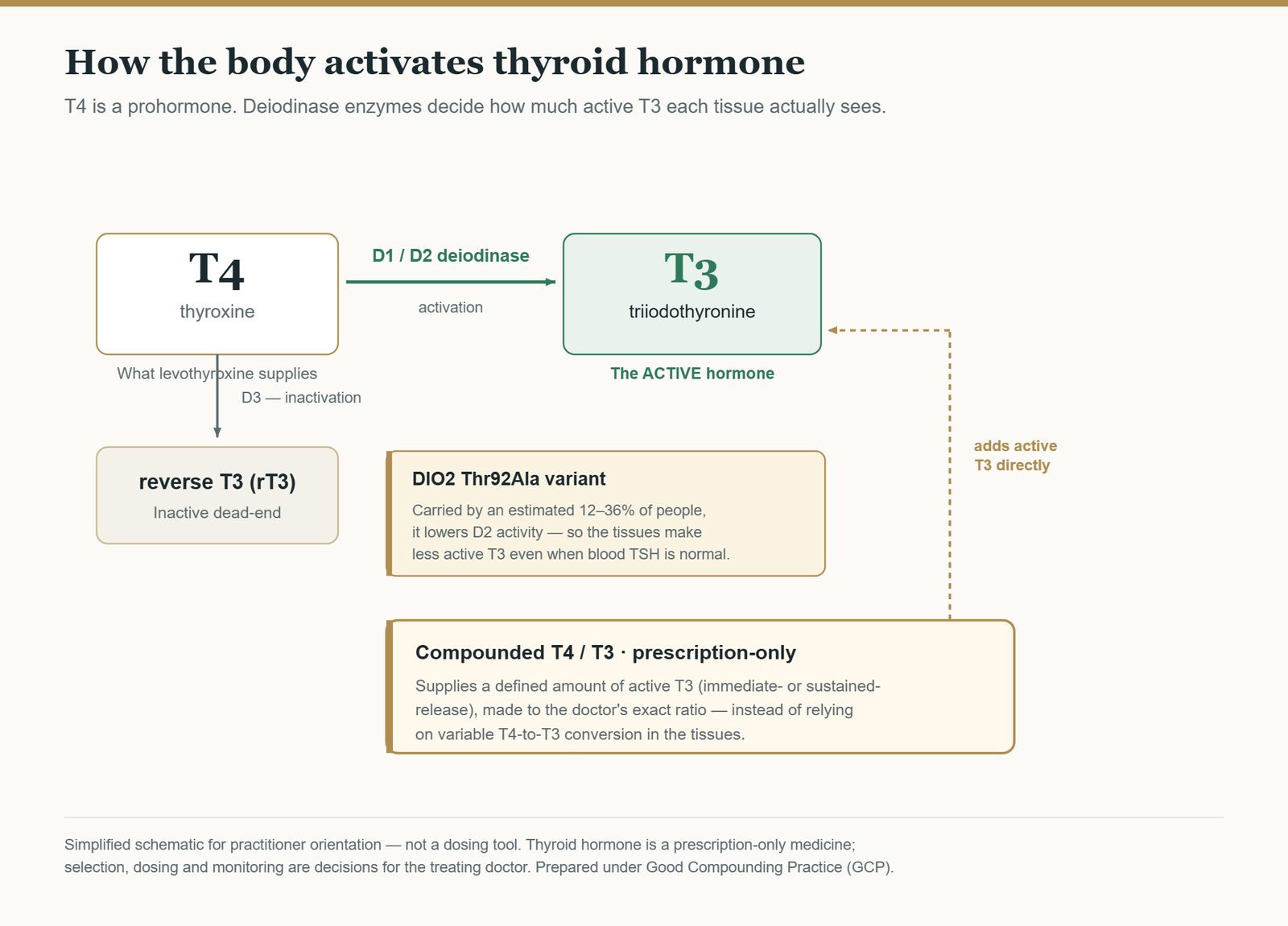
This is where a common genetic variant enters the picture. A single-letter change in the D2 gene — the DIO2 Thr92Ala polymorphism, carried by an estimated 12 to 36% of the population — reduces the enzyme’s catalytic efficiency. Studies have linked it to lower tissue and serum T3 during T4 replacement and a poorer symptomatic response to levothyroxine alone, with some data suggesting carriers are among those who improve when a little T3 is added. The evidence is associative rather than settled, and routine genotyping is not standard practice — but it offers a plausible reason why “normal TSH” and “feels well” are not always the same thing.
T3 itself is the second pharmacological wrinkle: it is short-acting. Given as immediate-release liothyronine it peaks within a few hours and clears quickly, producing a surge-and-trough over the day. That is the whole rationale for sustained-release T3 — spreading a small dose across many hours to smooth the curve — something only a compounding pharmacy can build to specification.
What the evidence actually says
Honesty matters here, because enthusiasm has often run ahead of the trials. Randomised studies comparing T4+T3 combination therapy, or desiccated thyroid extract, against levothyroxine alone have not shown a consistent advantage on hard clinical endpoints. What they have repeatedly shown is that many patients prefer a combination when asked, and that quality-of-life measures sometimes favour it.
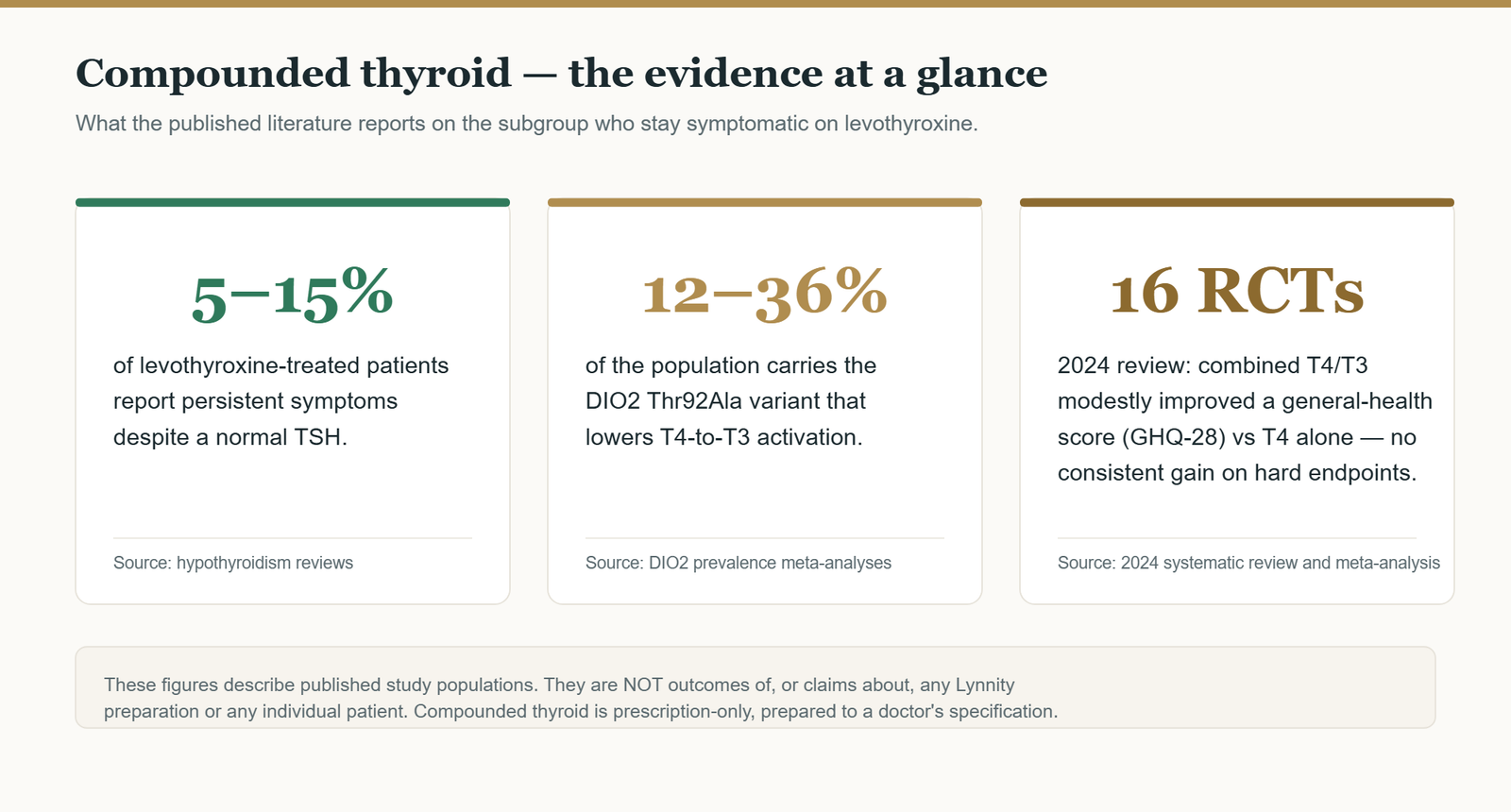
A 2024 systematic review and meta-analysis pooling 16 randomised controlled trials found that combination T4/T3 therapy produced modestly better scores on a validated general-health questionnaire (the GHQ-28) than levothyroxine alone, while most other endpoints showed no clear difference. A 2024 safety review concluded that, with appropriate patient selection and monitoring, adverse events attributable to thyrotoxicosis were uncommon. The reasonable reading, reflected in current specialist guidance, is that combination therapy is not a routine upgrade for everyone — but a supervised, time-limited trial can be justified in a carefully selected patient who stays symptomatic on optimised levothyroxine.
The honest framing. The trials differ in dose, ratio and formulation, and a preference signal is a reason to consider an individualised trial — not proof it will help any one person. Nothing here is a claim that a compounded preparation treats, prevents or cures hypothyroidism or any other condition. Compounded thyroid hormone is a prescription medicine whose selection, dosing and monitoring belong to the treating doctor; Lynnity’s role is to prepare it accurately to that prescription.
Where a compounding pharmacy adds value
Commercial thyroid products come in a fixed menu of strengths and a fixed T4:T3 ratio. Compounding exists for the patients who fall between those fixed points. The levers a pharmacy can control are:
| Formulation lever | Why it matters for thyroid |
|---|---|
| Custom T4:T3 ratio | The prescriber sets the exact T4 and T3 content — for example a mostly-T4 base with a small, defined T3 addition — rather than a fixed tablet ratio. |
| Sustained-release T3 | T3 is short-acting; a slow-release capsule spreads a small dose over many hours to avoid the peak-and-trough of immediate-release liothyronine. |
| Incremental micro-dosing | Fine strength steps (small microgram increments) that commercial tablets do not offer, allowing cautious titration and split dosing. |
| Dye- and allergen-free base | Preparations made without lactose, gluten, corn, soy or specific dyes for patients who react to the fillers in commercial products. |
What Lynnity can prepare — and what it cannot
Lynnity compounds to a doctor’s prescription in capsule, liquid, cream, tonic and serum forms, under Good Compounding Practice (GCP). For thyroid hormone the practical routes are:
- Two-piece capsule — a custom T4/T3 combination, or a defined T3-only strength, at the prescriber’s exact ratio and dose; the workhorse form.
- Sustained-release capsule — a slow-release T3 to smooth the short half-life, where steadier hormone levels through the day are wanted.
- Oral or sublingual liquid — a titratable liquid for very fine dose adjustment or patients who cannot swallow capsules.
What Lynnity does not make is a compressed tablet or a softgel — the very fixed-dose formats a compounded preparation is meant to move beyond. The point of a compounding pharmacy is the individualised capsule or liquid, not another off-the-shelf strength.
Safety, monitoring and who is not a candidate
Thyroid hormone is a potent medicine with a narrow margin, and the safety conversation is part of the prescription. Over-replacement — particularly the surges possible with immediate-release T3 — carries real risks including palpitations, atrial fibrillation and, over time, bone loss, so older patients and anyone with heart disease are approached with extra caution. Combination and T3-containing regimens are generally not first-line, are not recommended in pregnancy, and call for periodic review of symptoms and thyroid function. All of this is the treating doctor’s remit; a compounding pharmacy supports it by preparing an accurate, clearly-labelled formulation, not by directing therapy.
Working with Lynnity
Lynnity Compounding Pharmacy is based in Kuala Lumpur and works with clinics across the Klang Valley and with practitioners in Singapore. Every preparation — including hormone and thyroid formulations — is made only against a prescription from a registered doctor. Where commercial liothyronine or desiccated thyroid extract is not readily available or does not suit a particular patient, an individualised compounded preparation can fill the gap on a named-patient, prescription basis. Lynnity does not hold MAL registration for compounded preparations, does not sell direct to patients without a prescription, and does not do contract manufacturing.
Practitioners who want to discuss a formulation — a T4:T3 ratio, a sustained-release T3, a fine titration step or a dye-free base — can contact the pharmacy to talk it through with a compounding pharmacist before writing.
Frequently asked questions
Why do some patients feel unwell on levothyroxine despite a normal TSH?
Levothyroxine supplies only T4, and the body must convert it to the active hormone T3 in the tissues. For most people this works well, but an estimated 5 to 15% of treated patients report persistent symptoms even with a normal TSH. Differences in how efficiently individuals activate T4 — including a common variant in the D2 deiodinase enzyme — are one proposed explanation. It is a clinical question for the treating doctor to assess.
What is compounded T4/T3 thyroid, and how is it different from a commercial tablet?
A compounded thyroid preparation is made to a doctor’s exact prescription — a custom T4:T3 ratio, a specific microgram strength, or a sustained-release T3 — rather than a fixed commercial dose. It is prepared for the individual patient under Good Compounding Practice (GCP), and is a prescription-only medicine.
What does the evidence say about combination T4/T3 therapy?
Randomised trials have not shown a consistent advantage of combination therapy over levothyroxine alone on hard endpoints, though a 2024 meta-analysis of 16 RCTs found a modest quality-of-life benefit and many patients express a preference for it. Current specialist guidance supports a supervised, time-limited trial in carefully selected patients who remain symptomatic on optimised levothyroxine. This is not a claim that any preparation treats or cures hypothyroidism.
Why would T3 be made as a sustained-release form?
Liothyronine (T3) is short-acting — given as an immediate-release form it peaks within a few hours and clears quickly, which can cause an uncomfortable surge and trough. A sustained-release capsule spreads a small dose over many hours for steadier levels, and can only be made by a compounding pharmacy to a prescriber’s specification.
Does compounded thyroid need a prescription in Malaysia?
Yes. Thyroid hormone is a prescription medicine, and every Lynnity preparation — thyroid included — is dispensed only against a prescription from a registered doctor. Lynnity does not sell it directly to patients and does not hold MAL registration for compounded preparations.
Can a compounded preparation be made without dyes or common allergens?
Yes. A frequent reason clinicians turn to compounding is to remove lactose, gluten, corn, soy or specific dyes found in some commercial products, preparing a clean, excipient-aware capsule or liquid for sensitive patients — always to the prescriber’s specification.
Can Lynnity supply thyroid as a tablet or softgel?
No. Lynnity compounds in capsule, liquid, cream, tonic and serum forms only. For individualised thyroid therapy a custom capsule or a titratable liquid is the appropriate route in any case — a fixed tablet or softgel is exactly the format compounding is meant to improve on.
Clinically reviewed by the Lynnity compounding team, Kuala Lumpur. This article is written for registered healthcare practitioners and is provided for professional information only. It is not medical advice, not a treatment recommendation, and not a claim that any compounded preparation treats, prevents or cures any disease. Compounded thyroid hormone is a prescription medicine; selection, dosing and monitoring are decisions for the treating doctor. All Lynnity preparations require a prescription from a registered doctor. Compounded to Good Compounding Practice (GCP). Last reviewed 27 August 2026.