
Why the standardised extract — not the spice — is the story
Saffron’s activity is attributed to a handful of constituents: the crocins (responsible for its colour), safranal (its aroma), and picrocrocin. The randomised trials that generated the interest used extracts standardised to a defined level of these actives, so that every dose is the same — the opposite of culinary saffron, whose active content varies enormously with origin, harvest and storage.
Watch: the two-minute explainer
There is a second, harder-nosed reason standardisation matters here. Saffron is, gram for gram, one of the most expensive agricultural products on earth, and consequently one of the most faked — bulked out with safflower, marigold, dyed corn silk or spent threads. A clinic that wants the effect seen in the trials needs the material that was actually in the trials: identity-verified, standardised, and quality-controlled. That is a supply-and-formulation problem, and it is exactly what a compounding pharmacy is set up to control.
How saffron works in the body (pharmacology)
Saffron’s proposed mechanisms are plural rather than single, which is typical of a botanical with several active constituents. The most-cited is modulation of monoamine neurotransmission: crocin and safranal have been described as inhibiting the reuptake of serotonin, and to a lesser extent dopamine and noradrenaline — the same broad pathway conventional antidepressants act on, and the reason saffron alongside an SSRI is a prescriber-supervised decision rather than a casual addition. Second, the crocins are potent antioxidants and carry an anti-inflammatory action, reducing the oxidative and cytokine load increasingly implicated in low mood. Third, saffron constituents have been reported to influence the HPA axis, tempering the cortisol response to stress, and to show NMDA-receptor antagonism and glutamate modulation in experimental models. There is also evidence of support for BDNF signalling, the neurotrophic pathway involved in synaptic plasticity. These are mechanistic and largely pre-clinical findings — they explain how the molecule plausibly behaves in the body and why the trial signal exists; they are not a promise of a clinical outcome for any individual patient.
What the trials show
The mood evidence is the strongest. Beyond the 202-adult trial above, standardised saffron has been studied as an add-on to antidepressant medication for persistent depressive symptoms, in youth anxiety and depression, and against placebo for sleep quality. Effects on mood and stress have been reported as early as around five weeks.
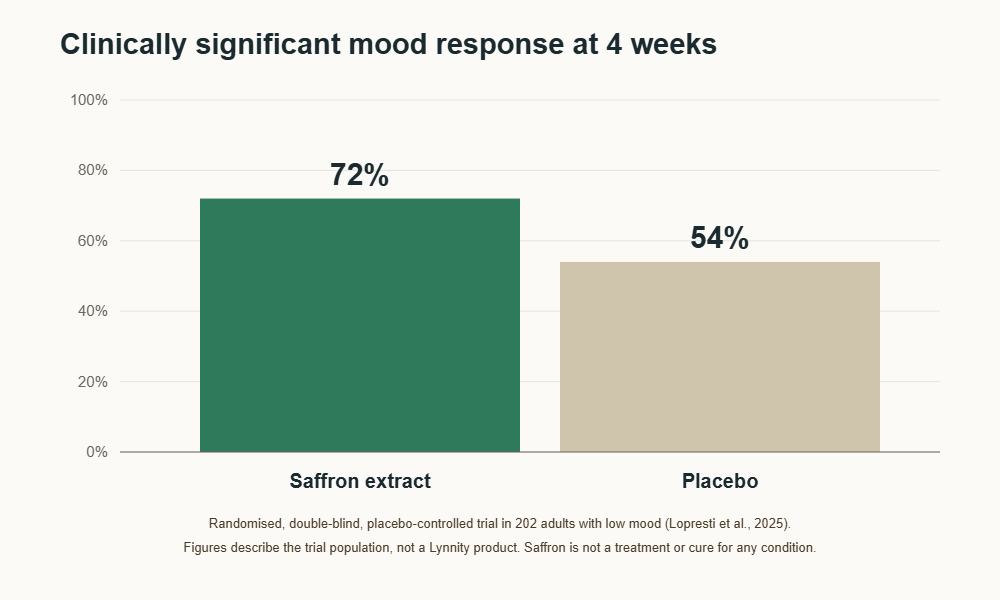
In that trial, about 72% of the saffron group met the threshold for a clinically significant mood response, against 54% on placebo, and self-rated low-mood scores fell by roughly a half. As always, the placebo response was substantial — a reminder that mood endpoints move a lot on their own — and the trials vary in population and design.
What a compounding pharmacy can control
| Formulation lever | Why it matters for saffron |
|---|---|
| Identity & standardisation | Verified Crocus sativus standardised to a defined actives level — the single most important quality control for a botanical this widely adulterated. |
| Exact, trial-matched dose | The evidence clusters at about 28–30 mg/day. Compounding lets the prescriber match that precisely rather than guess from a variable spice. |
| Purposeful combinations | Where the prescriber wants it, saffron can be paired with a compatible nutrient — for example within a considered sleep or stress preparation — in a single formulation. |
| Excipient control | A clean, excipient-aware preparation for sensitive patients. |
Dose, timing and safety
Most positive trials used about 28–30 mg per day of a standardised extract, often as a single daily dose, with benefit building over roughly one to six weeks. The exact regimen for an individual is a prescriber’s decision.
Pregnancy. High doses of saffron have a traditional reputation as a uterine stimulant, and saffron in pregnancy should be treated with real caution and left to a doctor’s judgement — a reason, on its own, for a prescriber to be in the loop.
Serotonergic and mood medicines. Because saffron is being used for mood, any patient already on an antidepressant or other serotonergic agent should only add it under their prescriber’s supervision. The add-on studies were done that way, and so should real-world use be.
At the doses used in trials, standardised saffron is generally well tolerated; higher intakes (into the gram range of raw saffron) can cause nausea and other effects and are a different matter entirely. As with any botanical, data in pregnancy and lactation are limited.
What Lynnity can prepare — and what it cannot
Lynnity compounds to a doctor’s prescription in capsule, liquid, cream, tonic and serum forms, under Good Compounding Practice (GCP). For saffron the practical routes are:
- Two-piece capsule — a standardised saffron extract at the prescriber’s dose, the workhorse for a trial-matched regimen.
- Oral liquid or tonic — where a liquid is preferred, or where saffron sits within a wider prescribed preparation.
What Lynnity does not make is a compressed tablet or a softgel. For a standardised botanical extract a capsule or a measured liquid is in any case the natural route, and it lets the prescriber set an exact, trial-matched dose rather than accept a fixed commercial strength.
Practical notes for prescribers
- Specify standardised extract. Ask for an identity-verified, standardised Crocus sativus extract at a defined dose — not “saffron”, which could mean anything.
- Match the trial dose. The evidence sits around 28–30 mg/day; compounding lets you write it exactly and review.
- Set expectations on timing. Benefit builds over weeks; review at 4–8 weeks.
- Mind the interactions. Supervise closely in patients on antidepressants, and treat pregnancy as a stop-and-ask.
- Storage. Cool, dark and dry — light and heat degrade saffron’s actives — and observe the beyond-use date.
Working with Lynnity
Lynnity Compounding Pharmacy is based in Kuala Lumpur and works with clinics across the Klang Valley and with practitioners in Singapore. Every preparation — including nutritional and supplement formulations — is made only against a prescription from a registered doctor. Lynnity does not hold MAL registration for compounded preparations, does not sell direct to patients without a prescription, and does not do contract manufacturing.
Practitioners who want to discuss a standardised saffron formulation can contact the pharmacy to talk it through with a compounding pharmacist before writing.
Frequently asked questions
Is this the same as cooking saffron?
No. The trials used a standardised extract of Crocus sativus, defined to a consistent level of active constituents and dosed at about 28–30 mg per day. Culinary saffron varies enormously in active content and is very widely adulterated, so it is not a reliable substitute for the material studied.
What does the research on saffron show?
The strongest evidence is for low mood: in a placebo-controlled trial of 202 adults, a standardised saffron extract produced a clinically significant response in about 72% versus 54% on placebo, with self-rated low-mood scores roughly halving. Saffron has also been studied as an antidepressant add-on, in youth anxiety and depression, and for sleep. The findings are supportive but not proof of benefit for any individual, and are not a claim to treat or cure any condition.
Why does standardisation matter so much for saffron?
Saffron is one of the most expensive and most adulterated botanicals in the world. To get the effect seen in trials you need the material used in trials — identity-verified and standardised to a defined actives level. That quality control is exactly what a compounding pharmacy is set up to provide.
Why does saffron need a prescription at Lynnity?
Every Lynnity preparation requires a prescription from a registered doctor, supplements included. Saffron adds specific reasons: it is being used for mood, so it needs oversight alongside any antidepressant; high doses carry a pregnancy caution; and a mood or sleep complaint deserves proper assessment rather than self-treatment.
Can saffron be taken with antidepressants?
Only under the prescriber’s supervision. Saffron has been studied as an add-on to antidepressant medication, but because both act on mood pathways this is a decision for the treating doctor, not something to start independently.
Is saffron safe in pregnancy?
It should be treated with caution. High doses of saffron have a traditional reputation as a uterine stimulant, so saffron in pregnancy should be left to a doctor’s judgement. Data in pregnancy and lactation are limited.
Can Lynnity supply saffron as a tablet or softgel?
No. Lynnity compounds in capsule, liquid, cream, tonic and serum forms only. For a standardised saffron extract a capsule or a measured liquid is the natural route.
Clinically reviewed by the Lynnity compounding team, Kuala Lumpur. Written for registered healthcare practitioners and provided for professional information only. It is not medical advice, not a treatment recommendation, and not a claim that any compounded preparation treats, prevents or cures any disease. All Lynnity preparations, including supplements, require a prescription from a registered doctor. Compounded to Good Compounding Practice (GCP).