
Why the standardised AKBA extract — not ordinary boswellia — is the story
Boswellic acids are a family, but they are not equal. AKBA is the most potent 5-lipoxygenase inhibitor among them, and 5-LOX sits upstream of the leukotrienes that drive a good deal of inflammatory joint pain. The problem is arithmetic: AKBA is a minor component of crude boswellia, so an unstandardised extract can carry a fraction of the active fraction that the trials used.
Watch: the two-minute explainer
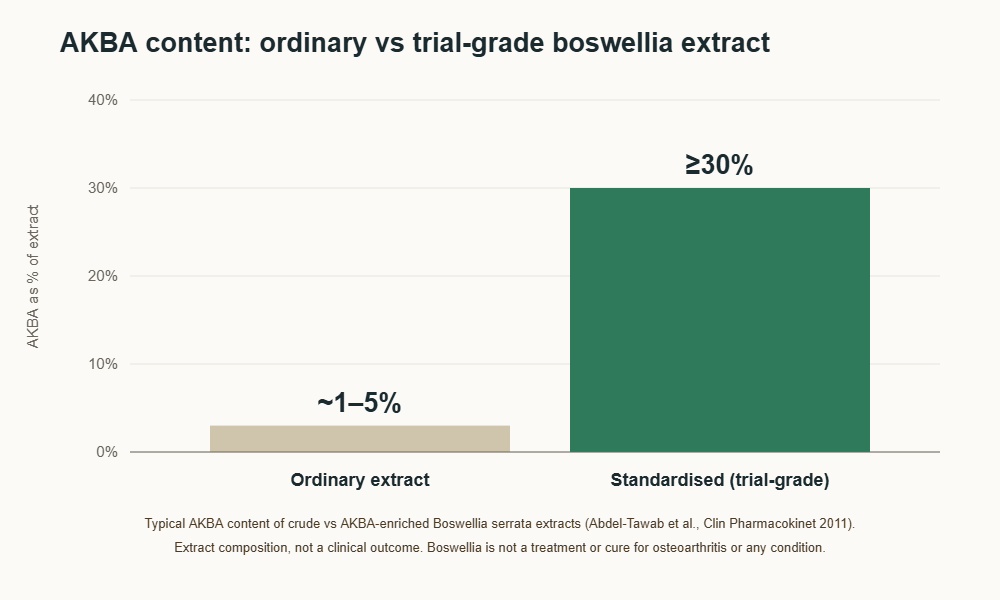
This is why “boswellia” on a label tells a prescriber almost nothing. Two products with the same weight of extract can differ roughly ten-fold in the constituent that matters. Matching the material used in the trials means specifying the standardisation — a defined AKBA percentage or dose — which is exactly the kind of specification a compounding pharmacy is built to honour.
How boswellia works in the body (pharmacology)
Boswellia’s mechanism is unusually well defined for a botanical. Its principal action is selective inhibition of 5-lipoxygenase (5-LOX) by AKBA. 5-LOX converts arachidonic acid into leukotrienes — signalling lipids that recruit inflammatory cells, increase vascular permeability and sustain the inflammatory environment inside a painful joint. Conventional NSAIDs act on a different branch of the same arachidonic-acid cascade (cyclo-oxygenase, producing prostaglandins), so boswellia is often described as complementary in mechanism rather than duplicative.
AKBA binds 5-LOX at a site separate from the substrate-binding pocket, which is why the inhibition is described as selective and non-redox. Beyond 5-LOX, boswellic acids have been reported to dampen NF-κB-driven transcription of inflammatory cytokines such as TNF-α and IL-1β, and to inhibit human leukocyte elastase, an enzyme implicated in cartilage matrix degradation. These are mechanistic and largely pre-clinical findings that explain how the molecule behaves in the body; they are not a promise of a clinical outcome for any individual patient.
What the trials show
The randomised evidence is concentrated in knee osteoarthritis. In a 30-day, double-blind, placebo-controlled study of a standardised, AKBA-enriched extract (Vishal and colleagues, International Journal of Medical Sciences, 2011), the treatment group’s WOMAC pain score fell by around 44%, with significant improvement reported as early as five days. A separate 90-day, placebo-controlled study of a 30%-AKBA extract at 100 mg and 250 mg daily likewise reported significant improvements in pain and function, with benefit at the higher dose seen from about a week. A systematic review of boswellia for osteoarthritis has since concluded the evidence is reasonably consistent for pain and function.
Dose, timing and safety
Trials have typically used about 100–250 mg per day of a standardised extract (or a defined AKBA dose), with onset ranging from a few days to a few weeks. The exact regimen for an individual is a prescriber’s decision.
Standardised boswellia is generally well tolerated; the most common reported effects are mild and gastrointestinal. Sensible cautions apply: data in pregnancy and lactation are limited, and because of its anti-inflammatory action it is reasonable to be thoughtful in patients on anticoagulants or with active gastrointestinal disease, and to keep the treating team informed.
What Lynnity can prepare — and what it cannot
Lynnity compounds to a doctor’s prescription in capsule, liquid, cream, tonic and serum forms, under Good Compounding Practice (GCP). For boswellia the practical routes are:
- Two-piece capsule — a standardised, defined-AKBA extract at the prescriber’s dose, the workhorse for a joint regimen.
- Topical cream — where the prescriber wants a boswellia preparation applied over an affected joint.
- Oral liquid or tonic, and combinations — for example boswellia with curcumin, where the prescriber wants the pairing in one formulation.
What Lynnity does not make is a compressed tablet or a softgel. For a standardised botanical a capsule, a cream or a measured liquid is in any case the natural route, and it lets the prescriber set an exact, standardised dose rather than accept a fixed commercial strength.
Practical notes for prescribers
- Specify the standardisation. Ask for a standardised Boswellia serrata extract at a defined AKBA level — not “boswellia”, which could be almost anything.
- Match the trial dose. The evidence sits around 100–250 mg/day of standardised extract.
- Consider the route. Oral for systemic effect; a compounded cream where a localised joint application is wanted.
- Mind the cautions. Be thoughtful in patients on anticoagulants, and treat pregnancy as a stop-and-ask.
- Storage. Cool and dry, and observe the beyond-use date.
Working with Lynnity
Lynnity Compounding Pharmacy is based in Kuala Lumpur and works with clinics across the Klang Valley and with practitioners in Singapore. Every preparation — including nutritional and supplement formulations — is made only against a prescription from a registered doctor. Lynnity does not hold MAL registration for compounded preparations, does not sell direct to patients without a prescription, and does not do contract manufacturing.
Practitioners who want to discuss a boswellia formulation — the AKBA standardisation and dose, an oral versus topical route, or a combination with curcumin — can contact the pharmacy to talk it through with a compounding pharmacist before writing.
Frequently asked questions
What is AKBA, and why does it matter?
AKBA (3-O-acetyl-11-keto-β-boswellic acid) is the most potent 5-lipoxygenase-inhibiting constituent of boswellia, and 5-LOX drives much of the inflammation behind joint pain. Ordinary boswellia extract contains only around 1–5% AKBA, whereas the extracts used in the osteoarthritis trials are standardised to 30% AKBA or more.
What does the research on boswellia show?
The randomised evidence is concentrated in knee osteoarthritis. Standardised, AKBA-enriched extracts have reduced WOMAC pain and improved function in placebo-controlled trials, some with onset within about five to seven days. The trials are modest in size, and the findings are not proof of benefit for any individual or a claim to treat or cure any condition.
Is standardised boswellia different from what’s on the shelf?
Often, yes. “Boswellia” on a label may mean an unstandardised extract with a fraction of the AKBA the trials used. To match the studied material you need a defined AKBA standardisation.
Why does boswellia need a prescription at Lynnity?
Every Lynnity preparation requires a prescription from a registered doctor, supplements included. With boswellia there is an added reason: the standardisation and dose that decide whether it matches the trial-grade material are clinical decisions, and there are cautions worth a prescriber’s eye in patients on anticoagulants or in pregnancy.
Can boswellia be used as a cream?
Yes. Boswellia is used both orally and topically, and where a prescriber wants a preparation applied over an affected joint, Lynnity can compound a cream to specification. Lynnity compounds creams, but not tablets or softgels.
Is boswellia safe?
Standardised boswellia is generally well tolerated, with mostly mild gastrointestinal effects reported. Data in pregnancy and lactation are limited, and it is reasonable to be thoughtful in patients on anticoagulants or with active gastrointestinal disease.
Can Lynnity supply boswellia as a tablet or softgel?
No. Lynnity compounds in capsule, liquid, cream, tonic and serum forms only. For boswellia a capsule, a topical cream or a measured liquid is the natural route.
Clinically reviewed by the Lynnity compounding team, Kuala Lumpur. Written for registered healthcare practitioners and provided for professional information only. It is not medical advice, not a treatment recommendation, and not a claim that any compounded preparation treats, prevents or cures any disease. All Lynnity preparations, including supplements, require a prescription from a registered doctor. Compounded to Good Compounding Practice (GCP).