
Short answer: Silicon is the trace mineral the body uses where structure is made — collagen, hair keratin, nail plate, bone matrix — and studies suggest intake and absorption decline with age. The catch is chemistry: the body can only absorb silicon as monomeric orthosilicic acid, and ordinary silica — the form in most supplements and in bamboo or horsetail extracts — arrives largely polymerised and poorly absorbed. That is why the clinical record belongs almost entirely to one differentiated form: choline-stabilised orthosilicic acid (ch-OSA), in which choline holds the silicic acid in its absorbable state. Randomised, placebo-controlled trials of 10 mg silicon daily reported firmer, less rough photodamaged skin and reduced hair and nail brittleness over 20 weeks; thicker, stronger hair over 9 months; and, with calcium and vitamin D3, higher bone-formation markers in osteopenic women over 12 months. A knee-osteoarthritis trial was honest in the other direction: no overall benefit, with improvement confined to men in a subgroup analysis. ch-OSA is scarcely available in Malaysia, and generic silica products do not carry its evidence. For clinics in KL and the Klang Valley, a doctor-prescribed, compounded silicon preparation from Lynnity — a titratable oral liquid (its natural form is drops) or a customised capsule, prepared under Good Compounding Practice (GCP) — delivers the studied form at the studied dose, inside a plan the prescriber designs.
Lynnity · Compounding Journal
THE MINERAL THAT GELS ITSELF
The only form of silicon the body absorbs destroys itself at supplement strength — not past a shelf date, but in the bottle, by its own chemistry.
Lynnity Compounding Pharmacy · Kuala Lumpur — Prescription-only · Good Compounding Practice (GCP)
The chemistry
ONLY THE MONOMER GETS IN
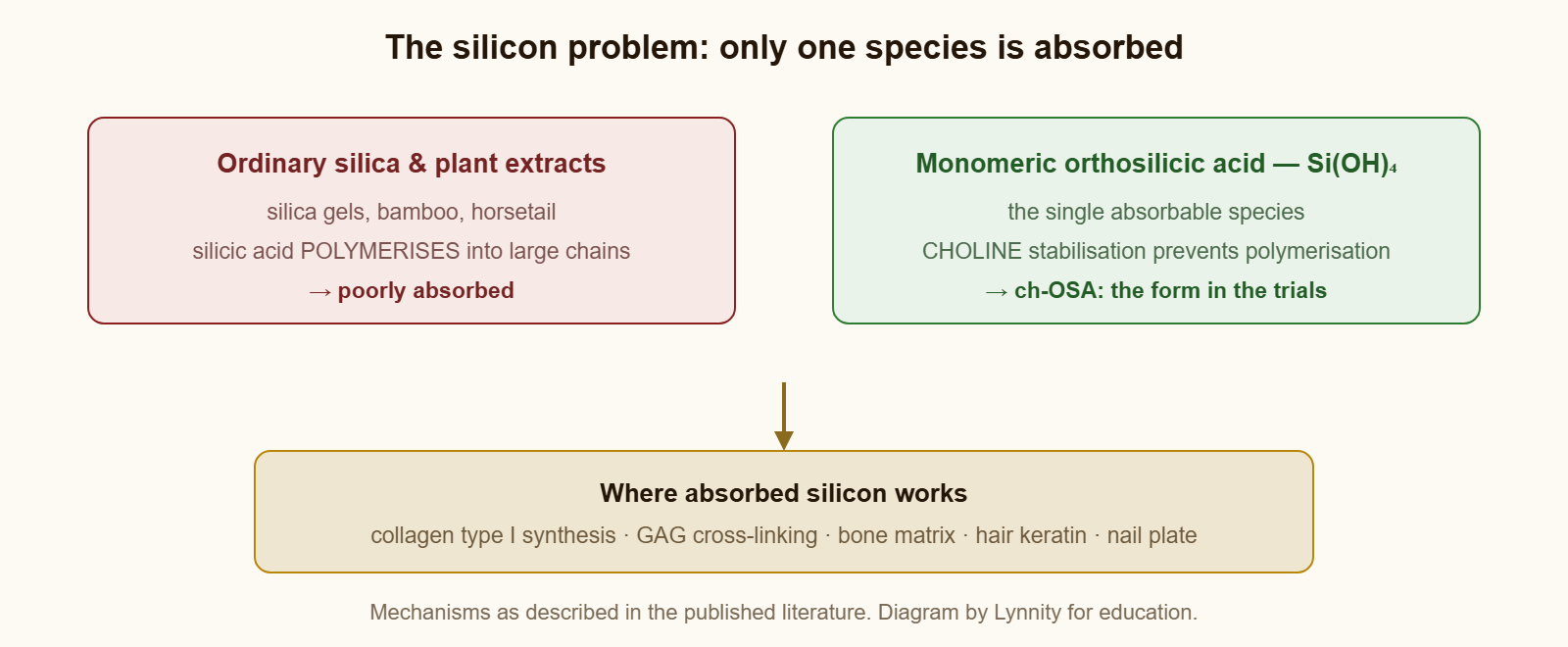
The gut takes up silicon one way only: as single molecules of orthosilicic acid. Concentrate them and they condense into polymers and gels that are barely absorbed — most shelf silica, bamboo and horsetail arrives already polymerised.
Lynnity Compounding Pharmacy · Kuala Lumpur — Prescription-only · Good Compounding Practice (GCP)
The same element, twice
ONE ELEMENT. TWO CHEMISTRIES.
The published numbers
SMOOTHER SKIN — IN THE STABILISED FORM ONLY
Change in facial skin roughness over 20 weeks · 10 mg silicon/day as ch-OSA vs placebo · a fall means smoother skin.
Honest notes: instrumental profilometry, not appearance ratings; serum silicon 169 vs 98 ppb (P < .001); hair and nail brittleness also fell. A 12-week knee-osteoarthritis RCT (Geusens 2017, 166 analysed) found no overall benefit, and the bone data (Spector 2008) is a formation biomarker, not a fracture outcome.
Source: Barel A. et al., Arch Dermatol Res 2005;297(4):147–153 — randomised, double-blind, placebo-controlled, n=50 women with photodamaged skin. Reported by the study — NOT a claim about any Lynnity preparation.
Read the jar
FOUR NUMBERS A SHELF JAR NEVER SHOWS
Which silicon species it contains · how much is still monomeric · the elemental silicon dose · and the evidence behind that exact form.
Lynnity Compounding Pharmacy · Kuala Lumpur — Prescription-only · Good Compounding Practice (GCP)
The compounding answer
THE STUDIED FORM. IN DROPS. ON PRESCRIPTION.
Stabilised orthosilicic acid is naturally a concentrated oral liquid, measured in drops and titratable to the milligram — or a customised capsule where that suits the patient better.
Lynnity Compounding Pharmacy · Kuala Lumpur — Prescription-only · Good Compounding Practice (GCP)
For prescribers
WHICH CHEMISTRY ARE YOU ACTUALLY GIVING?
A prescriber’s question — answered by formulation, not by a label. Every Lynnity preparation, including supplements, is compounded to a registered doctor’s prescription under Good Compounding Practice (GCP), with the silicon species and elemental dose calculated and stated by the pharmacist.
No Lynnity preparation is presented as treating any disease. The trial record informs a prescriber’s judgement.
Lynnity · Compounding Journal
SPECIFY THE FORM. NOT THE LABEL.
The full clinical breakdown — the monomer/polymer chemistry, every randomised trial and the honest null — continues in the article below.
Lynnity Compounding Pharmacy · Kuala Lumpur — Prescription-only · Good Compounding Practice (GCP)
The forgotten structural mineral
Silicon rarely makes a clinic’s shortlist, yet it is one of the most abundant trace elements in the body’s connective tissues. It concentrates where architecture is built: in bone’s collagen scaffold before mineralisation, in the dermis, in the hair shaft and nail plate. Mechanistic work suggests it participates in collagen type I synthesis and in the cross-linking of glycosaminoglycans — the biochemical carpentry behind skin firmness, hair tensile strength and bone matrix quality. Dietary silicon comes mainly from whole grains, certain waters and plant foods, and published work suggests both intake and absorption drift downward with age — precisely when collagen turnover starts losing ground.
None of that would matter clinically if silicon were easy to supplement. It is not — and the reason is the story of this article.
What the randomised trials show — and where they came up short
ch-OSA is unusual among beauty-aisle minerals in having a genuine RCT record, with published numbers on measurable endpoints:
- Photodamaged skin, hair and nails — Barel and colleagues, 2005. Fifty women with photodamaged facial skin were randomised to 10 mg silicon daily as ch-OSA or placebo for 20 weeks. Skin surface roughness decreased in the ch-OSA group (Rt −16%) while it increased on placebo (Rt +8%), and both hair and nail brittleness scores fell significantly versus placebo.
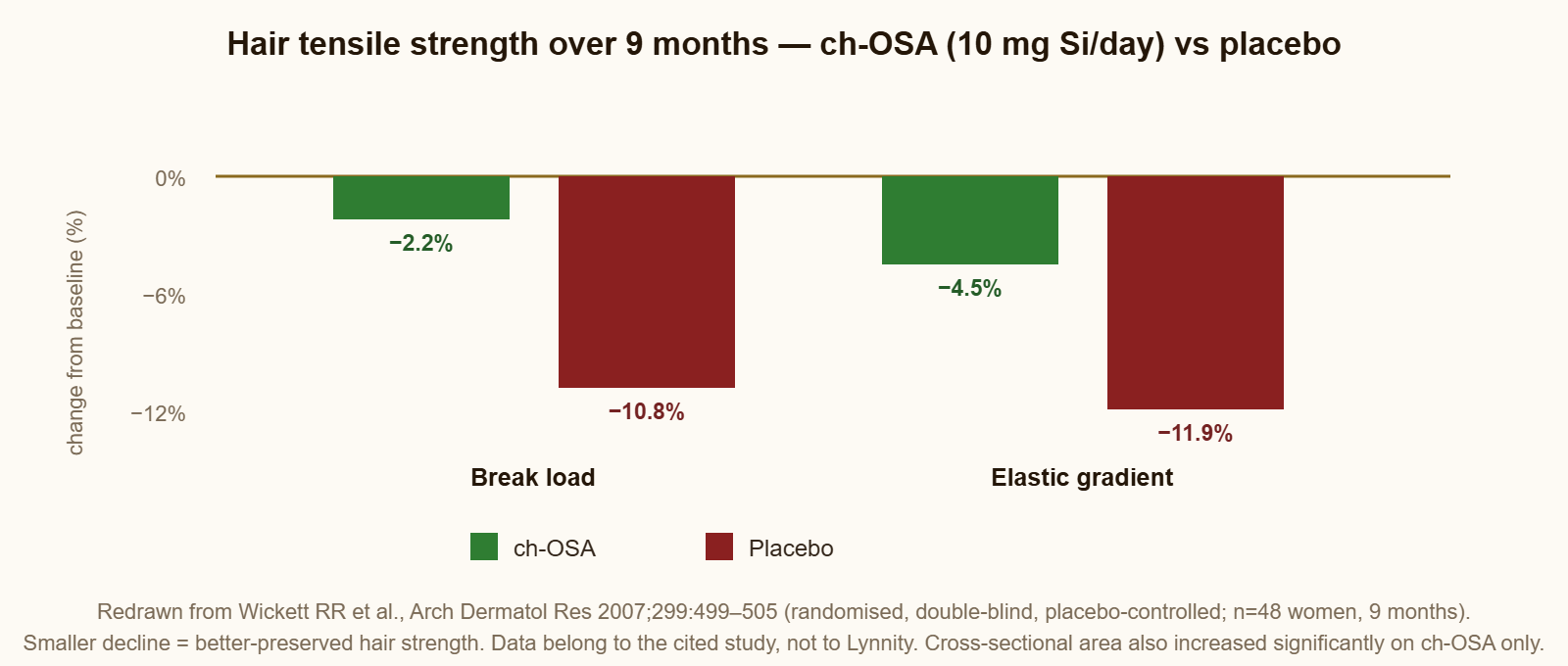
- Fine hair — Wickett and colleagues, 2007. Forty-eight women with fine hair took 10 mg silicon daily as ch-OSA or placebo for nine months. Hair cross-sectional area increased significantly in the ch-OSA group only — measurably thicker hair — and tensile properties held up better: break load fell 10.8% on placebo but only 2.2% on ch-OSA (see Figure 2).
- Bone-formation markers — Spector and colleagues, 2008. In 136 osteopenic women, ch-OSA (3, 6 or 12 mg silicon daily) added to calcium and vitamin D3 for 12 months raised the bone-formation marker PINP versus calcium/D3 alone at the 6 mg dose, with a positive trend in femoral bone density. A biomarker signal, not a fracture outcome — worth stating plainly.
- Knee osteoarthritis — Geusens and colleagues, 2017 — the honest miss. In a 12-week multicentre RCT (166 patients analysed), ch-OSA produced no significant benefit in the overall population on WOMAC scores or cartilage-degradation biomarkers. In the male subgroup, WOMAC total, stiffness and function improved and biomarkers rose less — an interesting gender interaction, but a subgroup finding that needs its own trial before anyone builds a claim on it.
Net position for a prescriber: consistent, placebo-controlled signals on skin texture, hair calibre and strength, nail brittleness and bone-formation markers at 6–10 mg elemental silicon daily — in the stabilised form only — and a null result in knee OA that keeps the story honest. No trial here supports treating any disease, and Lynnity presents none of this as a treatment claim.
Why this is a compounding question
Walk any Malaysian pharmacy aisle and “silicon” means generic silica tablets or bamboo/horsetail extracts — polymerised forms that do not carry the trial evidence and arrive largely unabsorbed. ch-OSA itself is scarcely distributed here; what patients find online is a scatter of imports of uncertain strength. As with sulforaphane, the active is only as good as its form — and the form is exactly what a compounding pharmacy controls:
- The studied form at the studied dose. A doctor can prescribe stabilised orthosilicic acid at the trial-consistent 6–10 mg of elemental silicon daily — with the elemental content calculated and stated by the pharmacist, not inferred from a “silica complex” panel.
- Drops, naturally. Stabilised silicic acid’s native presentation is a concentrated oral liquid dosed in drops into water or juice — a form Lynnity compounds routinely, and one that makes dose titration trivial. A customised capsule suits patients who prefer it.
- One protocol, one review. Aesthetic and healthy-ageing clinics typically run silicon alongside other actives — collagen-support protocols, hair formulations, bone regimens with calcium and D3 (as in the Spector trial). Compounding brings the set under a single pharmacist medication review, excipient-aware formulation and one beyond-use-date discipline.
- Honest positioning. A compounded preparation is dispensed with the evidence stated as it is — skin, hair, nail and bone-marker findings, an OA null — rather than the borrowed glow generic silica products enjoy on a retail shelf.
Who it may suit — and the cautions
Prescribers most often consider stabilised silicon for patients focused on hair thinning or fragility, brittle nails, photodamaged or ageing skin, and as an adjunct in bone-health protocols already anchored on calcium, vitamin D and resistance exercise. The cautions: the evidence base is made of small-to-mid-size trials on cosmetic and biomarker endpoints — supportive, not definitive; the knee-OA result was null overall; data in pregnancy and breastfeeding are lacking, so it is avoided there; and silicon is excreted renally, so significant kidney impairment belongs to the doctor’s judgement. ch-OSA was well tolerated in the published trials. No supplement — compounded or otherwise — treats or cures any disease; hair, skin and bone outcomes rest first on the fundamentals the prescriber manages.
How patients get compounded silicon in Malaysia
Through a doctor — as with everything Lynnity prepares. All Lynnity preparations, including supplements, are compounded only against a registered doctor’s prescription under Good Compounding Practice (GCP), with no MAL registration, for a named patient with a beyond-use date. The prescriber specifies the form (oral liquid drops or capsule), the elemental-silicon dose and the protocol around it; Lynnity compounds and dispenses against that prescription. Doctors, aesthetic and dermatology clinics, and wellness practices across KL, the Klang Valley and Singapore can refer patients or set up a practitioner account.
Frequently asked questions
What is ch-OSA (choline-stabilised orthosilicic acid)?
It is silicon held in its only absorbable form — monomeric orthosilicic acid — with choline preventing the polymerisation that makes ordinary silica supplements poorly absorbed. Nearly all of silicon’s randomised clinical evidence was generated with this stabilised form.
What did the clinical trials of ch-OSA actually find?
Randomised placebo-controlled trials at 6–10 mg silicon daily reported reduced skin roughness and less hair and nail brittleness over 20 weeks, thicker and stronger hair over 9 months, and higher bone-formation markers in osteopenic women over 12 months alongside calcium and vitamin D3. A 12-week knee-osteoarthritis trial found no overall benefit, with improvement only in a male subgroup.
Is silicon from bamboo or horsetail extract the same thing?
No. Plant-derived and generic silica arrives largely polymerised, which the body absorbs poorly, and those products were not the forms tested in the trials. The absorbable species is monomeric orthosilicic acid, which requires stabilisation — that difference is the whole story.
Why compound silicon instead of buying a supplement?
Because the studied stabilised form is scarcely available in Malaysia, and shelf silica does not carry its evidence. A compounding pharmacy prepares the doctor-prescribed elemental-silicon dose as titratable oral liquid drops or a customised capsule, with the form and strength verified by a pharmacist and reviewed against the patient’s other medicines.
Is ch-OSA safe?
It was well tolerated in the published trials. Data in pregnancy and breastfeeding are lacking, so it is avoided there, and significant kidney impairment calls for the doctor’s judgement since silicon is renally excreted. It is prescription-only at Lynnity and does not treat or cure any disease.
How do I get compounded silicon in Malaysia?
Through a registered doctor. All Lynnity preparations are prescription-only, compounded under Good Compounding Practice (GCP) with no MAL registration, for a named patient with a beyond-use date. Doctors, aesthetic and dermatology clinics and wellness centres in KL, the Klang Valley and Singapore can refer patients or prescribe directly.
Reviewed by the Lynnity pharmacy team — registered pharmacists compounding to Good Compounding Practice (GCP) in Kuala Lumpur. This article is educational and is not medical advice; all compounded preparations require a prescription from a registered doctor.
Key sources: Barel A et al., Arch Dermatol Res 2005;297:147 (RCT, n=50, 20 wk) · Wickett RR et al., Arch Dermatol Res 2007;299:499 (RCT, n=48, 9 mo) · Spector TD et al., BMC Musculoskelet Disord 2008;9:85 (RCT, n=136, 12 mo) · Geusens P et al., BMC Musculoskelet Disord 2017;18:2 (n=166 analysed; overall null, male-subgroup signal).