
Short answer: Sulforaphane is one of the most heavily studied phytochemicals in modern nutrition — a potent activator of the Nrf2 pathway, with human trials in prostate cancer follow-up, autism, airway disease and metabolic health. It is also one of the most fragile molecules a clinic will ever prescribe. Sulforaphane barely exists in a finished capsule: it has to be generated at the point of use from a stable precursor, glucoraphanin, by an enzyme, myrosinase — and most commercial products have inactivated that enzyme in processing. The practical consequence is stark: the same labelled dose can deliver anywhere from almost nothing to a genuinely useful amount, depending entirely on the formulation. In a controlled crossover study, co-delivering active myrosinase with glucoraphanin roughly doubled how much sulforaphane reached the bloodstream. That makes sulforaphane a formulation problem, not a shelf purchase — and every Lynnity preparation, sulforaphane included, requires a prescription from a registered doctor.
Why practitioners are paying attention
Sulforaphane’s interest to clinicians comes from its mechanism. It is among the most potent natural inducers of Nrf2, the transcription factor that switches on the body’s own antioxidant and detoxification enzymes. That single upstream action is why one molecule keeps appearing across such different trial settings.
The human literature is genuinely broad, if still early. A randomised, placebo-controlled study in men with biochemical recurrence after prostatectomy (Cipolla and colleagues, 2015) reported a lengthening of the PSA doubling time on sulforaphane. A frequently-cited randomised trial in young men with autism spectrum disorder (Singh and colleagues, PNAS 2014) reported improvements in behavioural scores. Further randomised work has examined airway inflammation, Helicobacter pylori carriage, and markers of glucose metabolism. None of this is a settled therapy, and none of it licenses a disease claim — but it is a serious body of work for a food-derived compound, and it is why integrative, urology and neurodevelopmental practitioners ask about it.
The honest framing
These are early-to-mid-stage trials on a measurable marker, not proof of benefit for any individual, and nothing here should be read as a claim that a compounded preparation treats, prevents or cures cancer, autism or any other condition. What the evidence does establish beyond doubt is narrower and more useful to a formulator: how much sulforaphane the patient absorbs is decided by the form, not the label.
The formulation problem — and why it is the whole story
Sulforaphane is not present as such in broccoli, in seeds, or in a well-made capsule. What is present is glucoraphanin, a stable glucosinolate, sitting separately from the enzyme myrosinase that converts it. The two only meet when plant tissue is crushed — or when a formulation deliberately brings them together. Sulforaphane itself is heat-sensitive and unstable, so it cannot simply be pre-made and stored.
Here is where most products fall down. Processing that dries and extracts broccoli typically denatures the myrosinase, leaving a supplement rich in glucoraphanin but with no active enzyme to convert it. The patient is then relying on the myrosinase activity of their own gut bacteria, which is highly variable between individuals and often low. The result is a product that looks identical on a label to an effective one, but delivers a fraction of the sulforaphane.
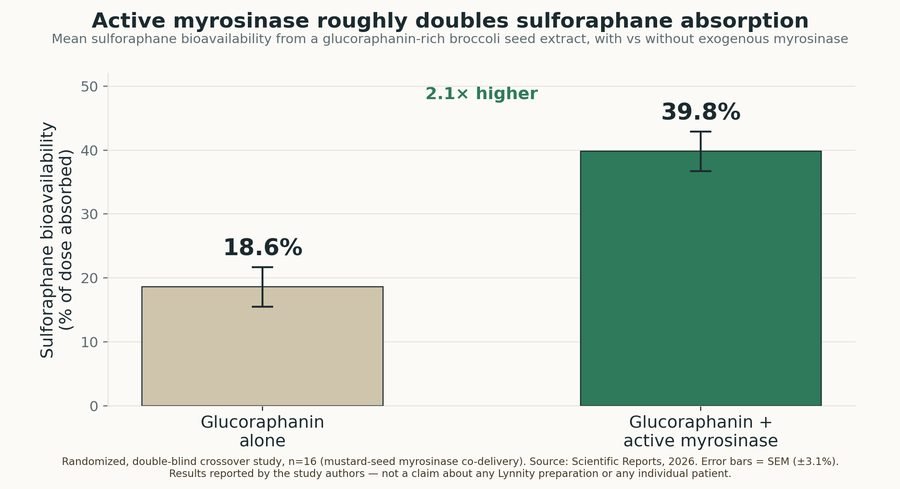
The controlled data are unambiguous about direction. When active myrosinase was co-delivered with a glucoraphanin-rich broccoli seed extract, mean sulforaphane bioavailability was about 39.8%, against about 18.6% for the extract alone — roughly double. Older work from the same field reported that preparations containing active plant myrosinase delivered three- to four-fold more sulforaphane than glucoraphanin given without it. For a prescriber, the message is simple: specifying the form is not fussiness, it is the difference between a therapeutic dose and a placebo.
What a compounding pharmacy can actually control
This is the rare case where the compounding rationale is not a marketing line but the entire point of the exercise. To the prescriber’s specification, a compounding pharmacy can:
| Formulation lever | Why it matters for sulforaphane |
|---|---|
| Co-deliver active myrosinase | Pairing standardised glucoraphanin with a source of active myrosinase (for example mustard seed) is the single biggest determinant of how much sulforaphane is generated and absorbed. |
| Set the glucoraphanin dose | The prescriber fixes the precursor dose rather than accepting whatever a brand chose, allowing a defined, reviewable regimen. |
| Protect the enzyme | Gentle, low-heat handling and appropriate storage keep the myrosinase active — the opposite of the high-heat processing that kills it in mass-market products. |
| Manage stomach acid | Myrosinase is acid-sensitive; formulation and timing can be used to give the enzyme its best chance to work, an option a fixed commercial product does not offer. |
Dose, timing and safety
Most human trials have delivered glucoraphanin in the region of tens to low-hundreds of micromoles per day (broadly equivalent to a few tens of milligrams of glucoraphanin upward), often standardised to a target sulforaphane yield. The exact dose for an individual is a prescriber’s decision, and one of the reasons to compound is that the prescriber — not a label — sets it.
Sulforaphane and glucoraphanin are generally well tolerated; reported effects are usually mild and gastrointestinal, such as bloating or wind. As with any Nrf2-active compound there are sensible cautions: data in pregnancy and lactation are limited, and any patient on active oncology treatment should only use it under their specialist’s direction, because antioxidant-pathway modulation around chemotherapy or radiotherapy is a question for the treating oncologist, not a supplement decision. These cautions are, again, reasons for a prescriber to be in the loop.
What Lynnity can prepare — and what it cannot
Lynnity compounds to a doctor’s prescription in capsule, liquid, cream, tonic and serum forms, under Good Compounding Practice (GCP). For sulforaphane the practical routes are:
- Two-piece capsule — standardised glucoraphanin co-formulated with a source of active myrosinase, made to the prescriber’s dose. The workhorse.
- Oral liquid or tonic — where the prescriber wants the precursor and enzyme brought together in a measured dose dispersed at the point of use, or where swallowing capsules is difficult.
What Lynnity does not make is a compressed tablet or a softgel — and for this molecule that is an advantage rather than a limitation. High-compression tableting and the heat some processes involve are exactly the conditions that jeopardise a delicate enzyme; a gently made capsule or a freshly dispersed liquid is the more sensible route, and it lets the prescriber, not a factory, set the dose.
Practical notes for prescribers
- Specify the form. “Sulforaphane” on a request is ambiguous. What matters is standardised glucoraphanin plus a source of active myrosinase — say so explicitly, and the pharmacy can build to it.
- Dose the precursor. Set a defined daily glucoraphanin dose and review, rather than chasing a sulforaphane number that depends on conversion.
- Timing. Away from very hot drinks; a compounding pharmacist can advise on taking it in a way that protects enzyme activity.
- Oncology patients. Defer to the treating specialist on timing around any active cancer therapy.
- Storage. Cool and dry, and observe the beyond-use date — this is not a molecule that forgives a hot car.
Working with Lynnity
Lynnity Compounding Pharmacy is based in Kuala Lumpur and works with clinics across the Klang Valley and with practitioners in Singapore. Every preparation — including nutritional and supplement formulations — is made only against a prescription from a registered doctor. Lynnity does not hold MAL registration for compounded preparations, does not sell direct to patients without a prescription, and does not do contract manufacturing.
Practitioners who want to discuss a sulforaphane formulation — the glucoraphanin dose, the myrosinase source, stability, or a combination with a compatible active — can contact the pharmacy to talk it through with a compounding pharmacist before writing.
Frequently asked questions
Why can’t a patient just buy a sulforaphane supplement off the shelf?
They can, but many shelf products deliver far less sulforaphane than the label implies. Sulforaphane is generated from a precursor, glucoraphanin, by the enzyme myrosinase, which most processing inactivates. Without active myrosinase, conversion relies on the patient’s own gut bacteria, which is variable and often low. Controlled data show co-delivering active myrosinase roughly doubles absorption — which is a formulation decision, not something a patient can fix at home.
What is the difference between glucoraphanin, myrosinase and sulforaphane?
Glucoraphanin is the stable precursor found in broccoli. Myrosinase is the enzyme that converts it. Sulforaphane is the active molecule that results. Sulforaphane itself is unstable and cannot simply be pre-made and stored, which is why the precursor and enzyme are formulated to meet at the point of use.
What does the research actually show?
Sulforaphane is a potent Nrf2 activator, and randomised human trials have examined it in men with biochemical recurrence of prostate cancer, in autism spectrum disorder, in airway inflammation and in metabolic markers. The findings are promising but early, and none establish a benefit for any individual. Nothing here is a claim that a compounded preparation treats, prevents or cures any disease.
Why does sulforaphane need a prescription at Lynnity?
Every Lynnity preparation requires a prescription from a registered doctor, supplements included. With sulforaphane there is an added reason to have a prescriber involved: the formulation choices that decide whether the patient absorbs a useful dose are clinical decisions, and there are real cautions in pregnancy, lactation and around active cancer therapy.
Is sulforaphane safe?
It is generally well tolerated, with mostly mild gastrointestinal effects reported. Data in pregnancy and lactation are limited, and patients on active oncology treatment should only use it under their specialist’s direction. Dose for an individual is a prescriber’s decision.
Can it be combined with other actives?
Yes — where the prescriber wants it, sulforaphane can be compounded alongside a compatible nutrient in a single preparation. The priority, though, is always getting the glucoraphanin-plus-myrosinase core right first.
Can Lynnity supply sulforaphane as a tablet or softgel?
No. Lynnity compounds in capsule, liquid, cream, tonic and serum forms only. For sulforaphane a gently made two-piece capsule or a freshly dispersed liquid is the better route in any case, because high-compression tableting and heat can damage the very enzyme the preparation depends on.
Sources
- Exogenous myrosinase from mustard seed increases bioavailability of sulforaphane from a glucoraphanin-rich broccoli seed extract: a randomised clinical study. Scientific Reports 2026: nature.com
- Fahey JW, et al. Sulforaphane bioavailability from glucoraphanin-rich broccoli: control by active endogenous myrosinase. PLoS ONE 2015: journals.plos.org
- Cipolla BG, et al. Effect of sulforaphane in men with biochemical recurrence after radical prostatectomy: randomised controlled trial. Cancer Prevention Research 2015: ncbi.nlm.nih.gov
- Singh K, et al. Sulforaphane treatment of autism spectrum disorder (ASD). PNAS 2014;111(43):15550–15555: pnas.org
- Yagishita Y, Fahey JW, Dinkova-Kostova AT, Kensler TW. Broccoli or sulforaphane: is it the source or dose that matters? Molecules 2019: ncbi.nlm.nih.gov