
Short answer: Luteolin is a plant flavone with an unusually rich mechanistic story — it stabilises mast cells, crosses into the brain and calms activated microglia — and it has drawn real clinical interest for neuro-inflammatory presentations such as long-COVID “brain fog.” Its problem is absorption: luteolin is almost insoluble in water and heavily broken down on first pass through the gut and liver, so a plain powder delivers very little to the circulation. That makes the delivery form the deciding factor, which is exactly where a liposomal or phospholipid preparation earns its place. A compounding pharmacy lets a prescriber standardise the dose, choose a liposomal delivery, and co-formulate luteolin rationally — for example with palmitoylethanolamide (PEA) or quercetin — as a capsule or an oral liquid. At Lynnity every such preparation is made under Good Compounding Practice (GCP), for a named patient, on a prescription from a registered doctor. There is no over-the-counter or “no prescription needed” route.
Why Klang Valley clinics keep getting asked about luteolin
Luteolin has moved out of the biochemistry journals and into the consultation room. Patients across Kuala Lumpur, the Klang Valley and Singapore now ask about it by name — usually after reading that it is a “natural mast-cell stabiliser” or a remedy for histamine intolerance, allergy symptoms and the stubborn cognitive fog that can follow a viral illness. Interest surged with long-COVID, where luteolin (often paired with PEA) became one of the most-discussed nutraceutical options for persistent fatigue and brain fog. For a prescriber the molecule is genuinely interesting, because its laboratory pharmacology is coherent and specific rather than a vague “antioxidant” claim — but the human evidence is early, and the marketing again runs well ahead of the data. The useful job is to hold both facts at once.
What luteolin is, and why the source and standardisation matter
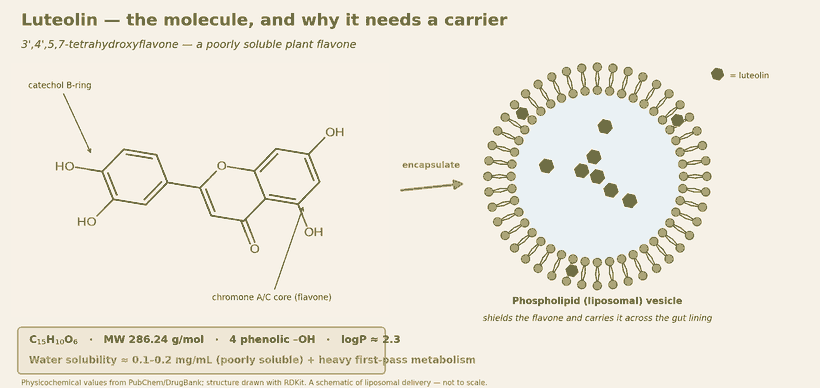
Luteolin (3′,4′,5,7-tetrahydroxyflavone) is a flavone found in chamomile, celery, parsley, perilla, artichoke and peanut hulls; supplement-grade material is typically extracted from Sophora japonica or peanut shell and standardised to high purity. One point worth clearing up in clinic: luteolin is not lutein. Lutein is the yellow eye-carotenoid used for macular support; luteolin is a colourless flavone with a completely different mechanism. The names are close enough that patients — and the occasional label — confuse them. Because the trial-grade material is a defined, high-purity flavone (studies typically use >95% luteolin), the meaningful prescriber question is “standardised luteolin, at what milligram dose and in what delivery form?”, not simply “luteolin: yes or no?” A compounder can specify the purity, the dose and the form; an opaque retail capsule frequently does not.
How luteolin works (pharmacology)
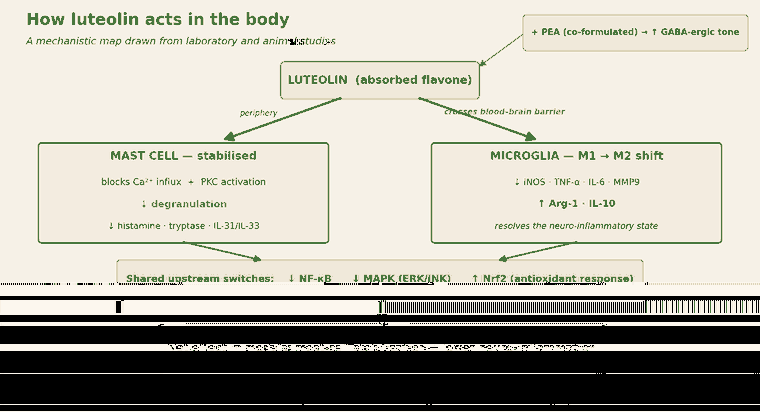
Luteolin’s mechanisms are its main attraction, and they are well characterised in laboratory and animal work. As a mast-cell stabiliser it suppresses intracellular calcium (Ca2+) influx and blocks protein kinase C (PKC) activation — two signals mast cells need in order to degranulate — which reduces the release of histamine, tryptase and inflammatory cytokines. It is also lipophilic enough to cross the blood–brain barrier, where it shifts microglia away from the pro-inflammatory M1 state toward the resolving M2 state: in cell studies it lowers iNOS, IL-6, TNF-α and MMP9 while raising Arg-1 and IL-10. Upstream, luteolin dampens the NF-κB and MAPK (ERK/JNK) signalling cascades that amplify cytokines such as TNF-α, IL-6, IL-1β, IL-31 and IL-33, and it activates the Nrf2 antioxidant-response pathway. Finally, luteolin is often combined with palmitoylethanolamide (PEA), an endocannabinoid-like mediator that enhances GABA-ergic transmission and quietens glial activation; the two are thought to act on complementary arms of neuro-inflammation. These are mechanistic findings that explain why luteolin is studied and how it behaves — not a guaranteed result for any individual patient.
What the trial evidence actually shows
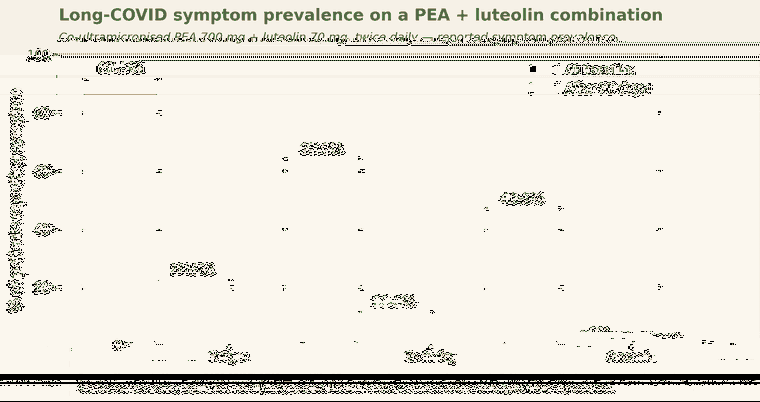
The most developed human evidence sits in neuro-inflammation, and specifically in the co-ultramicronised PEA–luteolin combination studied for long-COVID. In a randomised, controlled study, patients with post-COVID fatigue and cognitive difficulty took PEA 700 mg plus luteolin 70 mg twice daily for eight weeks; the treated group showed reduced brain fog alongside normalised GABA(B)-ergic activity and cortical plasticity measured by transcranial magnetic stimulation (Versace et al., 2023, n = 39). A separate real-life retrospective by nine general practitioners tracked symptom prevalence over 90 days on the same combination and reported falls in fatigue, brain fog and anosmia (Pirro et al., 2023), charted below.
Earlier work points the same way without settling it. A longitudinal study of ultramicronised PEA with luteolin reported improved olfaction and memory in long-COVID patients (2022). And one of the first formulation studies of luteolin itself — an open-label pilot using a purified luteolin–quercetin–rutin blend in an olive-oil carrier (Taliou et al., 2013) — reported a follow-up drop in serum IL-6 and TNF at 26 weeks (Tsilioni et al., 2015). That study matters here for one narrow reason: it showed a measurable fall in neuro-inflammatory cytokines in humans, and it worked only because the poorly soluble flavonoid was formulated to be absorbed. It was small and uncontrolled, and it is not evidence that luteolin treats any condition. On the mast-cell / histamine side that drives much of the consumer interest, the mechanism is strong and luteolin is frequently combined with quercetin in practice — but robust double-blind trials in diagnosed mast-cell activation syndrome are still lacking, and that gap should be stated plainly to any patient.
Why the delivery form is the whole story
Luteolin is a textbook “the form decides everything” molecule. Its water solubility is only about 0.1–0.2 mg/mL, and what does dissolve faces extensive first-pass metabolism — rapid glucuronidation and sulfation in the gut wall and liver — so oral bioavailability of a plain powder is low even though absorption itself is quick. This is precisely the problem a compounding pharmacy is built to solve. Formulation science has repeatedly shown that enclosing luteolin in a phospholipid or liposomal system, or reducing it to nanoscale particles, raises its dissolution and measured absorption severalfold over the raw material; the same phospholipid shell also protects the flavone from oxidation on the shelf. A liposomal preparation applies that logic directly: it helps the molecule survive the gut and reach the circulation intact. If you would like the underlying science, our explainer on the science of liposomal delivery covers how these vesicles are built and why uniformity matters. One honest caveat: “liposomal” is used loosely on consumer shelves, and the word on a label is no guarantee that a genuine phospholipid system is present — a reason a prescriber may prefer a preparation made to a defined standard over an opaque commercial one.
A necessary caveat: none of this makes luteolin a treatment for long-COVID, allergy, mast-cell disease or any neurological condition. The human data are early — strongest for a PEA–luteolin combination in post-viral cognitive symptoms, and otherwise largely mechanistic or uncontrolled. Luteolin is best framed as a doctor-assessed, prescription-led adjunct chosen for a defined reason, not a substitute for diagnosis and standard care.
Where a compounding pharmacy fits
A retail luteolin capsule comes as a fixed strength, a fixed delivery and a fixed excipient list. Compounding lets the prescriber specify the preparation to the patient instead. In practice a doctor can:
- Standardise the dose to a defined milligram content of high-purity luteolin, rather than accepting an implied label figure.
- Choose a liposomal or phospholipid delivery, matching the formulation logic that carries the better absorption data for a poorly soluble flavone.
- Co-formulate rationally — luteolin with PEA for a neuro-inflammation-directed preparation, or with quercetin for a mast-cell / histamine focus — into a single preparation, where clinically appropriate.
- Set the strength to the patient, working around the doses used in the literature rather than a one-size number.
- Exclude specific excipients for sensitive patients, and select a form the patient will reliably take.
This is the same individualisation logic behind our customised supplement formulations for clinics — the difference with luteolin is simply that the delivery form is doing more of the work.
Delivery forms Lynnity can prepare
For a luteolin preparation the practical, permitted options are an oral capsule of liposomal or phospholipid-complexed luteolin; the same active dispersed as a measured powder into an oral liquid or tonic for patients who prefer not to swallow capsules; or, for a skin-directed histamine or inflammatory presentation, a topical serum or cream. We do not supply tablets or softgels, and we do not prepare troches, lozenges or gummies. A two-piece capsule carrying a liposomal dispersion, or a lipid-based oral liquid or tonic, achieves the delivery logic that matters for luteolin within the forms a compounding pharmacy can properly prepare.
Safety, cautions and interactions
Luteolin has a long history of dietary exposure and is generally well tolerated at study doses, with mild gastrointestinal upset the most common complaint. The useful cautions are practical. It can influence drug-metabolising enzymes in laboratory systems, so review is sensible for a patient on a narrow-therapeutic-index medicine or several interacting drugs, and a theoretical antiplatelet effect warrants caution alongside anticoagulants. Data in pregnancy and breastfeeding are limited, making use there a prescriber’s judgement. And luteolin is not a rescue therapy: allergic disease, mast-cell disorders and post-viral neurological symptoms all deserve a proper diagnostic work-up. Screening, suitability and dosing are decisions for the prescribing doctor.
The prescriber workflow in KL, Klang Valley and Singapore
Because Lynnity is a compounding pharmacy, every preparation — supplements included — is made only on a prescription from a registered doctor, for a named patient, under Good Compounding Practice. There is no MAL-registered product and no direct-to-patient purchase. The simplest way to start is to speak with our pharmacy team before you write the first prescription: we can talk through achievable luteolin strengths, which co-formulations (such as PEA or quercetin) can be prepared together, the available delivery forms and beyond-use dating, so the prescription you write is one we can prepare exactly as specified.
FAQ
Is compounded luteolin available over the counter in Malaysia?
No. Generic luteolin capsules are sold online, but a Lynnity compounded luteolin preparation is made only on a registered doctor’s prescription, individualised to the patient and prepared under Good Compounding Practice. There is no direct-purchase or “no prescription needed” route with us.
Is luteolin the same as lutein?
No — they are different molecules that are easily confused. Lutein is the yellow carotenoid used for macular and eye support. Luteolin is a colourless plant flavone studied for mast-cell stabilisation and neuro-inflammation. A compounder can confirm you are prescribing the right one at a defined purity and dose.
Why prescribe a liposomal luteolin rather than a standard capsule?
Because luteolin is almost insoluble in water (about 0.1–0.2 mg/mL) and heavily metabolised on first pass, a plain powder delivers little to the circulation. Enclosing it in a phospholipid or liposomal system raises its measured absorption severalfold in formulation studies and protects it from oxidation. Whether that is clinically worthwhile for a given patient is the prescriber’s judgement.
What does the long-COVID evidence actually support?
A co-ultramicronised PEA–luteolin combination (PEA 700 mg + luteolin 70 mg twice daily) reduced brain fog and normalised cortical measures in a controlled study, and a real-life retrospective reported lower fatigue, brain fog and anosmia over 90 days. The signal is for post-viral cognitive and fatigue symptoms in studied populations — not a cure, and the trials are early and mostly on the combination rather than luteolin alone.
Is luteolin a treatment for allergies, MCAS or autism?
No. Lynnity does not prepare or promote luteolin as a treatment or cure for any condition. Its mast-cell mechanism is well described in the laboratory, but robust human trials in diagnosed mast-cell activation syndrome are lacking, and the early autism formulation study was small and uncontrolled. Luteolin is prepared only for a doctor-assessed, prescription-led purpose alongside standard care.
What delivery forms can Lynnity prepare it in?
An oral capsule of liposomal or phospholipid-complexed luteolin, the active dispersed into an oral liquid or tonic, or a topical serum or cream for a skin-directed preparation. We do not supply tablets or softgels, and we do not prepare troches, lozenges or gummies.
We run a clinic in KL — how do we start prescribing through Lynnity?
Visit www.lynnitypharma.com and ask to speak with a pharmacist. We can talk through achievable luteolin strengths, liposomal delivery, co-formulations such as PEA or quercetin, delivery forms and beyond-use dating before your first prescription is sent.
—
Reviewed by the Lynnity pharmacy team — registered pharmacists compounding to Good Compounding Practice (GCP) in Kuala Lumpur.
This article is general information for healthcare practitioners and is not medical advice. It does not diagnose, treat or recommend therapy for any condition, and it makes no disease-treatment claim. Luteolin preparations at Lynnity are prepared only on a prescription from a registered doctor.