
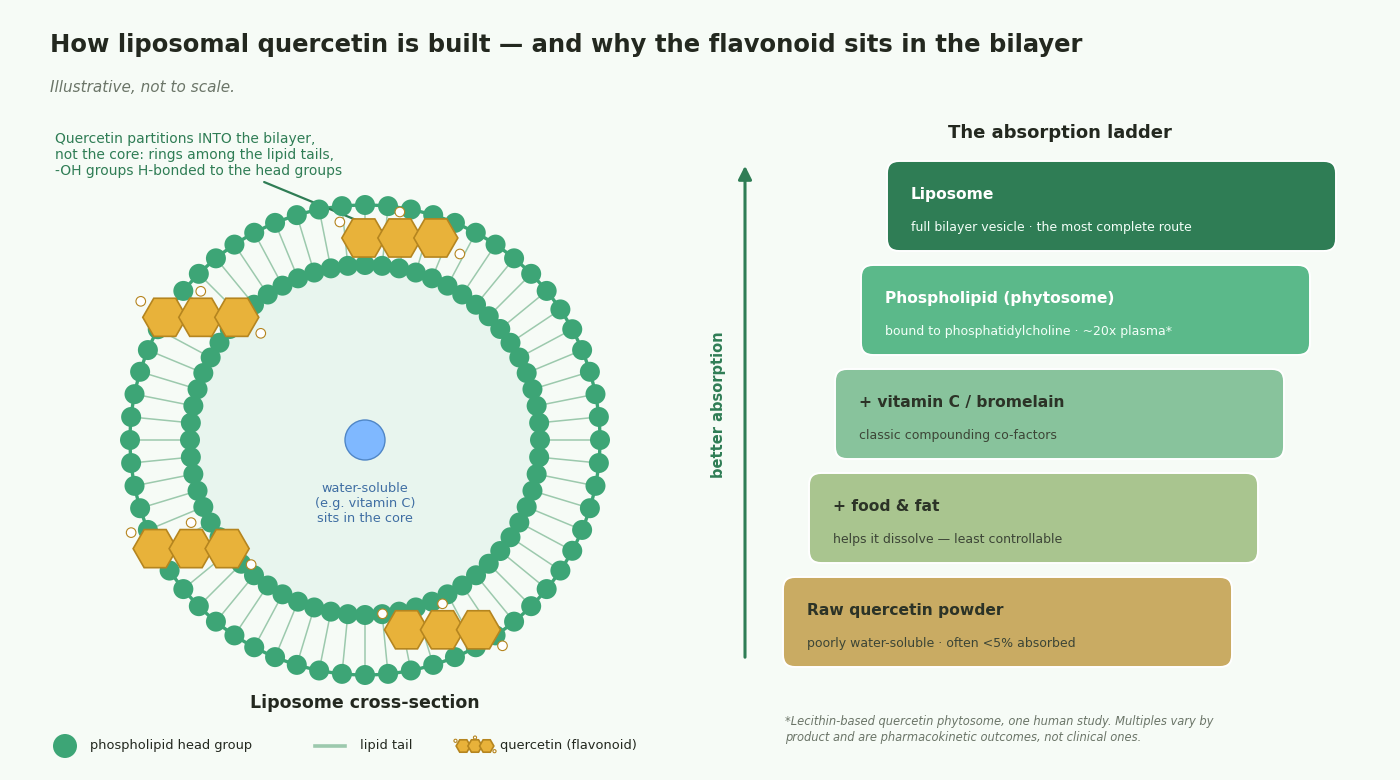
Short answer: Quercetin is one of the clearest examples in the supplement world of a promising molecule held back by poor delivery. It is a flavonoid that dissolves badly in water, is heavily metabolised in the gut wall and liver within minutes of being absorbed, and is cleared quickly — so only a small fraction of a standard oral dose, often cited as under five per cent, ever reaches the circulation. This is an absorption problem, not a dosing one, and "take more" runs straight into the same solubility wall. The strategies that genuinely change the picture all work by solving that solubility: taking it with food and fat, pairing it with co-factors such as vitamin C or bromelain, binding it to a phospholipid (a phytosome), and — the most complete of these — building it into a liposome. Because quercetin is poorly water-soluble, it does not sit contentedly in the watery centre of a vesicle the way vitamin C does; it associates with the phospholipid bilayer itself, tucking in among the lipid tails and hydrogen-bonding to the head groups, which is a more natural home for it. That match between the active and the carrier is exactly why a well-made liposome suits this particular flavonoid. Lynnity's two core capabilities sit right here: liposomal supplement formulations built in-house with ultrasonic technology, and specialised creams in a skin-identical lipid base. Retail quercetin is on every shelf in Malaysia; a Lynnity compounded preparation is a different thing entirely — individualised in strength and form, and prepared only on a prescription from a registered doctor, under the Ministry of Health's Good Compounding Practice (GCP) guideline.
Compounded Liposomal Quercetin in Malaysia: A Practitioner’s Guide to Bioavailability, Mast-Cell Support and When It’s Prescribed
Quercetin is one of the most-requested botanical actives in integrative, allergy and functional practice across Kuala Lumpur, the Klang Valley and Singapore. Practitioners who already recommend it arrive at the same frustration: the literature on what quercetin does is vast, but the literature on getting it absorbed is where the clinical conversation actually lives. This guide is for prescribers who want to understand the delivery problem well enough to specify a preparation, rather than accept whatever a retail bottle contains.
Why quercetin is a textbook bioavailability problem
Quercetin is a polyphenolic flavonoid — the pigment family that colours onion skin, apples and capers — and like many flavonoids it is only sparingly soluble in water. That single property drives everything downstream. Poor aqueous solubility limits how much can dissolve and present to the intestinal wall; what is absorbed is then subject to extensive first-pass metabolism — glucuronidation and sulfation in the gut wall and liver — and to rapid elimination. Reviews of quercetin pharmacokinetics have described its oral bioavailability as low for years, with figures for unenhanced quercetin commonly cited below five per cent. The reasons are consistent across the literature: low solubility, instability at intestinal pH, rapid metabolism and quick clearance.
The practical consequence is the one a clinic cares about. A patient on a standard quercetin dihydrate capsule may be absorbing only a small fraction of the labelled dose, and simply raising the milligrams meets the same solubility ceiling. The interesting clinical lever is not the number on the label — it is the delivery system around it.
The enhancement ladder: food, co-factors, phospholipid, liposome
There is a recognised progression of strategies for making quercetin more absorbable, and it is worth walking a prescriber up it, because each rung explains the next.
Take it with food and fat. Co-ingesting quercetin with a meal, and with some fat, improves how much dissolves and is carried across the gut. It is the simplest intervention and the least controllable.
Pair it with co-factors. Quercetin is traditionally paired with vitamin C and bromelain — the rationale being complementary antioxidant chemistry and, for bromelain, a proteolytic effect some practitioners feel supports tolerability. A compounding pharmacy can make these choices deliberately, rather than leaving them to a retail blend.
Bind it to a phospholipid. A phospholipid complex — often described as a phytosome — pairs quercetin with phosphatidylcholine to produce a far more lipid-compatible, dispersible molecule that absorbs better than raw powder. A well-studied lecithin-based quercetin phytosome has been reported to raise plasma quercetin markedly — on the order of twenty-fold over standard quercetin in human volunteers in one study.
Build it into a liposome. The most complete strategy encloses quercetin in a full phospholipid vesicle, improving its solubility and shielding it from premature breakdown. Reported plasma advantages over standard quercetin depend heavily on how the vesicle is made.
Two honest caveats belong with those numbers. First, the multiples vary enormously between products and track the quality of the delivery system, not the milligrams on the label. Second, and more important, higher plasma exposure is a pharmacokinetic outcome, not a clinical one — better absorption is not itself a treatment for anything, and nothing here should be read as a claim that it is.
Where a poorly-soluble flavonoid sits in the vesicle
A liposome is a vesicle whose wall is a phospholipid bilayer — the same architecture as a cell membrane — enclosing a watery centre. A water-soluble molecule such as ascorbate sits in that aqueous core. Quercetin behaves differently: being poorly water-soluble and mildly lipophilic, it partitions into the bilayer itself, its ring system tucking among the fatty acyl chains while its hydroxyl groups hydrogen-bond to the phospholipid head groups at the membrane surface. That is not a workaround; it is the flavonoid finding the part of the vesicle it is chemically most comfortable in — which is why the structure diagram for this article shows quercetin seated in the bilayer, not the core.
Why how the vesicle is made decides what it does
A bottle marked "liposomal" and a compounded liposomal preparation are not the same claim. Vesicle size and uniformity determine whether a liposome behaves as intended or simply disperses in the gut. Lynnity builds its liposomes with ultrasonic technology: high-frequency sound waves create and collapse microscopic cavities throughout the lipid dispersion, and those micro-implosions shear the lipid into small, uniform vesicles at an energy density beyond ordinary mechanical mixing. The process is designed to yield a consistent vesicle population from batch to batch. We describe what the technology does; we attach no absorption multiple or health outcome to it.
What practitioners actually reach for quercetin for
This is the section that most needs careful language, because quercetin's popularity runs ahead of its proof. What follows is how the molecule is described in the research literature and how clinicians tend to use it — not a promise of results, and not a treatment claim for any condition.
Quercetin's most-discussed property is mast-cell stabilisation. In laboratory studies it has been reported to reduce the release of histamine and inflammatory mediators from mast cells, and one frequently cited in-vitro comparison found it more effective than cromolyn at blocking cytokine release from human mast cells. Mechanistic reviews describe several parallel actions — dampening histamine release, suppressing pro-inflammatory cytokines and reducing leukotriene formation — which is why quercetin appears so often in discussions of seasonal allergic rhinitis, histamine intolerance and mast-cell activation. Much of this evidence is preclinical or early and human trial results are mixed, so it is best framed to patients as supportive and individual rather than established.
Two practical points follow. First, because quercetin is thought to stabilise mast cells preventively rather than block histamine after the fact, practitioners commonly start it two to four weeks ahead of a patient's typical allergy season rather than at the first sneeze. Second, its poor absorption matters most precisely here: a mast-cell effect shown in a laboratory dish means little if the oral dose never reaches meaningful circulating levels — which loops the conversation straight back to delivery.
Where compounding changes the conversation
Retail quercetin arrives in fixed strengths, with a manufacturer's excipients and, often, an undisclosed enhancement approach. A prescription-led compounding pharmacy addresses each of those variables directly.
Dose granularity. Supplemental quercetin is commonly used around 500–1,000 mg daily, often split into two doses; a compounded preparation can be made to a specified strength and schedule, allowing deliberate titration instead of whatever a retail capsule fixes.
The liposomal route. For prescribers who want exposure beyond a standard capsule, a liposomal preparation built to a defined specification is the direct answer to the solubility problem described above.
Rational combination. Quercetin is rarely alone on a plan — vitamin C and bromelain are its classic partners. Where a clinician wants compatible actives together in a single preparation, that consolidation is exactly what nutritional compounding does, subject to compatibility and stability assessment by our pharmacists.
Excipient and allergen control. This matters more than usual for the very patients drawn to quercetin: someone managing histamine or allergy issues is often sensitive to dyes, fillers and other excipients. Sugar-free, dye-free and allergen-conscious preparations are available where the history requires it.
The safety points that stay with the prescriber
Quercetin is well tolerated by most people at usual supplemental doses, which is exactly why the genuine cautions get overlooked. All of them are prescriber-level questions rather than shelf decisions.
Drug interactions. The best-documented is with warfarin: quercetin can inhibit CYP2C9, the enzyme that clears warfarin, so the combination warrants caution and monitoring. Interactions have also been raised with quinolone antibiotics and ciclosporin, and with other medicines handled by CYP enzymes and drug transporters. The full medicines list belongs with the prescriber for exactly this reason.
Kidney status and other populations. Caution is advised in people with existing kidney disease, and safety has not been established in pregnancy, breastfeeding or childhood — all reasons these preparations are individualised and doctor-directed rather than bought off a shelf.
High doses and duration. Adverse effects at 500–1,000 mg daily are uncommon and usually mild — gastrointestinal upset or headache — but robust safety data for high doses (≥1,000 mg) taken beyond about twelve weeks are limited, so extended high-dose use is a considered clinical decision rather than a default.
None of these is a reason to avoid quercetin. They are reasons the preparation belongs on a prescription rather than in a shopping basket.
How a clinic works with us
Every Lynnity preparation, supplements included, is made only on a prescription from a registered doctor after assessment. There is no direct-purchase route. A clinic in KL, the Klang Valley or Singapore typically speaks with one of our pharmacists first, to establish which forms, strengths, liposomal specifications and beyond-use dates are achievable, then sends the prescription. Formulations are compounded under the Ministry of Health's Good Compounding Practice (GCP) guideline.
Frequently asked questions
Why does my patient's standard quercetin capsule seem to do so little?
Most likely absorption, not dose. Quercetin dissolves poorly in water, is heavily metabolised in the gut wall and liver, and is cleared quickly, so only a small fraction of a standard oral dose — often cited below five per cent — reaches the circulation. Raising the milligrams meets the same solubility wall; the delivery system is the lever that matters.
Does liposomal or phytosome quercetin absorb better than standard quercetin?
Reported pharmacokinetic studies generally favour enhanced-delivery quercetin over raw powder. A lecithin-based quercetin phytosome has been reported to raise plasma quercetin markedly — on the order of twenty-fold over standard quercetin in one human study — and liposomal systems improve solubility and protect the molecule. The range is wide because vesicle quality varies enormously, and higher absorption is a pharmacokinetic finding, not a clinical claim.
Does quercetin sit in the watery core of a liposome or in the bilayer?
In the bilayer. Because quercetin is poorly water-soluble and mildly lipophilic, it partitions into the phospholipid layer itself — its ring system tucking among the fatty tails while its hydroxyl groups hydrogen-bond to the head groups at the membrane surface — rather than floating free in the aqueous centre the way vitamin C does.
What do clinicians use quercetin for?
In the research literature quercetin is most discussed as a mast-cell stabiliser, described in laboratory studies as reducing histamine release and inflammatory mediators, and it appears in discussions of seasonal allergic rhinitis, histamine intolerance and mast-cell activation. Much of this evidence is preclinical or early and human results are mixed, so it is best framed to patients as supportive and individual rather than established. It is not a treatment for any disease.
Which patients need a prescriber's judgement before quercetin?
At least those on warfarin or other anticoagulants (quercetin can inhibit CYP2C9), those on quinolone antibiotics or ciclosporin, anyone on narrow-therapeutic-index medicines handled by CYP enzymes, people with existing kidney disease, and those who are pregnant, breastfeeding or children, where safety is not established. These are reasons a compounded quercetin preparation is dispensed on a doctor's prescription.
Can Lynnity prepare a liposomal quercetin, and combine it with vitamin C or bromelain?
Yes. Liposomal supplement formulation is one of our two core capabilities, and the liposomes are built in-house with ultrasonic technology. Quercetin is traditionally paired with vitamin C and bromelain, and compatible actives can be consolidated into a single made-to-prescription preparation, subject to compatibility and stability assessment by our pharmacists. Strength and form follow the prescription, and no absorption or outcome promise is attached.
We run a clinic in KL or Singapore — how do we start?
Contact us through lynnitypharma.com and ask to speak with a pharmacist. We can talk through achievable forms, strengths, liposomal specifications and beyond-use dating before your first prescription is sent. Every preparation, supplements included, is made only on a prescription from a registered doctor.
Reviewed by the Lynnity pharmacy team — registered pharmacists compounding to Good Compounding Practice (GCP) in Kuala Lumpur.
This article is general information for healthcare practitioners and is not medical advice. It does not diagnose, treat or recommend therapy for any condition. Compounded quercetin preparations at Lynnity are prepared only on a prescription from a registered doctor.