
Short answer: Palmitoylethanolamide (PEA) is a fatty-acid amide the body makes in its own tissues in response to injury and inflammation. It works through the same anti-inflammatory and pain-modulating machinery as the endocannabinoid system without being a cannabinoid, and it has accumulated a genuinely respectable trial record: a 2023 meta-analysis of eleven double-blind randomised controlled trials (774 patients) reported a large reduction in chronic pain scores, with a safety profile that is one of PEA’s biggest attractions. The catch is physical. PEA is waxy and poorly water-soluble, so how much reaches the patient depends heavily on its particle size — which is why the strongest trials used micronized or ultramicronized preparations rather than raw powder. That makes PEA a formulation-sensitive molecule, and getting the form and dose right is a prescriber-and-pharmacist decision. Every Lynnity preparation, PEA included, requires a prescription from a registered doctor.
Why pain and neurology clinics are interested
PEA belongs to a family of molecules the body produces on demand to dampen inflammation and pain — an “autacoid local injury antagonist”. Mechanistically it acts largely through the nuclear receptor PPAR-α and by calming over-active mast cells and glial cells, the non-neuronal players increasingly implicated in persistent and neuropathic pain. Clinicians sometimes describe it as working “alongside” the endocannabinoid system rather than on the cannabinoid receptors directly.
The human evidence spans exactly the settings a pain clinic sees: sciatic and low-back pain, diabetic peripheral neuropathy, pelvic and dysmenorrhoeic pain, dental and post-operative pain, and — more recently — neuroinflammatory presentations including long-COVID symptom clusters. Pooled across eleven double-blind trials, the direction and size of effect were consistent.
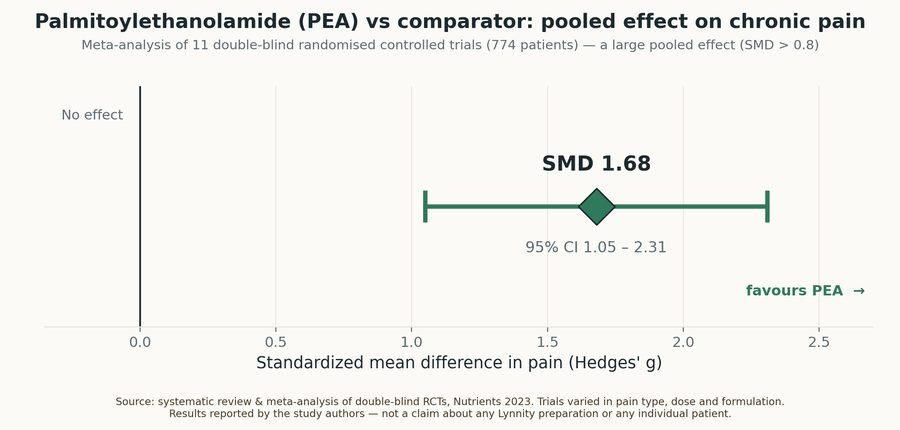
The pooled standardised mean difference was 1.68 (95% confidence interval 1.05 to 2.31) in favour of PEA — a large effect by convention — and, importantly for a real-world adjunct, no major adverse effects were attributed to PEA across the studies. That tolerability is much of the clinical appeal: it makes PEA a candidate to add to a multimodal plan, potentially as an opioid- or NSAID-sparing component, rather than another drug with a difficult side-effect ledger.
The honest framing
These trials differ in pain type, dose and formulation, and a large pooled effect is a reason to consider PEA, not proof it will help any individual. Nothing here is a claim that a compounded preparation treats, prevents or cures any pain condition; PEA is best positioned as a prescriber-directed adjunct whose evidence supports a trial, with review.
The form problem — particle size is the lever
PEA’s chemistry is the reason a compounding pharmacy is relevant. It is lipophilic and essentially insoluble in water, and as a raw crystalline powder it dissolves poorly in the gut. Reducing the particle size to the micron scale — micronization, and further ultramicronization — increases the surface area available for dissolution, and the preparations that carry the strongest randomised evidence are precisely these engineered, small-particle or cold-water-dispersible forms.
It is worth being straight about the debate: some human data have questioned whether micronization is strictly necessary, and at least one trial reported benefit with a non-micronized product. But the weight of the positive RCT evidence sits with micronized and ultramicronized forms, and particle size remains the single most discussed formulation variable for this molecule. For a prescriber, that means the form is not a detail to leave to chance — it is a specification worth making explicitly.
What a compounding pharmacy can control
| Formulation lever | Why it matters for PEA |
|---|---|
| Particle size / dispersibility | A poorly-soluble waxy molecule absorbs better when it is finely divided or made cold-water dispersible — the variable most linked to the positive trials. |
| Exact, titratable dose | Trials commonly used the region of 600–1,200 mg per day, often split. The prescriber can set a starting dose and step it up or down at review, rather than accepting a fixed commercial strength. |
| Combination with luteolin | Co-formulating PEA with the flavonoid luteolin (a pairing studied for neuroinflammation) is a recognised approach a compounding pharmacy can build to a prescriber’s specification. |
| Excipient control | A clean, excipient-aware preparation for patients who react to fillers — a routine strength of compounding. |
Dose, timing and safety
Most trials have used PEA in the range of about 600 to 1,200 mg per day, frequently as 300–600 mg twice daily, sometimes loading higher for the first weeks and then reducing. The onset is gradual — benefit typically builds over weeks rather than hours — which is worth setting as an expectation with the patient. The exact regimen for an individual is a prescriber’s decision.
PEA’s safety record is a genuine strength: across the randomised literature it has been very well tolerated, with no significant adverse effects attributed to it and no clinically important drug interactions established. As with any supplement, data in pregnancy and lactation are limited, and it should complement rather than replace a properly worked-up pain diagnosis and plan. These points, again, are reasons for a prescriber to be in the loop.
What Lynnity can prepare — and what it cannot
Lynnity compounds to a doctor’s prescription in capsule, liquid, cream, tonic and serum forms, under Good Compounding Practice (GCP). For PEA the practical routes are:
- Two-piece capsule — finely-divided PEA at the prescriber’s dose, the workhorse for a titratable regimen.
- Oral liquid or a measured powder dispersed into liquid — useful for higher doses, for gradual titration, or where swallowing capsules is difficult.
- Combination preparation — for example PEA with luteolin, where the prescriber wants the pairing in one formulation.
What Lynnity does not make is a compressed tablet or a softgel. For PEA a finely-divided capsule or a dispersed liquid is in any case the more sensible route, because it is particle size and dispersibility — not a hard tablet shell — that determine whether the molecule is absorbed.
Practical notes for prescribers
- Specify the form. Ask for micronized or finely-divided / dispersible PEA rather than raw powder; it is the variable most tied to the positive evidence.
- Set a titration. A common pattern is a higher initial daily dose for the first few weeks, then a maintenance dose — compounding lets you write it exactly.
- Set expectations on timing. Benefit builds over weeks; review at 4–8 weeks rather than expecting an immediate effect.
- Use it as an adjunct. PEA’s tolerability makes it a candidate to layer onto a multimodal plan, not a stand-alone replacement for a diagnosis.
- Storage. Cool and dry, and observe the beyond-use date.
Working with Lynnity
Lynnity Compounding Pharmacy is based in Kuala Lumpur and works with clinics across the Klang Valley and with practitioners in Singapore. Every preparation — including nutritional and supplement formulations — is made only against a prescription from a registered doctor. Lynnity does not hold MAL registration for compounded preparations, does not sell direct to patients without a prescription, and does not do contract manufacturing.
Practitioners who want to discuss a PEA formulation — particle size, a starting dose and titration, or a combination with luteolin — can contact the pharmacy to talk it through with a compounding pharmacist before writing.
Frequently asked questions
What is PEA and how does it work?
Palmitoylethanolamide is a fatty-acid amide the body produces in its own tissues in response to injury and inflammation. It acts largely through the receptor PPAR-α and by calming over-active mast cells and glial cells, and is often described as working alongside the endocannabinoid system without being a cannabinoid.
What does the research on PEA show?
A 2023 meta-analysis of eleven double-blind randomised controlled trials (774 patients) reported a large pooled reduction in chronic pain scores (standardised mean difference 1.68), with no major adverse effects attributed to PEA. Trials span sciatica, diabetic neuropathy, pelvic pain and other settings. The effect is a reason to consider a supervised trial, not proof of benefit for any individual, and nothing here is a claim to treat or cure any condition.
Why does the “micronized” form matter?
PEA is waxy and poorly water-soluble, so as a raw powder it dissolves and absorbs poorly. Reducing particle size to the micron scale (micronized, ultramicronized) increases surface area for dissolution, and the strongest randomised evidence used these small-particle or cold-water-dispersible forms. Some data question whether micronization is essential, but particle size remains the key formulation variable.
Why does PEA need a prescription at Lynnity?
Every Lynnity preparation requires a prescription from a registered doctor, supplements included. With PEA there is an added reason: the form and dose that decide whether it works are clinical decisions, and PEA is best used as part of a properly worked-up pain plan rather than self-directed.
Is PEA safe, and does it interact with medicines?
PEA has been very well tolerated across the randomised literature, with no significant adverse effects attributed to it and no clinically important interactions established, which is much of its appeal as an adjunct. Data in pregnancy and lactation are limited. Dose for an individual is a prescriber’s decision.
Can PEA be combined with other actives?
Yes. A recognised example is PEA with the flavonoid luteolin, studied for neuroinflammation. Where the prescriber wants a combination, a compounding pharmacy can build it to specification in a single preparation.
Can Lynnity supply PEA as a tablet or softgel?
No. Lynnity compounds in capsule, liquid, cream, tonic and serum forms only. For PEA a finely-divided capsule or a dispersed liquid is the better route in any case, because particle size and dispersibility — not a tablet shell — determine absorption.
Sources
- Palmitoylethanolamide in the treatment of chronic pain: a systematic review and meta-analysis of double-blind randomised controlled trials. Nutrients 2023;15(6):1350: ncbi.nlm.nih.gov
- Palmitoylethanolamide supplementation for human health: a state-of-the-art systematic review of RCTs in patient populations. ScienceDirect / PMC 2024: ncbi.nlm.nih.gov
- Gabrielsson L, Mattsson S, Fowler CJ. Palmitoylethanolamide for the treatment of pain: pharmacokinetics, safety and efficacy. Br J Clin Pharmacol 2016: ncbi.nlm.nih.gov
- Petrosino S, Di Marzo V. The pharmacology of palmitoylethanolamide and micronised formulations. Br J Pharmacol 2017: ncbi.nlm.nih.gov