
Short answer: Nattokinase is a fibrinolytic enzyme purified from natto, the fermented-soybean food, and it is one of the few “cardiovascular” supplements with genuine randomised-trial evidence — most solidly for a modest reduction in blood pressure. It is also a protein, which means the stomach is its biggest enemy: nattokinase is acid- and heat-labile, so an unprotected capsule can arrive in the gut with much of its activity already lost. On top of that, the enzyme is dosed in fibrinolytic units (FU), not milligrams, and independent testing has repeatedly found retail products that fall short of their labelled FU. The practical result is the recurring Lynnity theme: with nattokinase, the form — enteric protection, a verified FU dose, and vitamin K removal where it matters — decides what the patient actually receives. Every Lynnity preparation, nattokinase included, is made only against a prescription from a registered doctor.
Why prescribers are paying attention
Nattokinase (from Bacillus subtilis var. natto) is a serine protease of about 275 amino acids. Its interest to clinicians is mechanistic and unusually direct: it cleaves fibrin itself, and it also pushes the body’s own clot-clearing system — degrading plasminogen activator inhibitor‑1 (PAI‑1), supporting tissue plasminogen activator (t‑PA) activity, and raising circulating plasmin. In short-term human studies a single oral dose has shifted fibrinolytic and coagulation markers (for example a rise in D‑dimer and a fall in fibrinogen), which is why cardiologists, longevity clinicians and integrative practitioners keep asking about it.
The honest framing
The strongest clinical signal is for blood pressure. In a randomised, double-blind, placebo-controlled trial of 86 adults with pre- to stage-1 hypertension, 2,000 FU/day for eight weeks produced a net reduction of about 5.55 mmHg systolic and 2.84 mmHg diastolic versus placebo. A 2023 systematic review and meta-analysis of six randomised trials (546 participants) confirmed the direction — pooled reductions of roughly 3.45 mmHg systolic and 2.32 mmHg diastolic — while finding no convincing lipid-lowering effect at the low doses tested. Carotid-plaque data exist (a 26-week study reported reductions in intima-media thickness and plaque area at 6,500 FU/day) but that trial lacked a placebo arm, so it should be read as hypothesis-generating, not proof. None of this licenses a disease claim. What the evidence does establish is narrower and more useful to a formulator: the response depends on delivering a real, active FU dose — and that is a formulation problem.
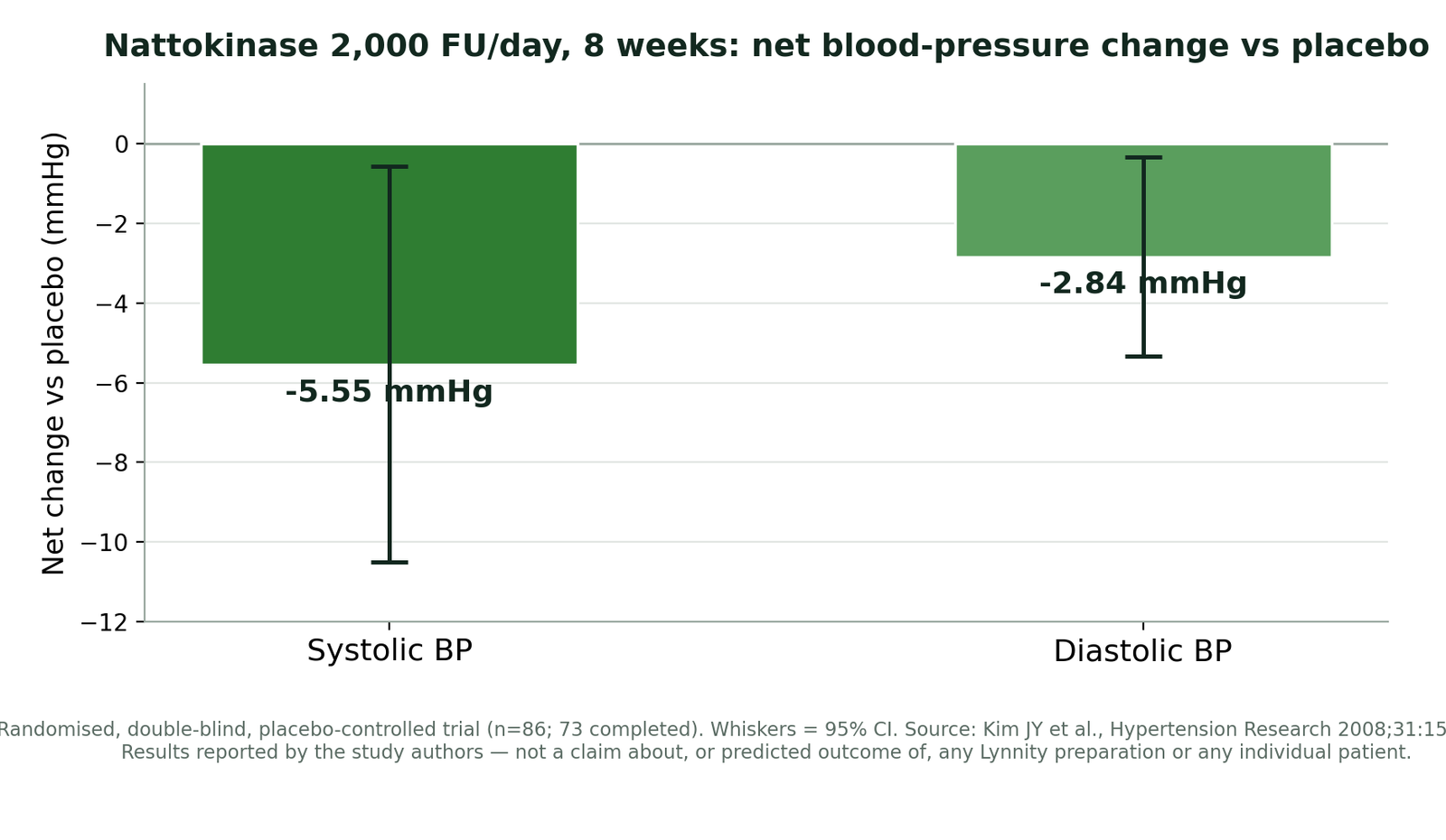
Net blood-pressure change vs placebo, nattokinase 2,000 FU/day for 8 weeks (randomised, double-blind, placebo-controlled; n=86, 73 completed). Whiskers = 95% CI. Source: Kim JY et al., Hypertension Research 2008;31:1583–1588. These are results reported by the study authors — not a claim about, or a predicted outcome of, any Lynnity preparation or any individual patient.
The formulation problem — and why it is the whole story
Three things stand between a nattokinase label and a therapeutic dose in the patient, and all three are formulation decisions rather than marketing:
1. It is acid-labile. Nattokinase is a protein enzyme; stomach acid and pepsin can denature it before it is absorbed. An unprotected capsule leaves the enzyme exposed. Enteric protection — a capsule that holds together through the stomach and releases in the small intestine — is the single biggest lever for how much active enzyme survives.
2. Its potency is in FU, and labels are often wrong. Nattokinase is standardised in fibrinolytic units (FU), not milligrams, because two products of identical weight can differ hugely in activity. Independent surveys of retail nattokinase have repeatedly found products delivering well below their stated FU. A “2,000 FU” claim on a shelf pack is only as good as the assay behind it — which the patient cannot see.
3. Natto is rich in vitamin K2. The food nattokinase comes from is one of the richest known sources of menaquinone-7 (vitamin K2). For most people that is incidental; for a patient on warfarin it is a direct antagonist of their therapy. Pharmaceutical-grade nattokinase should be vitamin K-depleted — and knowing whether it is, is again a quality question a label rarely answers.
What a compounding pharmacy can actually control
This is the rare case where the compounding rationale is the whole point, not a slogan. To a prescriber’s specification, a compounding pharmacy can:
| Formulation lever | Why it matters for nattokinase |
|---|---|
| Enteric protection | Shields the acid-labile enzyme through the stomach so more active nattokinase reaches the small intestine — the biggest determinant of delivered activity. |
| Verified FU dose | The prescriber sets a defined fibrinolytic-unit dose from assayed raw material, instead of trusting an unverified label number. |
| Vitamin K-depleted material | Allows a warfarin patient (where a prescriber judges nattokinase appropriate at all) to avoid the menaquinone-7 load that comes with natto. |
| Gentle, low-heat handling & storage | Heat also denatures the enzyme; cool, dry, controlled preparation and a sensible beyond-use date protect activity. |
| Rational combinations | Where the prescriber wants it, nattokinase can be compounded alongside a compatible active in one preparation — after the enteric-and-FU core is right. |
Dose, timing and safety
Most human trials have used 2,000 FU/day, with some plaque work at higher doses; the exact dose for an individual is a prescriber’s decision, which is one reason to compound rather than accept whatever a brand chose. Nattokinase is generally well tolerated, with mild gastrointestinal effects the most common report.
The safety story that matters is bleeding risk. Because nattokinase is fibrinolytic, it can add to the effect of anticoagulants (warfarin, direct oral anticoagulants) and antiplatelets (aspirin, clopidogrel), and it should be used with real caution — or not at all — in patients with bleeding disorders, active peptic ulcer, recent haemorrhagic stroke or recent surgery. It should be stopped well before any planned surgery or dental extraction, and data in pregnancy and lactation are insufficient to recommend use. These are precisely the situations where a prescriber, not a shelf, should be making the call.
What Lynnity can prepare — and what it cannot
Lynnity compounds to a doctor’s prescription in capsule, liquid, cream, tonic and serum forms, under Good Compounding Practice (GCP). For nattokinase the practical routes are:
- Enteric-protected capsule — assayed nattokinase at a defined FU dose, protected from stomach acid. The workhorse.
- Oral liquid or tonic — where a measured dose is preferred or capsules are difficult, formulated and dosed to protect enzyme activity.
What Lynnity does not make is a compressed tablet or a softgel — and for a delicate enzyme that is an advantage, not a limitation. High-compression tableting and the heat involved in some processes are exactly the conditions that jeopardise activity; a gently made, enteric-protected capsule is the more sensible route, and it lets the prescriber — not a factory — set the FU dose.
Practical notes for prescribers
- Specify FU, not milligrams. Set a defined fibrinolytic-unit dose (trials cluster around 2,000 FU/day) and ask for enteric protection explicitly.
- Screen the medication list. Anticoagulants and antiplatelets are the key interaction; nattokinase adds to their effect.
- Warfarin patients. If nattokinase is used at all, insist on vitamin K-depleted material and close INR review — or avoid it.
- Surgery. Discontinue well ahead of any planned procedure.
- Storage. Cool and dry, and observe the beyond-use date — heat is the enzyme’s enemy.
Working with Lynnity
Lynnity Compounding Pharmacy is based in Kuala Lumpur and works with clinics across the Klang Valley and with practitioners in Singapore. Every preparation — including nutritional and supplement formulations — is made only against a prescription from a registered doctor. Lynnity does not hold MAL registration for compounded preparations, does not sell direct to patients without a prescription, and does not do contract manufacturing.
Practitioners who want to discuss a nattokinase formulation — the FU dose, enteric protection, vitamin K-depleted material, or a combination with a compatible active — can contact the pharmacy to talk it through with a compounding pharmacist before writing.
Frequently asked questions
Why can’t a patient just buy nattokinase off the shelf?
They can, but two things a label rarely guarantees decide whether it works: whether the acid-labile enzyme is protected from stomach acid, and whether the product actually contains the fibrinolytic units (FU) it claims. Independent testing has repeatedly found retail nattokinase below its labelled activity. Compounding lets a prescriber set a verified FU dose in an enteric-protected form.
What does the evidence actually show?
The clearest signal is a modest blood-pressure reduction: a randomised placebo-controlled trial found about 5.55 mmHg systolic and 2.84 mmHg diastolic at 2,000 FU/day over eight weeks, and a 2023 meta-analysis of six trials confirmed the direction. Lipid-lowering was not convincingly shown at low doses, and carotid-plaque data come from a study without a placebo arm. Nothing here is a claim that a compounded preparation treats, prevents or cures any disease.
Is nattokinase measured in milligrams or FU?
In fibrinolytic units (FU). Two products of the same weight can differ greatly in activity, so the FU figure — backed by an assay — is what matters, not the milligram number.
Can nattokinase be taken with blood thinners?
This is the central caution. Nattokinase is fibrinolytic and can add to the effect of anticoagulants and antiplatelets, increasing bleeding risk. It should only be considered under a prescriber who is managing that interaction, and it should be stopped before surgery. It is not suitable for people with bleeding disorders or recent haemorrhage.
Does nattokinase affect warfarin through vitamin K?
It can. Natto is very rich in vitamin K2, which antagonises warfarin. Pharmaceutical-grade nattokinase should be vitamin K-depleted; for a warfarin patient this is a quality point a prescriber must confirm, on top of the bleeding-risk interaction.
Why does nattokinase need a prescription at Lynnity?
Every Lynnity preparation requires a prescription from a registered doctor, supplements included. With nattokinase there is an added reason: the bleeding-risk interactions and the warfarin/vitamin K question make it a clinical decision, and the formulation choices that decide whether the patient gets an active dose are best set by a prescriber.
Can Lynnity supply nattokinase as a tablet or softgel?
No. Lynnity compounds in capsule, liquid, cream, tonic and serum forms only. For a heat- and acid-sensitive enzyme, a gently made, enteric-protected capsule is the better route in any case.