
The problem with milk thistle isn’t the plant — it’s absorption
Milk thistle (Silybum marianum) is one of the most requested “liver” botanicals in Malaysian pharmacies, and clinics in the Klang Valley field the question constantly — usually alongside a fatty-liver result on an ultrasound or a raised ALT on a routine panel. It is a fair question to take seriously: metabolic dysfunction-associated steatotic liver disease (MASLD, the condition previously called NAFLD) is now strikingly common here. A cross-sectional study in the Klang Valley found definite MASLD in roughly 37% of the adults screened, with a higher burden among Malay and Indian participants than Chinese.
The catch is pharmacokinetic. The active fraction of milk thistle — a group of flavonolignans collectively called silymarin, of which silybin (silibinin) is the principal component — is poorly water-soluble, unstable in the gut, and rapidly conjugated and excreted. Even under favourable conditions only a modest fraction of an oral dose is absorbed, and the free, active silybin that actually reaches the circulation is lower still. Two consequences follow for a prescriber: a retail capsule labelled “1000 mg milk thistle” may deliver very little usable silybin, and results are hard to reproduce when extract standardisation and delivery vary from product to product.
“Silymarin” and “silybin” are not interchangeable labels
This matters at the point of prescribing. Silymarin is the whole flavonolignan complex; silybin is the single most-studied active within it. When the literature reports an effect, it is almost always tied to a defined silybin dose in a defined form — so “which milk thistle, standardised to what, in what delivery?” is the clinically meaningful question, not simply “milk thistle: yes or no?”
How silybin works in the liver (pharmacology)
Silybin’s hepatoprotective activity is well characterised in pharmacology reviews, and is usually described as working in four complementary ways. First, it is an antioxidant — it scavenges reactive oxygen species and helps regulate the hepatocyte’s intracellular glutathione, blunting the lipid peroxidation that drives steatohepatitis. Second, it acts as a membrane stabiliser, tightening hepatocyte membrane permeability so that membrane-acting toxins are less able to enter the cell — the classical rationale behind its historical use in Amanita mushroom poisoning. Third, it is anti-fibrotic: it targets hepatic stellate cells, the cells that once activated into myofibroblasts lay down the collagen of fibrosis, and has been shown in human stellate-cell and animal models to blunt that activation. Fourth, it promotes ribosomal RNA synthesis in hepatocytes, supporting the liver’s own regeneration. Layered on top is an anti-inflammatory action — dampening NF-κB-driven cytokine signalling and Kupffer-cell activation. These are mechanistic and largely pre-clinical findings: they explain why the molecule is studied in liver disease and how it behaves in the body, not a guaranteed outcome for any individual patient.
What the trial evidence actually shows in fatty liver
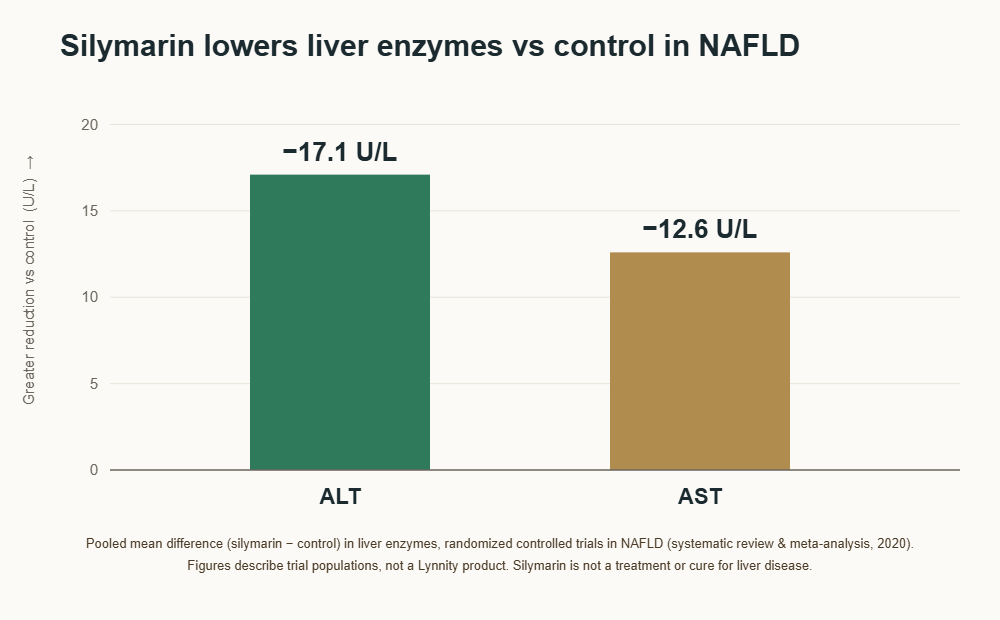
The evidence in MASLD/NAFLD is genuinely promising, while still short of definitive. Across randomised controlled trials pooled in systematic review, silymarin has been associated with lower liver transaminases versus control, with typical reported reductions on the order of a mid-teens drop in ALT and a slightly smaller drop in AST — alongside signals of improved lipids, fasting insulin and insulin resistance (HOMA-IR).
The most instructive single trial for a compounding conversation is the 12-month randomised controlled trial of a silybin–phosphatidylcholine complex co-formulated with vitamin E in 180 patients with histologically proven NAFLD. Over a year, the phospholipid-complexed silybin arm — but not placebo — was associated with improvements in ALT, AST and GGT, in insulin resistance, and in liver histology in roughly half of treated patients, without weight gain. The point for prescribers is not that any capsule “works,” but that the arm that improved used the phospholipid-bound silybin, not a plain extract. Delivery was doing real work.
Why the phospholipid (liposomal) form is the whole story
Because silybin is fat-loving and poorly absorbed, binding it to phosphatidylcholine — the same class of phospholipid that makes up your own cell membranes — helps it cross the gut lining intact. Reported gains are meaningful: complexation has been shown to raise silybin’s oral bioavailability by roughly four- to six-fold versus standard silymarin in comparative studies, which is precisely the gap between “labelled dose” and “delivered dose” that frustrates clinicians. A liposomal preparation extends the same principle, enclosing the active in a phospholipid shell. If you would like the underlying science, our explainer on the science of liposomal delivery covers how these vesicles are built and why uniformity matters.
One honest limitation: “liposomal” and “phytosome” are used loosely on consumer shelves, and a label alone is no guarantee that a true phospholipid complex is present — one reason a prescriber may prefer a preparation made to a defined standard over an opaque commercial one.
Where a compounding pharmacy fits
A retail softgel comes as a fixed strength, a fixed delivery and a fixed excipient list chosen for a general population. Compounding lets the prescriber specify the preparation to the patient instead. In practice that means a doctor can:
- Standardise to silybin, not just to a vague “milk thistle” weight, so the dose is defined.
- Choose a phospholipid-complexed or liposomal delivery, matching the form that carries the better absorption and trial data.
- Co-formulate rationally — for example with vitamin E, as in the landmark NAFLD trial — where clinically appropriate and compatible.
- Set the strength to the patient, titrating against liver panels and tolerance rather than accepting an off-the-shelf number.
- Exclude specific excipients for sensitive or allergic patients, and select a form the patient will actually take.
Delivery forms Lynnity can prepare
For a liver-support preparation the practical, permitted options are an oral capsule of phospholipid-complexed or liposomal silybin, or the same active dispersed into an oral liquid or tonic for patients who prefer not to swallow capsules. A measured silybin powder dispersed into a liquid is equally workable. We do not supply tablets or softgels, and the phospholipid-complex approach is chosen precisely because it is designed to carry more of the active across the gut than a plain extract would.
Safety, cautions and interactions
Silymarin is generally well tolerated in trials, with mild gastrointestinal upset the most common complaint. The clinically important considerations are interactions and suitability rather than acute toxicity: silybin can influence drug-metabolising enzymes and transporters, so caution is warranted in patients on medicines with a narrow therapeutic margin, and formal review is sensible for anyone on multiple prescriptions. People allergic to the Asteraceae family (ragweed, daisy, marigold, chrysanthemum) can react to milk thistle. Data in pregnancy and breastfeeding are limited, so use there is a prescriber’s judgement. And silybin is not a rescue therapy — abnormal liver tests or suspected liver disease need a proper diagnostic work-up, not self-directed supplementation. Screening, suitability and dosing are decisions for the prescribing doctor.
The prescriber workflow in KL, Klang Valley and Singapore
Because Lynnity is a compounding pharmacy, every preparation — supplements included — is made only on a prescription from a registered doctor, for a named patient, under Good Compounding Practice. There is no MAL-registered product and no direct-to-patient purchase. The simplest way to start is to speak with our pharmacy team before you write the first prescription: we will go through achievable silybin strengths, which co-formulations can be prepared together, the available delivery forms and beyond-use dating, so the prescription you write is one we can prepare exactly as specified.
Frequently asked questions
Is compounded silymarin available over the counter in Malaysia?
No. Generic milk thistle supplements are sold widely, but a Lynnity compounded silybin preparation is made only on a registered doctor’s prescription, individualised to the patient and prepared under Good Compounding Practice. There is no direct-purchase or “no prescription needed” route with us.
Why prescribe a phospholipid or liposomal silybin rather than a standard milk thistle capsule?
Because plain silybin is poorly absorbed, so much of a labelled dose may never reach the circulation. Binding silybin to phosphatidylcholine has been shown to raise its oral bioavailability roughly four- to six-fold in comparative studies, and the phospholipid-bound form is the one that carries the stronger NAFLD trial evidence. Whether that is clinically worthwhile for a given patient is the prescriber’s judgement.
What does the fatty-liver evidence actually support?
Randomised trials pooled in meta-analysis link silymarin to lower ALT and AST versus control in NAFLD, with signals of improved lipids and insulin resistance, and a 12-month trial of silybin–phosphatidylcholine plus vitamin E showed enzyme and histology improvements in about half of treated patients. This is a supportive, adjunctive signal — not proof of cure, and not a replacement for managing the metabolic drivers.
Is silybin a treatment for fatty liver or hepatitis?
No. Lynnity does not prepare or promote silybin as a treatment or cure for any liver condition. It is prepared only for a doctor-assessed, prescription-led purpose, as an adjunct alongside proper medical management of the underlying cause.
What delivery forms can Lynnity prepare it in?
An oral capsule of phospholipid-complexed or liposomal silybin, or the active dispersed into an oral liquid or tonic. We do not supply tablets or softgels.
Which patients need extra caution?
Those on medicines with a narrow therapeutic margin or on several prescriptions at once, because silybin can affect drug-metabolising enzymes and transporters; anyone allergic to the Asteraceae/daisy family; and patients who are pregnant or breastfeeding, where evidence is limited. Abnormal liver tests always warrant a diagnostic work-up first.
We run a clinic in KL — how do we start prescribing through Lynnity?
Visit www.lynnitypharma.com and ask to speak with a pharmacist. We can talk through achievable silybin strengths, phospholipid and liposomal options, delivery forms and beyond-use dating before your first prescription is sent.
Reviewed by the Lynnity pharmacy team — registered pharmacists compounding to Good Compounding Practice (GCP) in Kuala Lumpur.
This article is general information for healthcare practitioners and is not medical advice. It does not diagnose, treat or recommend therapy for any condition, and it makes no disease-treatment claim. Silybin and silymarin preparations at Lynnity are prepared only on a prescription from a registered doctor.