
Short answer: Butyrate is the short-chain fatty acid that colonic bacteria make from dietary fibre, and it is the preferred fuel of the cells lining the colon — by common estimates supplying the majority of their energy. Patients with irritable bowel syndrome, inflammatory bowel disease or a fibre-poor urban diet are repeatedly reported to run low on the bacteria that produce it. The catch is that butyrate cannot simply be swallowed plain: the free acid and its salts carry the smell of rancid butter, and what a patient does manage to swallow is largely absorbed high in the gut, well before the colon that needs it. Every encouraging randomised trial — in IBS as an adjunct, in active ulcerative colitis as an adjunct, and in type 2 diabetes — used a protected form: microencapsulated sodium butyrate or, more recently, tributyrin, a butyrate-carrying triglyceride. No protected butyrate preparation sits on a Malaysian pharmacy shelf. That combination — genuine trial evidence, a delivery problem, and an empty local market — is precisely where prescription-led compounding earns its place: a doctor prescribes, and Lynnity compounds a protected, trial-informed dose as an acid-resistant capsule or a measured oral liquid for that one patient, under Good Compounding Practice (GCP).
Why butyrate is suddenly in every gut conversation
Ask a dietitian or a GP with a gastro-heavy panel what patients bring up after probiotics, and “postbiotics” — the beneficial compounds bacteria produce, rather than the bacteria themselves — now lead the list, with butyrate the poster molecule. The attention has a real base. Butyrate is one of the three main short-chain fatty acids (with acetate and propionate) produced when colonic bacteria such as Faecalibacterium prausnitzii and Roseburia ferment fibre, and studies have repeatedly reported these butyrate-producing species to be depleted in IBS and IBD cohorts and after antibiotic courses. The local relevance is not abstract: Malaysian studies using Rome criteria have reported IBS in roughly one in ten adults — with some university cohorts higher — and constipation-predominant patterns common; low-fibre eating in the Klang Valley needs no citation. For the patient who cannot tolerate the fibre that would feed their own producers — the familiar IBS trap — interest in supplying the end product directly is an entirely reasonable clinical question, and it is the same logic our practitioner readers met in our urolithin A guide: when the microbial producers are missing, the conversation shifts to the metabolite itself.
What butyrate does in the colon
Three mechanisms recur across the literature. First, fuel: colonocytes preferentially burn butyrate, and by frequently cited estimates draw the majority of their energy from it — a starved epithelium is a leakier, more irritable one. Second, signalling: butyrate acts on short-chain fatty acid receptors (GPR41, GPR43, GPR109A) and inhibits histone deacetylases, mechanisms linked in laboratory work to regulatory T-cell induction and a calmer mucosal immune tone. Third, barrier: preclinical studies consistently report tighter junctions and better mucin production with adequate butyrate supply. All three are mechanistic findings — they explain why researchers bothered to run the human trials below, and they should be quoted as rationale, not as promises.
The delivery problem no shelf product solves
Butyric acid is the compound that gives rancid butter its smell — chemistry no marketing can talk around. Plain sodium butyrate powder announces itself the moment the jar opens, repeats on the patient afterwards, and in an unprotected form is largely taken up high in the gut, so that little of a swallowed dose reaches the colon it was meant for. This is why the clinical literature is built almost entirely on protected forms. Microencapsulation seals the salt in a lipid matrix that carries it past the stomach and releases it progressively along the lower gut — this is the form used in the randomised trials from the Polish gastroenterology groups. Tributyrin takes the prodrug route instead: three butyrate units esterified onto glycerol, odour-manageable, cleaved by lipases to release butyrate along the intestine; an early human pilot (29 healthy adults, 2024) reported a tributyrin complex well tolerated with favourable shifts in short-chain fatty acid production. One further point of precision for prescribers, because assistants and search engines blur it: sodium butyrate is not sodium phenylbutyrate, the registered orphan medicine used in urea-cycle disorders — different molecule, different world.
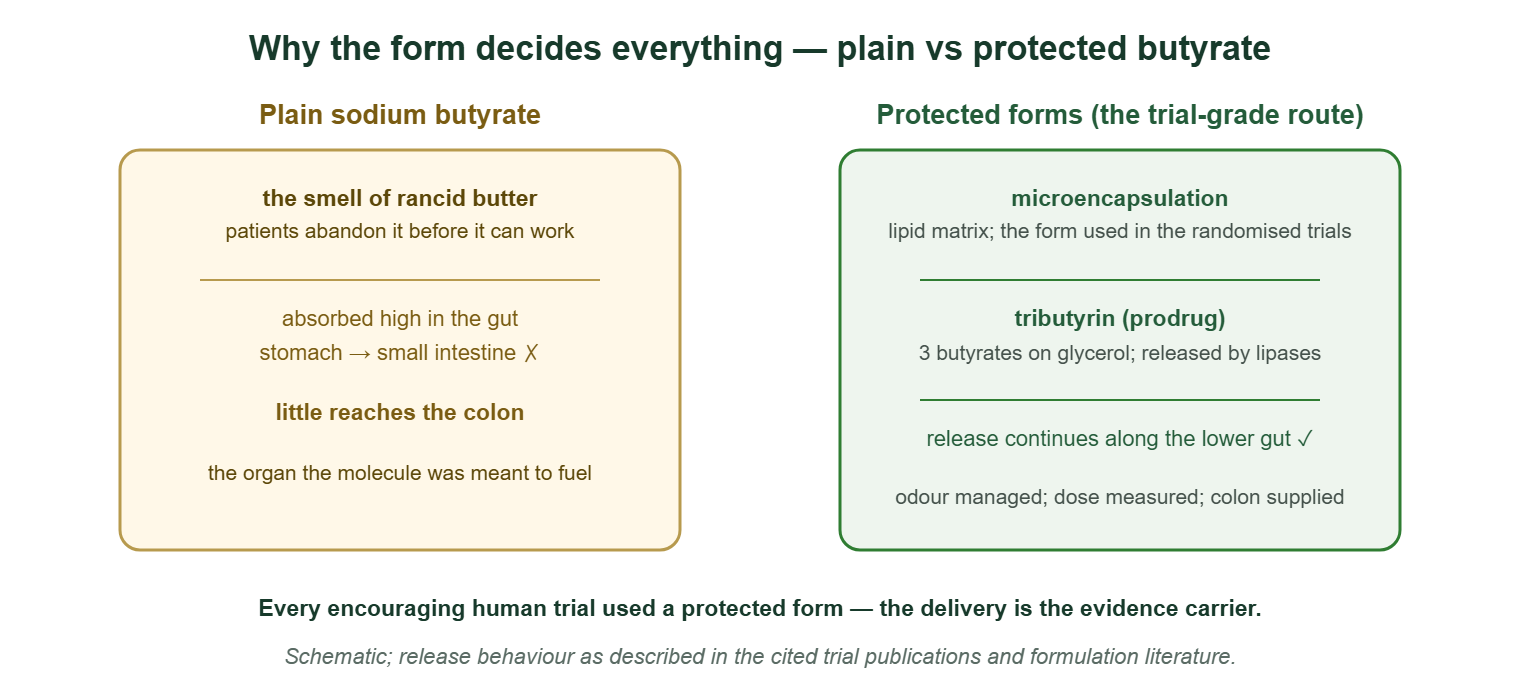
Figure 1. The delivery problem, and the two protected routes a compounding pharmacy can prescribe against — the whole compounding rationale in one picture.
What the randomised trials actually show
The butyrate literature is unusually candid, and prescribers should hear both its signals and its nulls. In the foundational IBS study — Banasiewicz and colleagues, Colorectal Disease (2013) — 66 patients already on standard IBS therapy added microencapsulated sodium butyrate 300 mg/day or placebo for 12 weeks: pain during defecation fell significantly from week 4, urgency and bowel habit improved by week 12, and — stated plainly — overall abdominal-pain severity and bloating did not separate from placebo; almost 94% of the supplemented group nonetheless asked to continue. A large multicentre real-world Polish study (Lewandowski and colleagues, 2022) later reported symptom reductions across IBS subtypes on the same preparation, uncontrolled but consistent. In active ulcerative colitis, Firoozi and colleagues (Journal of Nutrition and Metabolism, 2025) randomised 36 patients to a daily sodium-butyrate supplement or placebo alongside their standard therapy for 12 weeks and reported a fall in the Mayo severity score of 2.33 points versus a slight rise on placebo, with ESR and anxiety and depression scores also improving — an adjunct result in a doctor-managed disease, never a replacement for it; a separate multicentre double-blind trial published in 2025 reported microencapsulated sodium butyrate as add-on therapy improving remission induction in mild-to-moderate UC, and a 140-patient IBD trial the same year reported microbiome shifts on treatment. On the metabolic side, Roshanravan and colleagues (randomised, double-blind, 2017–2020 reports) gave 60 adults with type 2 diabetes sodium butyrate 600 mg/day, inulin, both or placebo for 45 days and reported falls in hs-CRP and malondialdehyde with quieter inflammatory gene expression and a rise in Akkermansia abundance — biomarker endpoints, honestly labelled. And in 2026, Rydzewska and colleagues (Scientific Reports) published a placebo-controlled pilot in 52 adults with type 2 diabetes and gut symptoms on microencapsulated sodium butyrate 1.5 g/day for 12 weeks: abdominal pain improved in 53.8% versus 4.8% on placebo, positive lactulose breath tests fell from 76.9% to 26.9%, and HbA1c edged down about 0.3 percentage points against placebo — a pilot without a formal power calculation, to be read as a signal, not a verdict. Exploratory work in fatty-liver disease (a 181-patient interventional study) is following the same protected-form path.
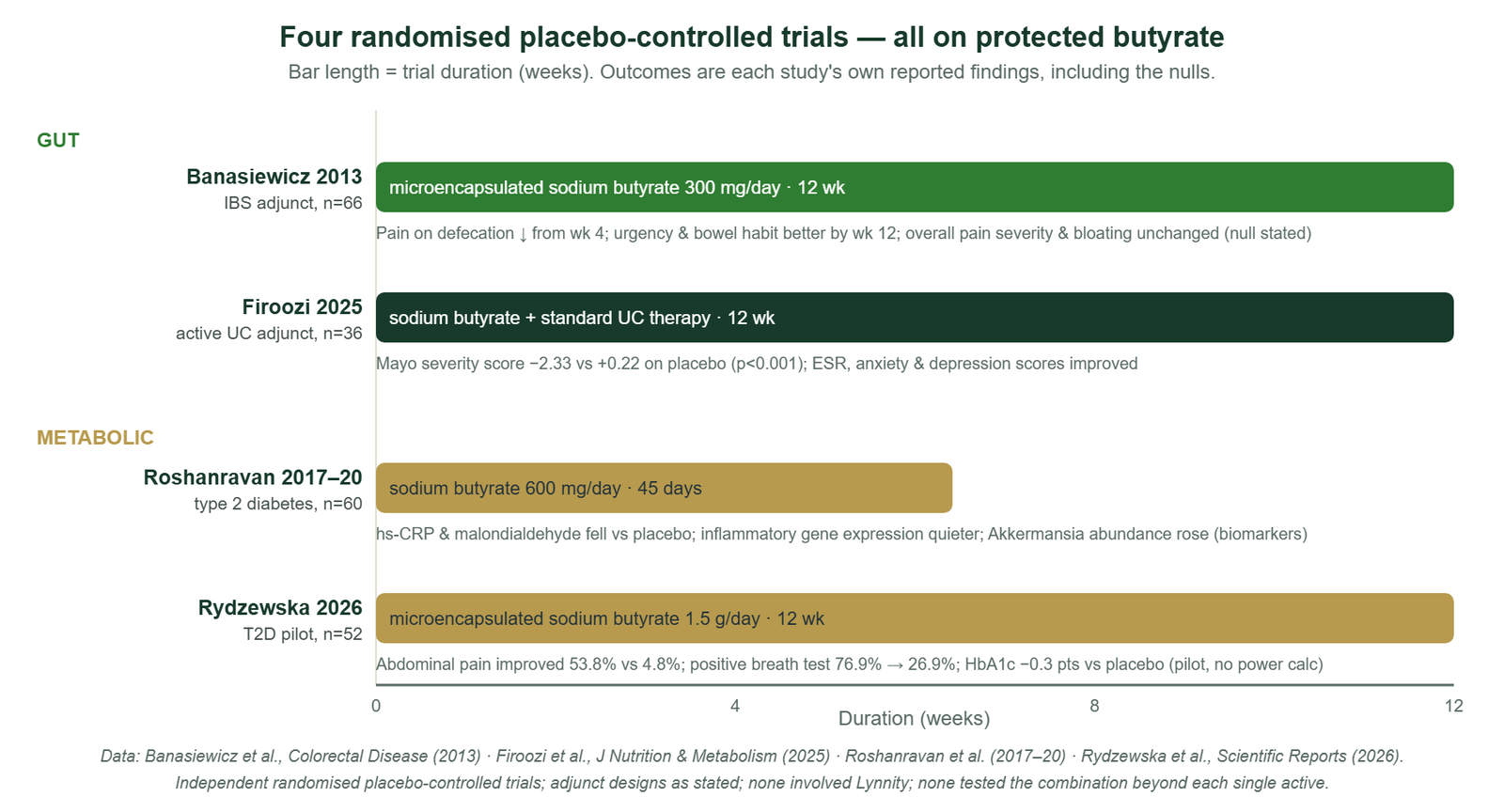
Figure 2. The randomised placebo-controlled record, gut and metabolic, one row per trial. Results are the studies’ own reported outcomes — including what did not change — and are not claims about any Lynnity preparation.
Where compounding earns its place
- The trial-grade form, not the raw salt. A protected preparation — matrix-protected sodium butyrate in an acid-resistant capsule, or tributyrin as a measured oral liquid — built to behave the way the studied forms behaved. Handing a patient plain butyrate powder is not a lower-cost version of the trials; it is a different, unstudied (and unswallowable) product.
- The dose follows the studies. The randomised trials ran from 300 mg to 1.5 g of sodium butyrate daily; a prescription states the strength and the preparation delivers it exactly, rather than whatever an import happens to contain.
- The form fits the patient. An acid-resistant capsule for most; a flavoured, measured oral liquid where capsules fail. The international retail products are mostly fixed-strength softgels — a format a prescriber cannot adjust and a patient cannot split.
- One accountable preparation. Where a doctor is already prescribing gut-directed actives, butyrate can be built into a coherent regimen — the pill-burden logic of our combined-capsule guide — made for a named patient under Good Compounding Practice (GCP), labelled with directions and a beyond-use date under our dating framework, after a pharmacist’s medication-list review.
How it works in Malaysia
Neither sodium butyrate nor tributyrin is a registered medicine in Malaysia, no protected butyrate preparation is stocked on local pharmacy shelves, and Lynnity’s compounded preparations carry no MAL registration — every Lynnity preparation, supplements included, is made only against a registered doctor’s prescription. The pathway is the standard prescription route: the doctor assesses first — gut symptoms with red flags (bleeding, weight loss, anaemia, a change in an older patient’s bowel habit) deserve investigation, not a supplement; the prescription specifies material, strength and form; Lynnity compounds and labels the preparation; and review is scheduled, because the longest trials ran twelve weeks. For clinics building a gut-health or metabolic service, this guide sits beside our pieces on urolithin A, nutrient support on GLP-1 therapy and customised formulations for clinics — the same delivery-first thinking that runs through our liposomal work, applied here to a molecule whose problem is the journey down the gut rather than into the bloodstream, and always matched to the patient, not the trend.
Who a prescriber might consider it for — and who not
Reasonable candidates, at the doctor’s discretion: the IBS patient stable on standard therapy whose defecation-related pain and erratic habit persist — the exact adjunct population Banasiewicz studied; the fibre-intolerant patient whose own producers are plausibly underfed; the type 2 diabetic with coexisting gut symptoms, on the strength of the 2026 pilot; and, strictly as a gastroenterologist-managed adjunct, the UC patient whose specialist wants to add it to — never instead of — standard therapy. Cautions are modest but real: tolerability in the trials was good, with mainly mild, transient digestive upset; a 1.5 g sodium-butyrate dose carries roughly 300 mg of sodium, worth counting in salt-restricted patients; there are no pregnancy or breastfeeding safety data, so avoid; and paediatric use belongs with the prescribing doctor alone. Anyone expecting butyrate to treat or cure IBS, IBD or diabetes should hear clearly that no such claim exists — the honest offer is a trial-informed, doctor-reviewed adjunct with a defined stop-and-reassess date. Our guide to Good Compounding Practice covers the quality framework behind every preparation.
Frequently asked questions
What is butyrate, in one sentence?
Butyrate is the short-chain fatty acid that colonic bacteria produce from dietary fibre — the preferred fuel of the cells lining the colon and a signalling molecule for gut barrier and immune tone, which is why it is called a postbiotic.
If gut bacteria make butyrate, why would anyone supplement it?
Because the producers can be missing. Studies repeatedly report depleted butyrate-producing species (such as Faecalibacterium prausnitzii) in IBS and IBD and after antibiotics — and many of the same patients cannot tolerate the fibre that would feed those bacteria. Supplying the end product directly, in a protected form, is the clinical question the randomised trials set out to test.
Why can’t a patient just take plain butyrate powder?
Two reasons. Butyric acid smells of rancid butter — patients abandon the jar — and an unprotected dose is largely absorbed high in the gut, before the colon. The trials used protected forms: microencapsulated sodium butyrate or tributyrin. The delivery form is not packaging; it is the evidence carrier.
What is tributyrin?
Tributyrin is a triglyceride carrying three butyrate units on a glycerol backbone. It is far more manageable in odour terms, and gut lipases cleave it to release butyrate along the intestine. An early human pilot reported good tolerability with favourable shifts in short-chain fatty acid production; as a liquid it also suits a measured, flavoured compounded preparation.
Is sodium butyrate the same as sodium phenylbutyrate?
No. Sodium phenylbutyrate is a registered orphan medicine used in urea-cycle disorders. Sodium butyrate is the simple salt of the gut-derived short-chain fatty acid and is not a registered medicine in Malaysia. They are different molecules with entirely different uses, and search results routinely confuse them.
What have the human trials shown — honestly?
As an adjunct in IBS, microencapsulated sodium butyrate reduced pain during defecation and improved urgency and bowel habit, while overall pain severity and bloating did not separate from placebo. In active ulcerative colitis it improved the Mayo severity score alongside standard therapy. In type 2 diabetes, trials reported lower inflammatory biomarkers, fewer gut symptoms and a small HbA1c improvement in a pilot. Encouraging, adjunct-level, and not a cure for anything — that is the fair summary.
Can compounded butyrate replace IBD or diabetes medication?
No. In every positive trial butyrate was added to standard therapy, never substituted for it. A doctor decides whether an adjunct is appropriate, keeps the underlying treatment in place, and sets a review date. Stopping prescribed IBD or diabetes therapy in favour of a supplement would contradict the very studies that make butyrate interesting.
How would a patient get compounded butyrate in Malaysia?
Through a doctor. Protected butyrate preparations are not sold on Malaysian pharmacy shelves, and all Lynnity preparations — including supplements — are compounded only against a registered doctor’s prescription, under Good Compounding Practice (GCP), with no MAL registration. The doctor specifies material, strength and form — an acid-resistant capsule or a measured oral liquid — and Lynnity prepares it for that named patient with a beyond-use date.
Reviewed by the Lynnity pharmacy team — registered pharmacists compounding to Good Compounding Practice (GCP) in Kuala Lumpur. Education for healthcare practitioners in Malaysia and Singapore; no claim that butyrate or tributyrin treats, cures or prevents any disease. All Lynnity compounded preparations — including supplements — require a prescription from a registered doctor.