
Short answer: HMB (β-hydroxy-β-methylbutyrate) is a natural metabolite of the amino acid leucine that the body makes in tiny amounts — roughly five per cent of dietary leucine is converted, far too little to matter clinically, which is why it is studied as a supplement at about 3 g a day. Its job is muscle preservation: trial evidence suggests it supports muscle mass and strength in older adults and in sarcopenia, which is why practitioners now raise it for two groups — ageing patients losing muscle, and patients on GLP-1 weight-loss injections, where a meaningful share of the weight lost is lean tissue. HMB absorbs well, so unlike fisetin or resveratrol the case for compounding is not a liposomal rescue. The case is precision and format: retail HMB lives in fixed-dose sports-nutrition tubs and tablets designed for gym users, not for a 78-year-old or a patient on weekly injections. A doctor-prescribed, customised capsule or measured oral liquid from Lynnity — dosed 1 g three times daily, optionally paired with vitamin D3, prepared under Good Compounding Practice (GCP) — puts the right dose in a form the actual patient can take, inside a plan that keeps protein and resistance activity first.
What HMB is
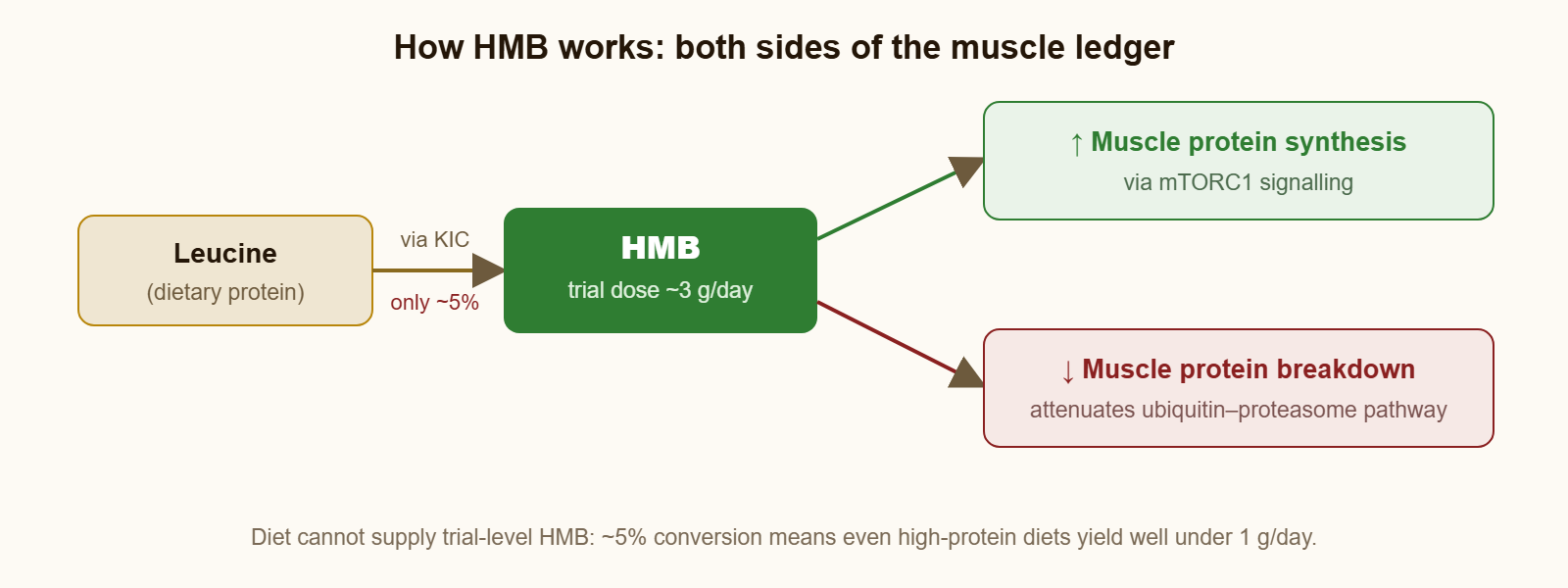
HMB is not a herb and not a drug in the usual sense — it is something your muscle chemistry already makes. When you eat protein, a portion of its leucine is converted in muscle and liver, via a ketoacid intermediate (α-ketoisocaproate, KIC), into β-hydroxy-β-methylbutyrate. Studies suggest only around five per cent of leucine takes this path, so even a very high-protein diet yields well under a gram of HMB a day. The supplemental doses used in clinical trials — typically 3 g daily — cannot practically be reached through food, which is why HMB is studied as a distinct intervention rather than as “more protein.”
Mechanistically, HMB appears to work on both sides of the muscle ledger: it stimulates muscle protein synthesis through the mTORC1 signalling pathway, and it dampens muscle protein breakdown by attenuating the ubiquitin–proteasome system, the cellular machinery that dismantles muscle protein during illness, immobility and rapid weight loss. Some work also suggests it helps stabilise the muscle cell membrane. In plain terms: it nudges building up while braking the tearing down — a profile suited to preserving muscle under stress rather than building it like a steroid.
Why practitioners are suddenly asking about it: the GLP-1 muscle problem
GLP-1 receptor agonist injections have transformed weight management in KL and Singapore clinics alike. But body-composition sub-studies of these medicines suggest that a meaningful share of the weight lost is not fat — in one DXA sub-study of semaglutide, lean tissue accounted for roughly 40 per cent of the total mass lost. For a younger patient with muscle to spare, that may be acceptable. For a patient in their 60s starting near the sarcopenia threshold, losing muscle at that rate is a real clinical cost: strength, glucose handling, bone loading and fall risk all lean on muscle.
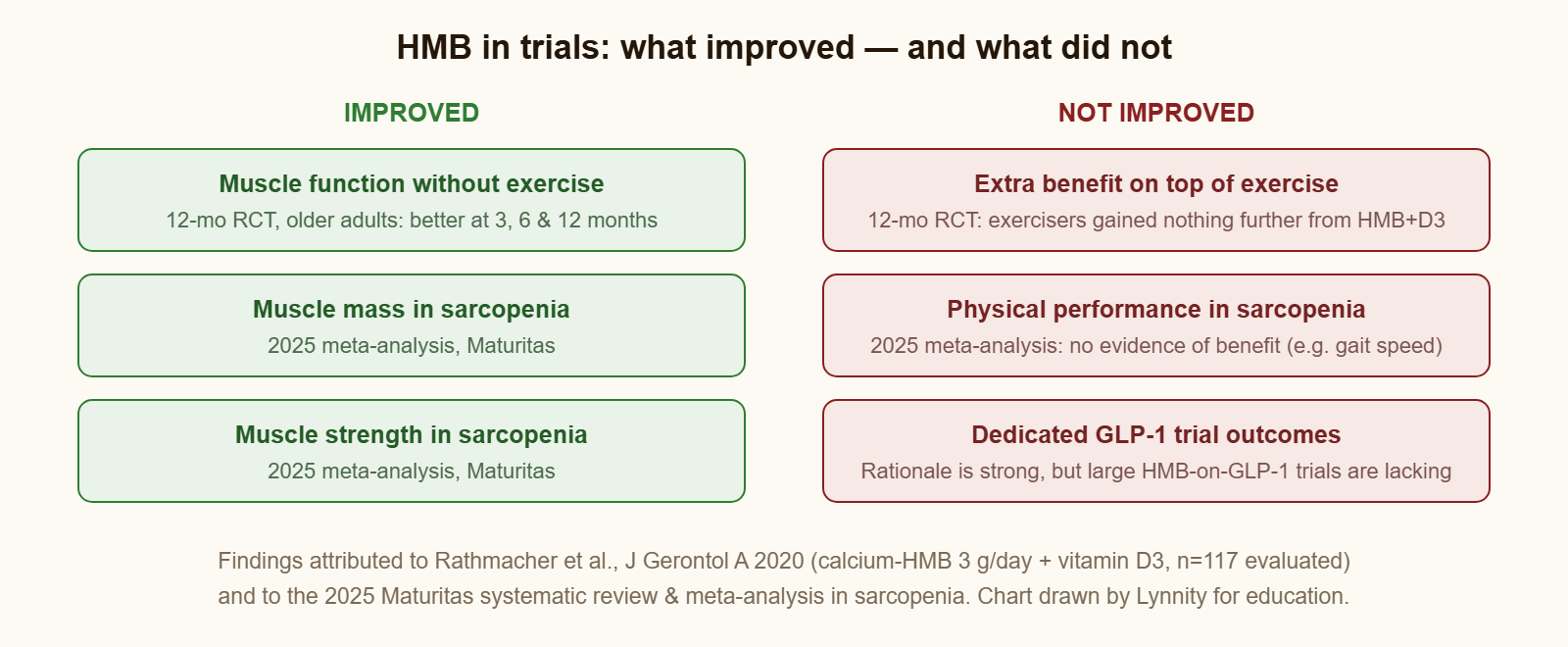
The first-line answers are not supplements at all — they are adequate protein (often 1.2–1.6 g/kg/day under a dietitian) and resistance exercise. HMB enters the conversation as an adjunct for patients who cannot reliably hit those targets: appetite on a GLP-1 is suppressed by design, and many older patients cannot eat their way to protein goals or train hard enough to defend muscle. A molecule that brakes muscle breakdown during an energy deficit has an obvious rationale here — though it must be said honestly that large dedicated trials of HMB specifically during GLP-1 therapy are still lacking. The strong evidence sits next door, in ageing and sarcopenia.
What the human evidence actually shows — and does not
HMB has an unusually mature evidence base for a supplement, and it is worth reporting with its edges intact.
- A 12-month randomised, double-blind, controlled trial in adults over 60 with insufficient vitamin D (Rathmacher and colleagues, Journals of Gerontology: Series A, 2020; 117 participants evaluated) tested calcium-HMB 3 g/day plus vitamin D3 against control, with and without a resistance-exercise programme. In the non-exercising participants, HMB+D3 significantly improved a composite index of muscle function at 3, 6 and 12 months, with strength benefits — a striking result, because it helped precisely the people who were not training. In participants who did exercise, adding HMB+D3 produced no significant extra benefit: exercise already did the work.
- A 2025 systematic review and meta-analysis in sarcopenia (Maturitas) concluded HMB supplementation benefits muscle mass and strength in sarcopenic patients — but found no evidence of benefit on physical performance measures such as walking speed. Mass and strength, yes; guaranteed functional transformation, no.
- A 2026 randomised crossover trial (Nutrients) examined HMB added to protein feeding in older men and women, probing its adjuvant effect on fed-state muscle protein turnover — part of a live research programme on HMB as a partner to protein rather than a replacement for it.
HMB is also used in clinical-nutrition formulas studied in cancer, cirrhosis and ICU populations, which is one reason hospital dietitians tend to know it before retail consumers do. Two formats exist: calcium-HMB, which carries most of the outcome data, and free-acid HMB, which reaches the bloodstream faster but has not been shown to produce better clinical outcomes. Trials up to 12 months report it as well tolerated, with few documented drug interactions.
Where a compounding pharmacy actually adds value
HMB absorbs well on its own, so — as with pterostilbene — a liposomal version would largely solve a problem that does not exist. The compounding case is practical and clinical:
- The right dose, split properly. The evidence base is built on about 3 g a day, usually divided — in practice 1 g three times daily. Retail formats are fixed-dose tubs, tablets and sports blends aimed at gym users; a compounded preparation is dosed to the prescription, not the marketing.
- A form the patient can take. Lynnity prepares HMB as customised capsules or as a measured oral liquid — a dispersed dose an older patient or a nauseated GLP-1 patient can actually swallow, flavoured if needed. No scoops, no guesswork.
- Sensible pairing. The strongest 12-month data co-dosed HMB with vitamin D3 in vitamin-D-insufficient adults — common in Malaysia despite the sunshine. Where the prescribing doctor wants both, they can be combined in one capsule against the patient’s tested vitamin D level.
- Excipient-aware formulation. Compounded HMB can be prepared free of the sweeteners, dyes and bulking agents of sports-nutrition products, for sensitive or polypharmacy patients.
- A prescriber in charge. The trial story above is nuanced — who benefits (non-exercisers, sarcopenic patients, protein-short GLP-1 patients) and who likely will not (well-trained patients already hitting protein targets). That triage belongs to a doctor and dietitian, with the pharmacist reviewing the medication list.
Who it may suit — and the cautions
Practitioners in KL, the Klang Valley and Singapore most often consider HMB for older adults with sarcopenia or declining strength who cannot train; patients on GLP-1 therapy losing lean mass with suppressed appetite; and patients recovering from illness or immobility under clinical-nutrition support. The cautions are as important: HMB is an adjunct, never a replacement for protein and resistance activity; it should not be expected to improve walking speed or athletic performance; data in pregnancy and breastfeeding are lacking, so it is avoided there; and although documented drug interactions are few, every Lynnity preparation begins with a pharmacist’s review of the full medication list. No supplement, compounded or otherwise, treats or cures any disease — HMB supports a muscle-preservation plan a doctor designs.
How patients get compounded HMB in Malaysia
Through a doctor — as with everything Lynnity prepares. HMB is not a registered medicine in Malaysia and Lynnity’s preparations carry no MAL registration; all Lynnity preparations, including supplements, are compounded only against a registered doctor’s prescription under Good Compounding Practice (GCP). The prescriber specifies the material (calcium-HMB or free-acid), strength, form (capsule or oral liquid) and any pairing such as vitamin D3; Lynnity compounds it for that named patient with a beyond-use date, and the clinic re-reviews at follow-up. Clinics, dietitians and wellness centres across the Klang Valley and Singapore can refer patients or set up a practitioner account to prescribe customised formulations.
Frequently asked questions
What is HMB?
HMB (β-hydroxy-β-methylbutyrate) is a natural metabolite of the amino acid leucine. The body converts only about five per cent of dietary leucine into HMB, so the roughly 3 g daily dose used in clinical trials cannot be reached through food and is taken as a supplement.
Does HMB actually work?
The evidence is real but specific. A 12-month randomised trial in older adults found HMB plus vitamin D3 improved muscle function in people who were not exercising, and a 2025 meta-analysis found benefits to muscle mass and strength in sarcopenia. It added nothing on top of exercise, and did not improve physical performance measures — so it helps preserve muscle, not replace training.
Can HMB prevent muscle loss on GLP-1 weight-loss injections?
The rationale is strong — body-composition studies suggest a meaningful share of GLP-1 weight loss is lean tissue, and HMB brakes muscle breakdown — but large dedicated trials of HMB during GLP-1 therapy are still lacking. Protein targets and resistance exercise come first; HMB is an adjunct a doctor may add when those are not achievable.
Why compound HMB instead of buying a sports-nutrition tub?
Retail HMB comes in fixed-dose tubs and tablets designed for athletes. A compounded preparation delivers the prescribed dose — typically 1 g three times daily — as customised capsules or a measured oral liquid an older or appetite-suppressed patient can take, optionally paired with vitamin D3, without sports-blend excipients, and inside a doctor’s plan.
Is HMB safe?
Trials up to 12 months report HMB as well tolerated, with few documented drug interactions. It is avoided in pregnancy and breastfeeding for lack of data, and every Lynnity preparation starts with a pharmacist’s medication-list review. It is not a treatment or cure for any disease.
How do I get compounded HMB in Malaysia?
Through a registered doctor. All Lynnity preparations, including supplements, are prescription-only, compounded under Good Compounding Practice (GCP) with no MAL registration, for a named patient with a beyond-use date. Doctors, dietitians and clinics in KL, the Klang Valley and Singapore can refer or prescribe directly.
Reviewed by the Lynnity pharmacy team — registered pharmacists compounding to Good Compounding Practice (GCP) in Kuala Lumpur. This article is educational and is not medical advice; all compounded preparations require a prescription from a registered doctor.
Key sources: Rathmacher JA et al., Journals of Gerontology: Series A 2020;75(11):2089 (12-month RCT, calcium-HMB 3 g/day + vitamin D3) · systematic review and meta-analysis of HMB in sarcopenia, Maturitas 2025 · randomised crossover trial of HMB with protein feeding in older adults, Nutrients 2026;18(9):1449 · semaglutide body-composition (DXA) sub-study data.