
Why bergamot keeps coming up in cardiometabolic clinics
Ask a lipid clinic or a healthy-ageing practice in the Klang Valley what patients now bring up when they are statin-hesitant, statin-intolerant, or sitting in the “borderline, not yet on a drug” band, and bergamot sits near the top of the list alongside red yeast rice and plant sterols. The interest is not only marketing. Bergamot’s flavonoid fraction contains brutieridin and melitidin — described in the chemistry literature as “statin-like principles,” because each is a hydroxy-methylglutaryl glycoside whose glutaryl arm mimics the natural substrate of HMG-CoA reductase, the rate-limiting enzyme of cholesterol synthesis that statins block. It is one of the few botanicals with a structural rationale for a lipid effect rather than a purely observational one, and it sits beside the other cardiometabolic actives our practitioner readers already know from our guides to CoQ10/ubiquinol and to combining several actives in one nutritional-compounding preparation. As with every one of them, the usefulness is decided less by the plant than by whether the preparation is standardised and dosed like the ones that were actually studied.
What the flavonoids actually do — the “statin-like” molecules, honestly
Two threads run through the mechanistic work, and both should be quoted as rationale, not as a promise. The first is the statin-like structure: brutieridin and melitidin carry the 3-hydroxy-3-methylglutaryl moiety, so early work proposed direct HMG-CoA reductase inhibition. The more careful recent cell studies complicate that tidy story — in liver-cell models, bergamot extract did not simply block the enzyme but lowered its expression, up-regulated the LDL receptor (so the liver clears more LDL from the blood), and modulated PCSK9, with additional signalling through AMPK-α and SIRT1; in vitro, intracellular cholesterol synthesis fell by roughly 30–40%. The second thread is broad antioxidant and anti-inflammatory flavonoid activity, the proposed basis for the vascular and metabolic effects reported beyond LDL alone. The fair summary for a clinician: a plausible, multi-mechanism lipid rationale with a real structural hook — but a modulator, not a pharmaceutical HMG-CoA reductase inhibitor, and not a substitute for one where a statin is indicated.
What the human evidence shows — honestly
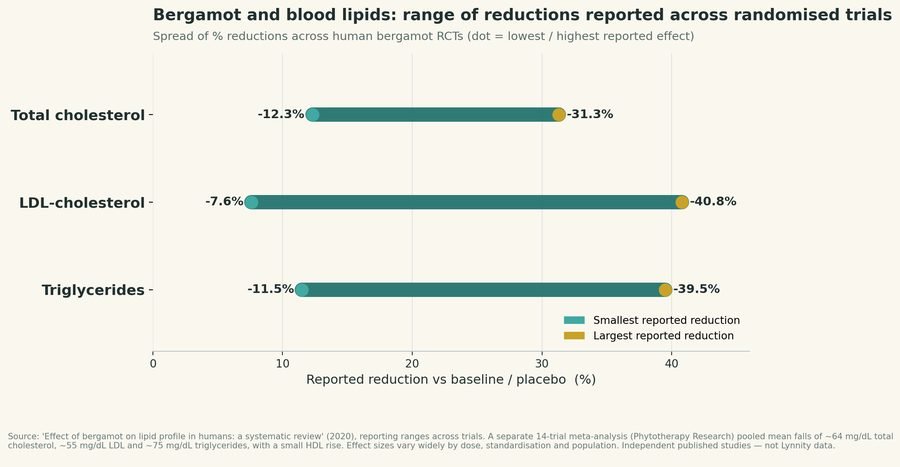
Here candour matters, because bergamot attracts more enthusiasm than most nutraceuticals earn. The evidence is genuinely favourable but heterogeneous. Early randomised, placebo-controlled work reported that a standardised BPF at 500 mg/day for 30 days significantly lowered total cholesterol, LDL and triglycerides versus placebo, with a larger effect at 1,000 mg. A 2020 systematic review found that about three-quarters of the studies showed significant reductions, with total cholesterol falling roughly 12–31%, LDL roughly 8–41% and triglycerides roughly 12–40% — wide ranges that themselves reveal how much formulation, dose and population matter. A later meta-analysis of 14 randomised trials pooled sizeable average reductions in total cholesterol, LDL and triglycerides and a small rise in HDL; the pooled numbers are eye-catching (the LDL figure exceeds what many drugs achieve), which is exactly why they should be read with the heterogeneity in mind rather than taken as a headline. More recent, better-standardised trials are more measured: a 2024 randomised, double-blind, placebo-controlled study in 64 adults with raised cholesterol used a concentrated standardised flavonoid extract at 150 mg/day and found significant reductions in total and LDL cholesterol emerging from the second month. And the picture is not uniformly positive — a low-dose BPF study in patients on second-generation antipsychotics found no metabolic improvement, a useful reminder that an under-dosed or wrong-population preparation simply does not work. The honest reading: a consistent direction of benefit on lipids across many trials, real but variable in size, clearly dependent on getting the standardised dose right — and no basis for any claim to treat or cure cardiovascular disease.
The standardisation problem no fixed retail pack solves
Bergamot is a textbook “the label is not the dose” case. The molecules that matter are the flavonoids — and products vary enormously in how much of them they contain. The trials that worked specified a standardised fraction: a defined BPF content, or an extract standardised to a stated percentage of total flavonoids (standardised phytosome preparations, for instance, are typically standardised to 11–19% total flavanones, and lecithin-bound “phytosome” forms carrying about 40% standardised BPF are built to raise the poor native absorption so that similar effects can be reached at a lower dose). A retail bottle that says only “bergamot 500 mg” could contain a fraction of the studied flavonoid load — or a well-standardised one — and nothing on the label lets a prescriber tell the difference. That single fact reframes the whole conversation: matching the studied effect means matching the studied flavonoid dose and absorption, not the milligrams of undefined powder. It is the reason a fixed retail pack fits the evidence so unreliably, and the reason a compounding pharmacy — which formulates to a stated standardisation and a defined strength — has something specific to offer.
Where compounding earns its place
- The standardised active, not an undefined powder. A preparation built to a stated flavonoid standardisation and a defined strength lets the prescription match what the trials actually dosed — the point of the whole exercise.
- The dose follows the patient and the target. The evidence spans roughly 150 mg of a concentrated standardised extract to 500–1,000 mg of BPF; a prescription can specify the exact strength and whether it is taken once or twice daily, before meals. A fixed-strength retail pack cannot be titrated.
- The form fits the patient. A capsule for most; a measured, bioavailability-optimised (lecithin-based) oral liquid or tonic where a patient struggles with capsules or where better absorption is wanted. Overseas retail products are fixed-strength softgels or tablets — a format a prescriber cannot adjust.
- Sensible combination, made accountable. Where a clinician wants bergamot alongside another lipid-supporting active in one coherent preparation, compounding builds a single, labelled product for a named patient under GCP, with a beyond-use date, after a pharmacist’s medication-list review — which matters here because of the drug-interaction points below.
How it works in Malaysia
Standardised prescription-grade bergamot is not a registered Malaysian medicine, and Lynnity’s compounded preparations carry no MAL registration — every Lynnity preparation, supplements included, is made only against a registered doctor’s prescription. The route is the standard prescription pathway: the doctor assesses the patient, the lipid picture and any existing therapy first, decides whether standardised bergamot is a reasonable adjunct or trial and how it sits alongside standard care, and sets the target; the prescription specifies the standardisation, strength, form and schedule; Lynnity compounds and labels the preparation for that one patient; and a review date and repeat lipid panel are set. For clinics building a cardiometabolic or healthy-ageing service, this guide sits beside our pieces on CoQ10/ubiquinol, liposomal resveratrol and customised multi-active formulations for clinics.
Who a prescriber might consider it for — and who not
Reasonable interest, at the doctor’s discretion: the statin-hesitant or borderline patient who wants an evidence-supported, doctor-supervised adjunct for lipid support, or the patient already on standard care in whom a clinician wants to add a monitored botanical — always with a repeat lipid panel to judge response. The cautions are specific. Whole bergamot contains furanocoumarins (bergamottin and 6′,7′-dihydroxybergamottin) that inhibit CYP3A4 — the “grapefruit effect” — which is relevant to statins and many other CYP3A4-metabolised drugs; standardised polyphenolic fractions are usually low in or depleted of these furanocoumarins, but product-to-product variability is real, so a pharmacist’s medication-list review before prescribing is not optional. There are no adequate pregnancy or breastfeeding safety data, so it should be avoided there; it is not a paediatric supplement. Above all, no one should expect bergamot to treat, cure or prevent cardiovascular disease, to substitute for a statin where one is indicated, or to be started or stopped without the prescribing doctor — its role is supportive and supervised.
Frequently asked questions
What is bergamot, in one sentence?
Bergamot (Citrus bergamia) is a Mediterranean citrus whose peel and juice are rich in flavonoids — including brutieridin and melitidin, two molecules with a statin-like chemical structure — studied mainly for their effect on cholesterol and other lipids.
Is bergamot a natural statin?
No. Two of its flavonoids share a structural motif with statins and act on the same cholesterol-synthesis pathway, but bergamot is a multi-mechanism modulator, not a pharmaceutical HMG-CoA reductase inhibitor. It should not be described as a statin, and it does not replace one where a statin is medically indicated.
Why can’t a patient just buy bergamot capsules off the shelf?
Because the label rarely tells you the dose that matters. The trials used a standardised flavonoid fraction (a defined BPF content or a stated percentage of total flavonoids); a bottle marked only “bergamot 500 mg” could deliver far less active than the studied preparations. A prescription-compounded product is made to a stated standardisation and strength, so it can match what was actually studied.
What dose was used in the studies?
Broadly, 500–1,000 mg a day of standardised BPF (with larger lipid changes at the higher dose), or a smaller dose — around 150 mg/day — of a concentrated, better-absorbed standardised extract, usually taken once or twice daily before meals for at least a month. The right figure depends on the standardisation and the patient, which is why a doctor sets it.
How strong is the evidence?
Favourable but variable. Most randomised trials show reductions in total cholesterol, LDL and triglycerides, and a systematic review and a 14-trial meta-analysis both report significant average falls — but effect sizes differ widely between studies, an under-dosed study showed no benefit, and none of this proves bergamot treats or prevents heart disease. It is best read as supportive evidence for lipid support, not as a drug substitute.
Does bergamot interact with medicines?
It can. Whole bergamot contains furanocoumarins that inhibit CYP3A4 (the “grapefruit effect”), which is relevant to statins and many other medicines; standardised fractions are usually low in these compounds, but variability means a pharmacist’s medication-list review before prescribing is essential — especially in anyone already on a statin or other CYP3A4-metabolised drug.
Can compounded bergamot replace my patient’s statin?
No. Bergamot is a supervised, evidence-supported adjunct, never a substitute for prescribed treatment. The doctor decides whether it complements standard care, keeps existing therapy in place unless they change it, and monitors the lipid panel.
How would a patient get compounded bergamot in Malaysia?
Through a doctor. Standardised bergamot is not sold as a registered Malaysian medicine, and all Lynnity preparations — including supplements — are compounded only against a registered doctor’s prescription, under Good Compounding Practice (GCP), with no MAL registration. The doctor specifies the standardisation, strength, form and schedule — a capsule or a measured oral liquid — and Lynnity prepares it for that named patient with a beyond-use date.
Reviewed by the Lynnity pharmacy team — registered pharmacists compounding to Good Compounding Practice (GCP) in Kuala Lumpur. Education for healthcare practitioners in Malaysia and Singapore; no claim that bergamot treats, cures or prevents any disease, and no claim that it replaces a statin or other prescribed therapy. All Lynnity compounded preparations — including supplements — require a prescription from a registered doctor.
Key sources: Di Donna et al., “Statin-like Principles of Bergamot Fruit” (brutieridin, melitidin) · Leopoldini et al., HMG-CoA reductase binding of bergamot flavonoids · cell-model work on the cholesterol-lowering mechanism (HMGCR expression, LDL-receptor up-regulation, PCSK9) in HepG2/Caco-2 · Mollace et al., randomised placebo-controlled BPF lipid trials (500/1,000 mg) · lecithin/phytosome BPF randomised trial in type-2 diabetes and mixed hyperlipidaemia · bergamot phytosome randomised trial in overweight/obese mild hypercholesterolaemia · “Effect of bergamot on lipid profile in humans: a systematic review” (2020) · systematic review and meta-analysis of 14 randomised trials (Phytotherapy Research) · 2024 randomised double-blind placebo-controlled Citrus bergamia standardised-extract trial (Foods) · negative low-dose BPF study in second-generation-antipsychotic patients · reviews of bergamot furanocoumarins and CYP3A4 interaction. Independent published research; none involved Lynnity.