
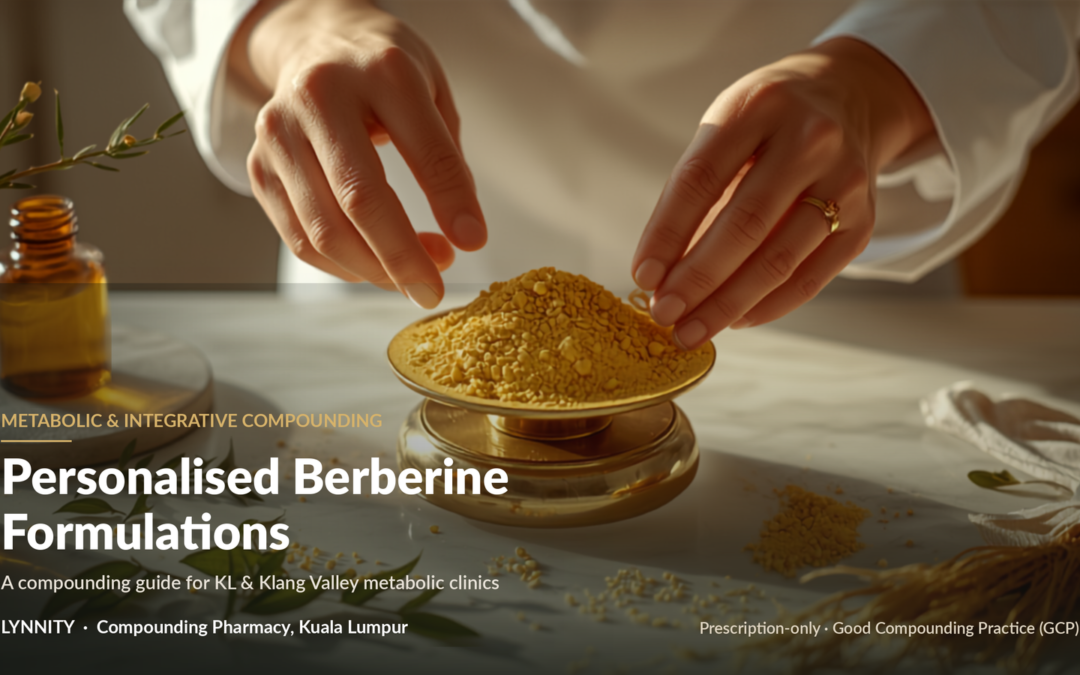
Short answer: Berberine is a plant alkaloid that has become one of the most-asked-about supplements for metabolic and blood-sugar support, but it has two practical problems a clinic runs into quickly: poor oral absorption and frequent gastrointestinal upset. A compounding pharmacy adds value by preparing a berberine formulation to one patient’s exact prescription — the precise dose split across the day, an absorption-considered form or delivery, a considered combination with compatible nutrients where a prescriber wants one, a clean excipient profile, and the ability to titrate to tolerance. At Lynnity this is prescription-only: every preparation, supplements included, is made solely on the prescription of a registered doctor and prepared under the Ministry of Health’s Good Compounding Practice (GCP) guideline. Berberine also has real drug interactions and clear contraindications, which is exactly why a prescriber sits at the centre. It is not a mass-produced, MAL-registered product and cannot be bought directly.
Few supplements generate as much clinic-room interest in Kuala Lumpur, Klang Valley and Singapore right now as berberine — often on the back of social-media claims that overshoot the evidence. This guide is written for prescribers and referring practitioners: what berberine is, where the evidence genuinely sits, the absorption and safety issues that matter, and how a compounding pharmacy lets a clinic move from a generic capsule to a formulation matched to the individual — always through a doctor’s prescription.
Why berberine is talked about — and why the hype needs tempering
Berberine is an alkaloid found in several plants, long used in traditional medicine systems. Interest has surged because studies suggest it may influence glucose and lipid metabolism, partly through activation of the AMPK energy-sensing pathway. That mechanism is real and interesting, but it has been stretched online into claims — “nature’s Ozempic” being the most common — that go well beyond what the data support. Berberine is not a pharmaceutical weight-loss agent, it is not equivalent to any prescription medicine, and it should not be presented to patients as either.
The defensible position for a clinic is narrower and more honest: some randomised trials and meta-analyses suggest berberine may modestly support healthy glucose and lipid metabolism as one part of a broader, doctor-supervised plan, while the quality of the underlying studies is variable and long-term outcome data are limited. Framing it that way — a supportive supplement used under supervision, not a treatment for any disease — keeps both the patient and the clinic on solid ground.
The two practical catches: absorption and tolerability
Berberine’s usefulness is limited by pharmacokinetics. Standard berberine hydrochloride is poorly absorbed from the gut, which is why studied doses are relatively high and typically split into two or three doses across the day, usually taken with meals. That same high oral load is what drives its most common side effects — cramping, diarrhoea, constipation and general GI upset — which are the usual reason patients abandon it.
These two problems are precisely where a compounded, prescriber-directed approach earns its place: the dose can be split and timed deliberately, started low and built up to improve tolerability, and prepared in an absorption-considered form or delivery where the prescriber wants one — rather than leaving the patient to self-manage a one-size capsule.
Forms and delivery, at a glance
The table below is orientation for prescribers, not a recommendation for any individual patient. Form, dose and any combination are clinical decisions; the pharmacy prepares what is prescribed.
| Form / approach | General profile (evidence-hedged) | Practical note |
|---|---|---|
| Berberine hydrochloride | The most-studied form; the majority of trials used it. Poorly absorbed, so studied doses are relatively high and split across the day. | Usually taken with meals in divided doses; GI upset is the common limiter. |
| Dihydroberberine | A reduced form promoted for better absorption; some early data suggest higher blood levels at lower doses, but the human evidence base is much smaller than for berberine HCl. | Chosen by some prescribers to reduce dose size or GI load; evidence is preliminary. |
| Liposomal / absorption-enhanced preparations | Approaches that aim to improve uptake of a poorly absorbed compound; plausible in principle, with berberine-specific human data still limited. | A prescriber-led choice where tolerability or dose burden is the issue; the pharmacy flags where evidence is thin. |
| Considered combinations | Some prescribers pair berberine with compatible nutrients (for example alpha-lipoic acid, chromium or inositol) as part of a wider plan; evidence for specific combinations varies and is often modest. | Compatibility and total capsule load are checked before preparing; the rationale sits with the prescriber. |
An honest caveat to share with clinics: much of the “which form is best” conversation runs ahead of the data. Berberine hydrochloride has by far the largest evidence base; the newer forms are promoted heavily but studied lightly. The role of compounding is not to chase a trend but to prepare what a prescriber decides, at a dose and in a form matched to the individual patient.
Where compounding adds value
The precise dose, split and titrated
A commercial capsule fixes one dose. A compounded preparation is built to the prescription, so a prescriber can set the exact amount, split it across the day, and start low and step up to improve tolerability — the single most useful lever for a supplement whose main drawback is GI upset.
Absorption-considered forms
Where a prescriber wants to address berberine’s poor uptake, the preparation can use an absorption-considered form or delivery. This is a clinical judgement informed by what the evidence does and does not support, and the pharmacy is candid about where the data are still thin.
Considered combinations and reduced pill burden
Where clinically appropriate, berberine can be prepared alongside other compatible nutrients a patient is already taking, consolidating several products into fewer capsules — subject to the compatibility and capsule-volume checks the pharmacist performs before preparing. This overlaps with the nutritional-compounding work many clinics already use.
A clean excipient profile
Because the pharmacy builds from raw actives, a prescription can request berberine without a particular dye, filler or allergen a sensitive patient reacts to — the same excipient-free and allergen-aware approach used across compounded supplements.
Safety and interactions: why a prescriber must sit at the centre
Berberine is not a benign “it’s just a herb” supplement, and this is the part clinics most need to hear. It inhibits key drug-metabolising enzymes (including CYP3A4) and transporters, so it can raise the levels of a range of prescription medicines and has meaningful interaction potential — for example with some agents used for blood sugar, cholesterol, blood pressure, immunosuppression and anticoagulation. Stacking berberine on top of a patient’s existing prescriptions without medical oversight is exactly the scenario to avoid.
There are also clear contraindications. Berberine should not be used in pregnancy or breastfeeding, and must not be given to newborns, because it can displace bilirubin and raise the risk of jaundice and related harm in infants. These are not edge cases — they are core reasons a registered doctor must assess suitability, review the patient’s full medication list and decide before any berberine preparation is made. A compounding pharmacy prepares to that decision; it does not make it.
It is also worth noting that raw-material quality varies in the wider berberine market. A disciplined compounding pharmacy works from characterised raw materials and prepares under GCP, which is one more reason a compounded, prescriber-led route differs from an anonymous online purchase.
Where a clinic fits: the referral and prescribing workflow
A personalised, compounded berberine preparation follows the same disciplined route as any compounded preparation at Lynnity, and it always starts with a prescriber — never with the pharmacy.
Prescribe directly
A registered doctor assesses the patient, reviews their full medication list for interactions, decides whether berberine is appropriate and at what dose and form, and writes a prescription specifying the form, the dose and schedule, the delivery form, the quantity and the directions. The clinic sends it to the pharmacy; Lynnity confirms feasibility and compatibility, prepares the preparation under GCP, and dispenses it back to the patient. Any change in dose or form goes back through the same loop as a fresh prescription.
Refer to a prescriber first
A non-prescribing practitioner — a nutritionist or dietitian, say — who thinks a patient may benefit refers them, with their notes, to a registered doctor. The doctor reviews, checks for interactions, decides and writes the prescription; only then does the pharmacy prepare it. A compounding pharmacy cannot supply a compounded supplement on a non-prescriber’s request alone, and no reputable one will imply otherwise. There is no “no prescription needed” route.
Both patterns share the same anchor: a registered doctor’s prescription sits at the centre, and the pharmacy prepares strictly to it under Good Compounding Practice (GCP) — the Ministry of Health guideline covering how compounded preparations are made, checked, labelled and documented. GCP is the correct standard for pharmacy compounding, and it is distinct from GMP, which governs mass manufacturing. Lynnity is a compounding pharmacy, not a manufacturer or a supplement brand: it does not mass-produce or contract-manufacture products, and it prepares only what a prescriber specifies for a named patient.
A note for Singapore clinics
Clinics in Singapore sometimes ask whether a Malaysian compounding pharmacy can prepare a personalised berberine formulation against a Singapore prescription. Cross-border supply of compounded, prescription-only preparations is governed by the receiving country’s own rules, which differ from Malaysia’s. Confirm the position with your own regulator before assuming a preparation can cross the border, and treat this article as general orientation rather than a compliance opinion.
Frequently asked questions
Is berberine “nature’s Ozempic”?
No. That comparison is marketing, not science. Berberine is a plant alkaloid that studies suggest may modestly support healthy glucose and lipid metabolism as part of a supervised plan; it is not a pharmaceutical weight-loss agent and is not equivalent to any prescription medicine. It should not be presented to patients as a substitute for prescribed treatment.
Why compound berberine instead of buying an off-the-shelf capsule?
Compounding lets a prescriber set the exact dose, split and time it across the day, start low and titrate to improve tolerability, use an absorption-considered form where wanted, leave out an allergen or dye, and consolidate it with other compatible nutrients — levers a fixed retail product cannot offer, and useful for a supplement whose main drawbacks are poor absorption and GI upset.
Why does berberine so often upset the stomach?
Because it is poorly absorbed, studied doses are relatively high and much of the dose stays in the gut, which commonly causes cramping, diarrhoea or constipation. Splitting the dose, taking it with meals and titrating up gradually — all straightforward with a compounded preparation — are the usual ways a prescriber manages this.
Does berberine interact with medications?
Yes. Berberine inhibits drug-metabolising enzymes such as CYP3A4 and can raise the levels of various prescription medicines, so it has real interaction potential — a key reason a registered doctor must review the patient’s full medication list before it is used. It is not a “just a herb, so it’s safe” supplement.
Who should not take berberine?
Berberine is contraindicated in pregnancy and breastfeeding and must not be given to newborns, in whom it can raise the risk of jaundice. Suitability in anyone on regular medication, or with significant medical conditions, is a decision for a registered doctor.
Do compounded berberine formulations still need a prescription?
Yes. Every Lynnity preparation, supplements included, is made solely on the prescription of a registered doctor. There is no direct-purchase or “no prescription needed” route. A referring practitioner sends the patient to a doctor, who assesses and prescribes.
We’re a clinic in KL — how do we start prescribing a personalised berberine formulation through Lynnity?
Contact us through lynnitypharma.com and ask to speak with a pharmacist. We can talk through workable doses and schedules, absorption-considered options, compatible combinations, excipient-free options and beyond-use dating before your first prescription is sent.
Reviewed by the Lynnity pharmacy team — registered pharmacists compounding to Good Compounding Practice (GCP) in Kuala Lumpur.
This article is general information for healthcare practitioners and is not medical advice. It does not diagnose, treat or recommend therapy for any condition. All Lynnity preparations, supplements included, require a prescription from a registered doctor.