
Resveratrol is one of the most durable names in the longevity conversation, and clinics across Kuala Lumpur, the Klang Valley and Singapore field patient questions about it regularly — increasingly about the liposomal versions promoted online. This guide is written for prescribers and referring practitioners: what resveratrol is, why its absorption is such a problem, why liposomal delivery is proposed to address it, where the evidence is genuinely promising and where it is oversold, and how a prescription-led compounding pharmacy fits.
What resveratrol is — and why clinics keep hearing about it
Resveratrol is a polyphenol of the stilbene family, produced by plants as a defence compound and concentrated in grape skins, some berries and — as the main commercial source — the root of Japanese knotweed (Polygonum cuspidatum). The form that matters pharmacologically is trans-resveratrol, the stable, biologically active isomer; the cis form is less stable and less studied, which is one reason a defined, well-handled preparation matters.
Its reputation comes from the laboratory. Resveratrol is the compound that popularised the idea of “sirtuin activation” — nudging a family of repair and signalling enzymes that also depend on NAD+, the coenzyme covered in our companion guide to compounded liposomal NAD+ precursors. That shared pathway is why practitioners often encounter the two together. It is worth keeping the reasoning honest: an interesting mechanism in cells and animal models is a promising hypothesis, not a proven human outcome. Human trials to date are mostly small, short and mixed, and a laboratory signal is not the same as a clinical benefit for a given patient. Whether resveratrol has any place in a particular person’s plan is a judgement for the prescriber.
Why absorption is the sticking point
Resveratrol has an unusual pharmacokinetic profile that sits at the centre of every serious discussion about it. A good share of an oral dose is actually absorbed across the gut wall — but almost all of it is immediately conjugated by sulfation and glucuronidation in the intestine and liver, so the amount of free resveratrol reaching the bloodstream is typically under 1% of what was swallowed, and what does appear is cleared within a few hours. In practice, a person can take a substantial oral dose and circulate very little intact compound.
There is a nuance prescribers should hold: those sulfate and glucuronide metabolites are not simply inert waste — research suggests some remain biologically active and may contribute to whatever effects are seen. But the core problem stands: standard oral resveratrol delivers little of the parent molecule and clears it quickly. That is precisely the weakness a liposomal formulation sets out to address.
What “liposomal” means for resveratrol
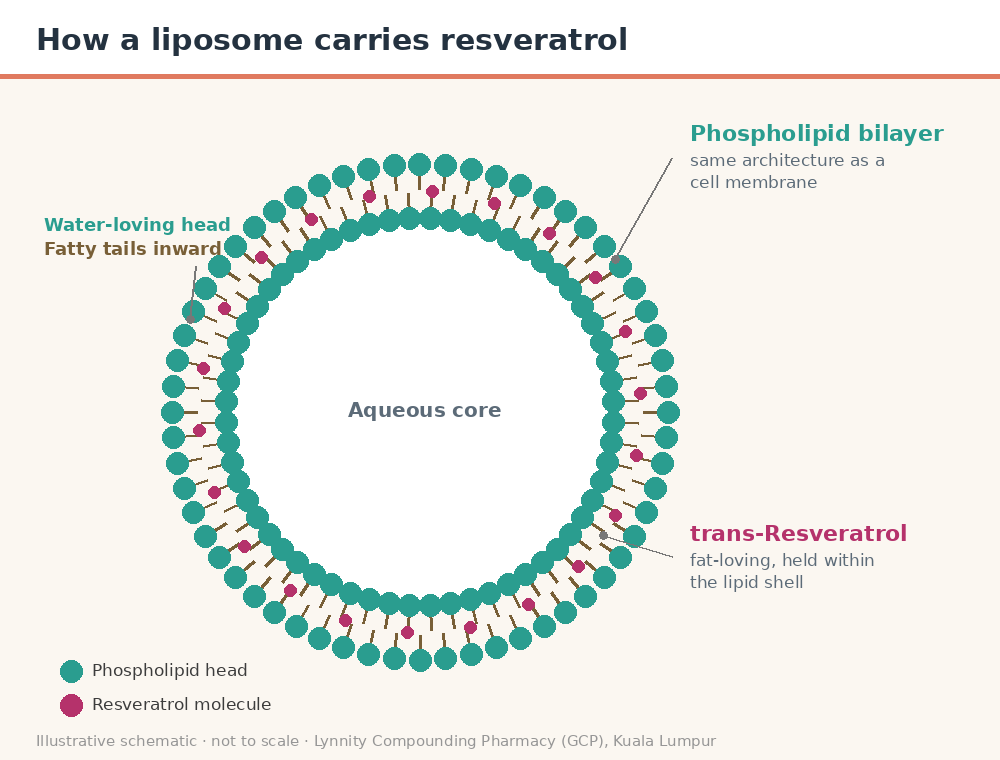
A liposome is a microscopic sphere whose wall is a phospholipid bilayer — the same class of fatty molecule that makes up your own cell membranes. Because resveratrol is fat-loving rather than water-loving, it can sit within that lipid shell itself, protected from oxidation and from the rapid first-pass conversion that destroys so much of an ordinary dose. The membrane-like carrier is designed to travel through the gut more intact and to present the compound for absorption — with some research pointing to uptake via the intestinal lymphatic route, which partly bypasses first-pass metabolism.
The published picture is encouraging but should be quoted carefully. Human and laboratory studies of lipid-based resveratrol delivery have reported meaningful increases in absorption — for example, roughly two- to three-fold higher blood levels from dispersion and liposomal approaches, and much larger gains in some phospholipid-complex models — compared with plain resveratrol. Those are real signals that the delivery problem can be improved. They are not a promise of a specific health outcome, and the size of the benefit varies with the exact formulation and the individual patient.
Two points keep this honest for practitioners. First, “liposomal” is a genuine pharmaceutical technique, but the word is applied loosely across the consumer market, and a label reading “liposomal” is not a guarantee that a properly formed liposome is present. Second, whether the added absorption is clinically meaningful for a particular patient remains a prescriber’s judgement; liposomal delivery is a tool to improve a known weakness, not a health claim. Lynnity makes no such claim.
Lynnity’s liposomal approach
Where a prescriber specifies a liposomal preparation, Lynnity compounds it in-house rather than repackaging a consumer product. Our formulation work centres on producing consistent, well-formed liposomes using an ultrasonic liposomal process, built on a skin-identical lipid base chosen to mirror the body’s own membrane chemistry. Because trans-resveratrol is oxidation-sensitive, freshness and handling matter: a compounded preparation is made to a defined standard with defined beyond-use dating, rather than sitting on a shelf for an unknown period. The aim is a reproducible, prescription-grade liposomal resveratrol — strength and lipid profile set by the doctor — not a generic off-the-shelf bottle.
Where a compounding pharmacy fits
Most resveratrol on the market is a mass-produced consumer supplement. A prescription-led compounding pharmacy occupies a different, narrower role.
Strength and form set by the prescriber
The clinical questions are which strength, in what delivery form, and for whom. Off-the-shelf products answer none of those individually. A compounded liposomal preparation lets the prescriber specify the exact strength — allowing genuine dose titration over a course — and lets the pharmacy build the liposomal carrier to a defined standard rather than trusting an opaque commercial “liposomal” claim.
A clean, defined excipient profile
Consumer supplements carry whatever fillers, flow agents and coatings the manufacturer chose, and independent testing has repeatedly found actual polyphenol content in some market products differing from the label. A compounded preparation lets the prescriber specify a lean, defined excipient and lipid profile — useful for patients with intolerances or on a tightly controlled regimen — with every ingredient signed off by the doctor.
Quality, freshness and traceability under GCP
A compounded liposomal resveratrol preparation is made and documented under the Ministry of Health’s Good Compounding Practice (GCP) guideline, with defined beyond-use dating and record-keeping — which suits an oxidation-sensitive polyphenol that benefits from fresh preparation. GCP is the compounding-specific quality framework; it is not the same as GMP, which governs large-scale manufacturing. Lynnity is a compounding pharmacy: we prepare individual, prescription-led formulations for named patients, and we do not mass-produce, contract-manufacture or wholesale products.
Safety — and why this is prescription-led
Resveratrol is generally well tolerated in the doses studied, with higher intakes most commonly associated with mild gastrointestinal upset. But it is not pharmacologically inert, and that is the point for prescribers. Resveratrol can have a mild blood-thinning (antiplatelet) effect and can influence some of the liver enzymes that metabolise medicines, so it warrants caution in patients on anticoagulants or antiplatelet therapy, those approaching surgery, and anyone on medicines with a narrow safety margin. Its interaction with hormone-sensitive situations is also not fully settled. None of this is a reason for alarm — it is the reason a doctor should assess suitability, screen for interactions and set the dose, and the reason Lynnity prepares resveratrol only against a prescription rather than selling it directly.
The practitioner workflow
Getting a compounded liposomal resveratrol preparation to a patient follows the same prescription-led path as any Lynnity formulation. A registered doctor assesses the patient and decides whether resveratrol is appropriate, whether a liposomal carrier is warranted, in what form and at what strength. That prescription comes to Lynnity; our pharmacists confirm the formulation is achievable and appropriate to compound; and the preparation is made under GCP and dispensed for the named patient. Longevity, aesthetic and wellness clinics that do not compound in-house can discuss the workflow with our pharmacy team first, so achievable strengths, delivery forms and beyond-use dating are clear before the first prescription is written. At no point can a patient — or a clinic — buy resveratrol from Lynnity without that prescription.
FAQ
Is liposomal resveratrol available over the counter in Malaysia?
Generic “liposomal” consumer versions are sold widely, but trans-resveratrol content, freshness and whether a true liposome is actually present vary considerably — and none is registered to treat any condition. A Lynnity compounded liposomal resveratrol preparation is prepared only on a registered doctor’s prescription, individualised to the patient; there is no direct-purchase or “no prescription needed” route with us.
Why does resveratrol need a liposomal form at all?
Because standard oral resveratrol is converted so rapidly in the gut wall and liver that typically under 1% circulates as the free compound. A liposomal shell — a phospholipid layer like your own cell membranes — is designed to protect the fat-loving molecule and support absorption. Whether that benefit is clinically meaningful for a given patient is the prescriber’s judgement.
Does liposomal delivery really improve absorption?
Studies of lipid-based resveratrol delivery do suggest higher blood levels than plain resveratrol — commonly reported as roughly two- to three-fold, with larger gains in some formulations. That addresses the delivery weakness; it does not, by itself, prove a particular health outcome, and results depend on the exact formulation.
Is a “liposomal” label always a real liposome?
Not necessarily. “Liposomal” is a genuine pharmaceutical technique, but the term is used loosely on consumer products and a label alone is no guarantee. This is part of why a prescriber may prefer a compounded preparation made to a defined standard rather than an opaque commercial claim.
Is resveratrol an anti-ageing treatment?
No. Lynnity does not prepare or promote resveratrol for any anti-ageing, disease or performance claim. It is prepared only for a doctor-assessed, prescription-led purpose, and the current human evidence does not support anti-ageing marketing.
Are there patients for whom resveratrol needs extra caution?
Yes. Because resveratrol can have a mild antiplatelet effect and can influence drug-metabolising enzymes, it warrants particular caution in patients on blood thinners or antiplatelet therapy, those nearing surgery, and anyone on medicines with a narrow safety margin — which is precisely why suitability, screening and dosing are decisions for the prescribing doctor.
We run a longevity or wellness clinic in KL — how do we start prescribing through Lynnity?
Visit www.lynnitypharma.com and ask to speak with a pharmacist. We can talk through achievable strengths, liposomal options, delivery forms and beyond-use dating before your first prescription is sent.
This article is general information for healthcare practitioners and is not medical advice. It does not diagnose, treat or recommend therapy for any condition, and it makes no anti-ageing or disease claim. Liposomal resveratrol preparations at Lynnity are prepared only on a prescription from a registered doctor.