
For healthcare professionals. Compounded preparations are dispensed on a doctor’s prescription.
Short answer: Creatine monohydrate has been studied in resistance-trained males (PMID 41579075), young adults in a resistance-training programme (PMID 39545789) and postmenopausal women. A 2026 meta-analysis of seven randomised trials (608 women) reported gains in leg-press strength with creatine, with the benefit evident at 5 g/day or more combined with resistance training (PMID 42141930). Doses differ; the prescriber sets the amount.
Why exercise performance is a prescribing question
Exercise performance and muscle strength are the indication this guide covers. A prescriber asked about creatine by a patient, a coach or a sports clinic faces three practical questions: which form, which daily amount, and over what period, in what training context. Creatine monohydrate is a single, well-defined compound, so the decision is less about which molecule to choose and more about the dose, the form and the training it is paired with.
The trials below express dose in two ways, as grams per day and as grams per kilogram of body weight. Where a prescriber works from a per-kilogram figure, the amount for one patient has to be calculated and written on the prescription. A compounded preparation is made to that written amount, for one named patient, on a registered doctor’s prescription.
The active and the formulation questions
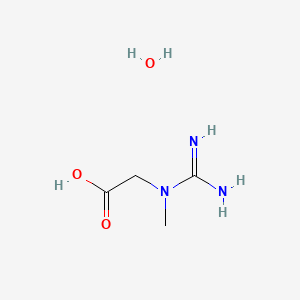
Creatine monohydrate is the form studied in the trials cited here. Its structure is shown below.
For compounding, three formulation questions matter: the amount per dose, the physical form of the powder and its container, and how the directions are written. The trials describe the creatine products they tested. They do not describe a compounded preparation, and their doses are study doses rather than recommendations for any individual.
What the trials show
Crossover trial in resistance-trained males
A double-blind, randomised crossover trial in resistance-trained males gave creatine monohydrate at 0.3 g/kg/day, or placebo, for three days (Journal of the International Society of Sports Nutrition, 2025; PMID 41579075). The abstract reports that creatine monohydrate significantly increased the repetitions completed at 60% to 80% of one-repetition maximum in the bench press and back squat, compared with placebo (PMID 41579075). Ten participants were analysed, so the result rests on a small group and a short dosing period.
Trial in young adults during an eight-week training programme
A randomised trial of 40 participants aged 18 to 25 years compared resistance training with creatine monohydrate, creatine hydrochloride or placebo over eight weeks (Physiological Research, 2024; PMID 39545789). The authors report that creatine monohydrate and creatine hydrochloride “significantly enhanced the beneficial effects of RT on strength, hypertrophy, and hormonal responses, with Cr-HCl showing no benefit over CrM” (PMID 39545789). The trial also tested a loading phase, which is set out in the dosing table below.
Meta-analysis in postmenopausal women
A systematic review and meta-analysis of seven randomised, placebo-controlled trials enrolled 608 women with a mean age of about 62 years (Journal of the International Society of Sports Nutrition, 2026; PMID 42141930). Its abstract reports a mean difference of +0.37 kg in lean mass (95% CI +0.05 to +0.69) with creatine, and a leg-press one-repetition maximum gain of +7.5 kg (95% CI +2.2 to +12.8) across three trials (PMID 42141930). The abstract says the benefits “were evident when creatine ≥ 5 g·day⁻¹ was combined with RT”, and that trials using “≤ 3 g·day⁻¹ without RT showed no measurable effect” (PMID 42141930). It describes the gains as “small but meaningful” and reports that bone density was unchanged overall (PMID 42141930). The abstract also reports that most included trials were rated “some concerns” for risk of bias (PMID 42141930), so the pooled gains should be read with that limitation in view.
Dosing ranges with sources
| Population and design | Regimen as reported | Duration as reported | Outcome as reported | PMID |
|---|---|---|---|---|
| Resistance-trained males, double-blind crossover | Creatine monohydrate 0.3 g/kg/day | Three days | More repetitions at 60% to 80% 1RM than placebo in bench press and back squat | 41579075 |
| Young adults (18 to 25 years) in a resistance-training programme | Loading 0.3 g/kg/day, then maintenance 0.03 g/kg/day (creatine monohydrate loading arm) | Loading five days; maintenance 51 days | Creatine monohydrate and creatine hydrochloride enhanced the effects of resistance training on strength; no benefit of Cr-HCl over CrM | 39545789 |
| Postmenopausal women, meta-analysis with resistance training | Creatine 5 g/day or more combined with resistance training | 12 to 104 weeks across trials | Benefit evident with resistance training; 3 g/day or less without resistance training showed no measurable effect | 42141930 |
These are the regimens each abstract reports. They are not dosing advice for a named patient, and the daily amount is the prescriber’s decision.
Safety, monitoring and interactions
In the postmenopausal meta-analysis, “adverse events were mild and similar to placebo; renal indices were unchanged” (PMID 42141930). These findings come from trials in one population, and they do not establish safety for every patient. Before writing a creatine preparation, a prescriber should screen for renal disease, fluid intake and any medicine that affects kidney function, and should set the daily amount with that screening in view.
Monitoring is the prescriber’s decision. A review date on the prescription lets the prescriber record training response and renal status at the interval the prescriber chooses. The trials cited here report the outcomes listed in the table and do not set a monitoring schedule.
Forms Lynnity prepares for this indication
Creatine monohydrate is prepared as a powder in a container, to the prescriber’s specification, for one named patient on a registered doctor’s prescription. The daily amount and the container quantity are written on the prescription. A per-kilogram or gram-per-day figure is measured from the container to the prescriber’s specification, and Good Compounding Practice (GCP) applies to each preparation.
Where the evidence stops
The three studies compare creatine monohydrate with placebo or with another creatine salt. None of them compares a compounded powder with a commercial product. The crossover trial was short and small. The meta-analysis pooled trials in postmenopausal women, a population that differs from the young adults in the other two trials. Results in a Malaysian clinic population are not established by these studies, and exposure beyond the durations in the abstracts is outside the evidence cited here.
How to prescribe
Creatine monohydrate is prepared only on a registered doctor’s prescription, for one named patient, under Good Compounding Practice (GCP). The prescription must state:
- the active, creatine monohydrate;
- the strength as the daily amount in grams, or in grams per kilogram of body weight, as the prescriber specifies;
- the form, a powder in a container;
- the quantity and the directions for use, including the planned duration and the review date.
Send the signed prescription through the contact page at https://www.lynnitypharma.com/contact-us/. A clinician who wants to start a conversation about a named patient can use the same route.
Related reading: custom compounded medication in Malaysia. Laboratory standards are described on the GCP laboratory page.
Reviewed by Vitthia Rama Murti, RPh (RPh 15632).
Frequently asked questions
What dose of creatine monohydrate do the trials use?
Doses differ between trials. One trial of 40 young adults in a resistance-training programme included a creatine monohydrate loading arm of 0.3 g/kg/day for five days, followed by 0.03 g/kg/day for 51 days (PMID 39545789). A 2026 meta-analysis of postmenopausal women reported benefit at 5 g/day or more combined with resistance training (PMID 42141930). The daily amount for any individual patient is the prescriber’s decision.
Is creatine monohydrate safe to prescribe?
In a 2026 meta-analysis of postmenopausal women, adverse events were mild and similar to placebo, and renal indices were unchanged (PMID 42141930). The trials are short and studied specific populations, so they do not establish safety for every patient. Renal risk, fluid intake and interacting medicines should be screened by the prescriber before a preparation is written.
Can a creatine powder be prescribed for one named patient?
Yes, on a registered doctor’s prescription. A compounded preparation is made for one named patient under Good Compounding Practice (GCP). The prescription states the active, the daily amount, the form, the quantity and the directions for use. Compounded preparations are not sold directly to patients.
What did the trials report for muscle strength?
Results differ by design. A crossover trial in resistance-trained males reported more repetitions at 60% to 80% of one-repetition maximum with creatine monohydrate than with placebo (PMID 41579075). A meta-analysis of three trials in postmenopausal women reported a leg-press gain of 7.5 kg (95% CI 2.2 to 12.8) (PMID 42141930). Both are limited to the populations and durations they studied.