
Short answer: In a topical preparation, the base is not inert packaging around the active — it is the single biggest determinant of whether the active ever reaches its target. The skin is built to keep things out, and its outermost layer, the stratum corneum, is a dense lipid barrier that most topical actives simply do not cross in useful amounts. A compounding pharmacy has two levers here that a finished tube off the shelf does not. The first is liposomal delivery: wrapping the active in a phospholipid vesicle that research suggests can carry it through the skin’s own lipid route rather than leaving it stranded on the surface. The second is a skin-identical lipid base — a cream built from the same lipid families (ceramides, cholesterol and free fatty acids) the barrier is itself made of, so it is recognised and integrated by the skin rather than forced through it. These are Lynnity’s two core capabilities, and both are prescriber-controlled. A retail cream comes in one strength, one base and one excipient list; a Lynnity compounded topical is made to a registered doctor’s prescription, under the Ministry of Health’s Good Compounding Practice (GCP) guideline, with no direct-purchase route. This guide is written for prescribing and referring clinicians in Kuala Lumpur, the Klang Valley and Singapore.
Clinicians choose an active with care and then, very often, give no thought at all to the vehicle it is dispensed in. Yet two creams containing the identical active at the identical percentage can behave completely differently on skin, because the base governs how much of that active is released, how far it penetrates, and how well it is tolerated. For a compounding pharmacy, the base is where most of the real formulation work happens.
The barrier you are actually prescribing across
The stratum corneum is often described as a “brick-and-mortar” wall. The bricks are corneocytes — flattened, protein-filled dead cells — and the mortar is a set of tightly ordered lipid layers, the lamellae, made predominantly of ceramides, cholesterol and free fatty acids. That lipid mortar, not the cells, is the rate-limiting barrier: it is what keeps water in (limiting transepidermal water loss) and keeps most foreign molecules out.
This is why so much topical prescribing quietly underperforms. An active dissolved in a generic base tends to sit on the surface, and only a small, variable fraction diffuses across the lamellar lipids into the living epidermis where it can act. The molecule’s size, its water- or fat-solubility, and above all the base it is carried in all decide how much arrives. Change nothing but the base and the delivered dose can change substantially.
What liposomal delivery is designed to change
A liposome is a microscopic vesicle whose wall is a phospholipid bilayer — the same architecture as a cell membrane — enclosing a watery core. That structure lets it carry water-soluble actives in the core and fat-soluble actives in the wall, and, crucially, it is chemically similar to the skin’s own lipids.
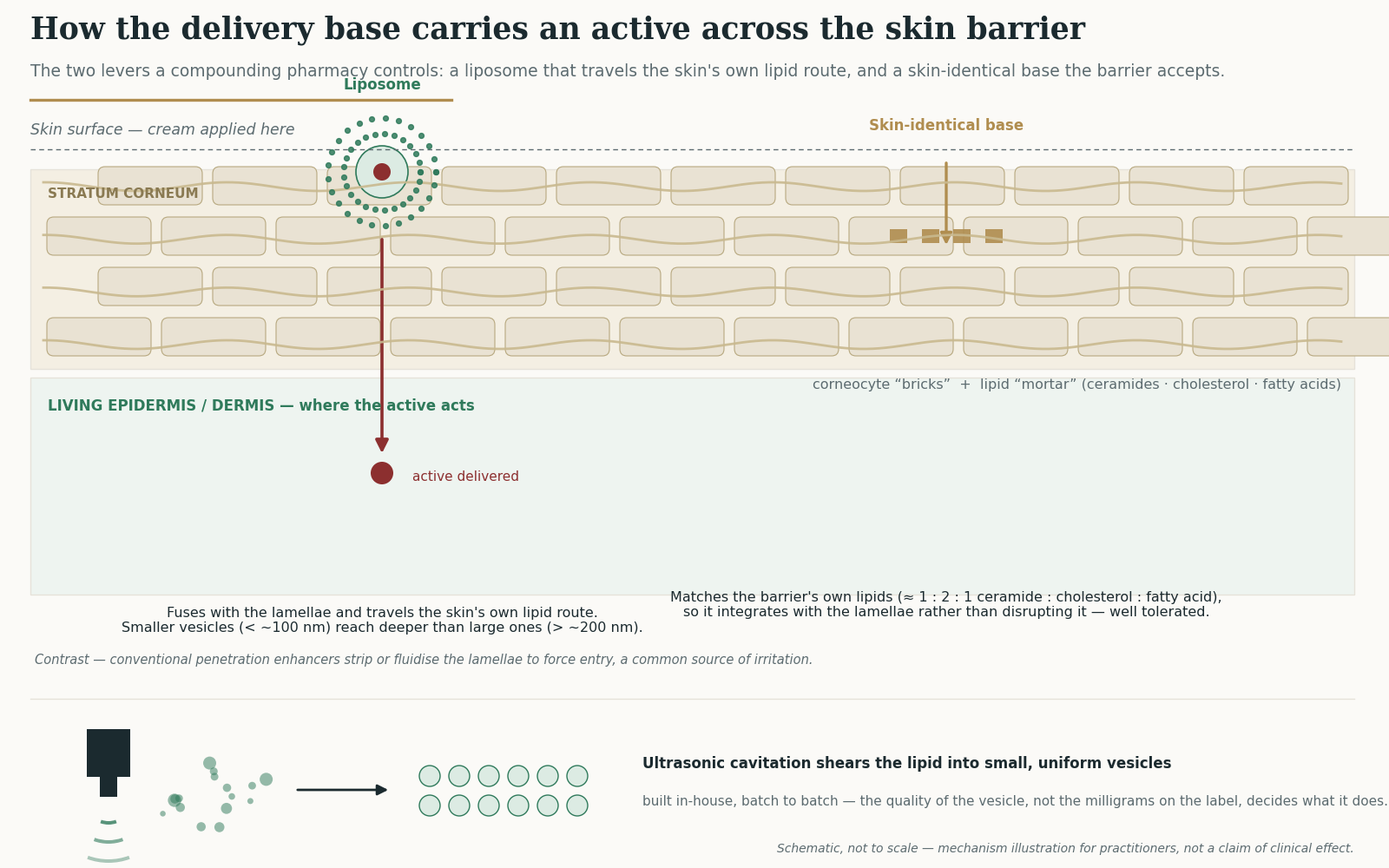
The published work on topical liposomes is encouraging, though it should be read as mechanism rather than as a promise of any clinical result. Skin-penetration studies report that phospholipid vesicles can increase the delivery of both entrapped and non-entrapped hydrophilic substances into the stratum corneum, and in some confocal work into the deeper epidermis and dermis. Proposed mechanisms include the vesicle fusing and merging with the barrier’s own lipids, transiently fluidising the lamellae so an active can pass, and travelling along the intercellular and follicular routes. One consistent finding matters for formulation: size is decisive. Research indicates that smaller vesicles — broadly under about 100 nm — reach the epidermis and dermis far more readily than larger ones above roughly 200 nm, which tend to stay superficial. In other words, a well-made small vesicle behaves very differently from a large, loose one, even at the same lipid concentration.
Why how the vesicle is made decides what it does
This is where a compounded preparation and a jar merely labelled “liposomal” part company. If the vesicles are large, uneven or unstable, the word on the label means very little. Lynnity builds its liposomes with ultrasonic technology: high-frequency sound waves generate and collapse microscopic cavities throughout the lipid dispersion, and those micro-implosions shear the lipid into small, uniform vesicles. The energy density is well beyond what ordinary mechanical mixing reaches — this is cavitation, not stirring — and the process is designed to yield a consistent, reproducible vesicle population from batch to batch. We describe what the technology does; we do not attach a penetration multiple or a health outcome to it.
The skin-identical lipid base
The second lever is the cream itself. Most conventional penetration enhancers work by disrupting the barrier — solvents and surfactants that fluidise or strip the lamellar lipids to force an active through. They can be effective, but that disruption is a well-recognised source of stinging, redness and irritation, which is exactly the wrong trade-off in already-compromised or sensitive skin.
A skin-identical base takes the opposite approach. It is built from the same lipid families that make up the barrier — ceramides, cholesterol and free fatty acids — in physiological proportions. The dermatology literature is clear that these lipids matter in the right ratio: studies of barrier-repair moisturisers report that formulations supplying ceramides, cholesterol and fatty acids in a balanced, physiological ratio restore the lamellar layers and reduce transepidermal water loss, with hydration and barrier benefits sustained far longer than non-physiological moisturisers achieve. Because such a base is recognised by the barrier rather than experienced as an attack on it, it is designed to integrate with the skin’s lamellar structure and carry its active along — a key the barrier already accepts, rather than a solvent forcing the lock. For clinicians managing fragile or reactive skin, that difference in tolerability is often as important as delivery itself.
Where this changes prescribing
The base is not an academic point; it changes what is achievable across several clinics that refer to us.
Dermatology and aesthetics
Many of the most-requested actives are either unstable, poorly penetrating, or irritating in a standard base. A liposomal or skin-identical preparation lets the prescriber set the active, the strength and the vehicle together, and is often better tolerated on inflamed or sensitive skin. The clinical indication and the choice of active remain entirely the doctor’s; the pharmacy’s job is to deliver that active into the skin as intended.
Topical hormones
Bioidentical hormone therapy is frequently prescribed as a cream or gel, where the base squarely determines absorption and dose consistency. A defined, reproducible base is central to making a topical hormone preparation behave predictably from one batch to the next — a formulation matter that sits alongside, and never replaces, the prescriber’s clinical decision.
Pain and sensitive-skin referrals
Topical routes are attractive when a clinician wants a local effect or wishes to avoid an oral one. A base engineered for delivery and tolerability is the difference between a preparation that is used as directed and one abandoned because it stings.
The same science powers our supplements
The liposomal capability is not limited to creams. The identical in-house ultrasonic process builds the oral liposomal supplement formulations that are Lynnity’s other core strength — so a clinic can source both a topical and an oral preparation, made to prescription, from one compounding pharmacy.
What a compounding pharmacy controls that a tube cannot
A finished retail cream fixes every variable at the factory. A prescription-led compounding pharmacy re-opens each of them for the prescriber.
Strength and active form
The exact percentage a clinician wants frequently does not exist commercially, and the salt or ester of an active can be chosen for stability or tolerability. Both are set to the prescription.
Base chemistry
Liposomal, skin-identical, anhydrous, gel or ointment — the vehicle is matched to the active and to the skin it is going on, rather than accepted as whatever the manufacturer supplied.
Excipient and allergen control
Fragrance-free, preservative-minimal and allergen-conscious preparations are possible where a patient’s history demands them — routinely a problem with off-the-shelf products.
Combination and beyond-use dating
Where clinically appropriate and compatible, more than one active can be combined into a single preparation, and each formulation is assigned a beyond-use date established under GCP rather than an arbitrary shelf life.
How a clinic works with us
Every Lynnity preparation — topical creams and oral supplements alike — is made only on a prescription from a registered doctor after assessment. There is no direct-purchase route, and nothing on this page can be bought without a prescription. A clinic in KL, the Klang Valley or Singapore usually speaks with one of our pharmacists first to establish which actives, strengths, bases and beyond-use dates are achievable, then sends the prescription. Formulations are prepared by our registered pharmacists under the Ministry of Health’s Good Compounding Practice (GCP) guideline.
Frequently asked questions
Does a liposomal cream actually penetrate better than a standard cream?
The published skin-penetration research is generally supportive: phospholipid vesicles have been reported to increase delivery of actives into the stratum corneum and, in some studies, into deeper skin layers, with smaller vesicles (broadly under about 100 nm) performing better than larger ones. That is a mechanism finding, not a guarantee of a clinical result, and how well any given preparation performs depends heavily on how the vesicles are made.
What is a skin-identical lipid base?
It is a cream built from the same lipid families as the skin barrier itself — ceramides, cholesterol and free fatty acids in physiological proportions. Because the barrier recognises these lipids, the base is designed to integrate with the skin’s own lamellar structure and to be well tolerated, rather than disrupting the barrier the way many conventional penetration enhancers do.
Is this the same liposomal technology as Lynnity’s supplements?
Yes. The same in-house ultrasonic process that builds our oral liposomal supplement formulations also builds the liposomes used in topical preparations. Liposomal formulation and specialised creams are Lynnity’s two core capabilities, so a clinic can obtain both oral and topical preparations from one compounding pharmacy.
How are the liposomes actually made?
With ultrasonic technology. High-frequency sound waves create and collapse microscopic cavities in the lipid dispersion, and that cavitation shears the lipid into small, uniform vesicles rather than mixing them mechanically. The aim is a consistent, reproducible vesicle population from batch to batch; no penetration or outcome figure is attached to it.
Can any active be put into a liposomal or skin-identical base?
Many can, but not all — compatibility, stability and the physicochemistry of the active all matter, and some actives are unsuitable. Our pharmacists assess each request on a case-by-case basis and advise the prescriber on what is achievable before anything is compounded.
Do patients need a prescription for a compounded cream?
Yes. Every compounded preparation at Lynnity, topical or oral, is made only on a prescription from a registered doctor after assessment. There is no direct-purchase route, and a compounded cream is not something a patient can buy over the counter.
Can you match a strength or base that has been discontinued or is unavailable?
Often, yes — reproducing a specified strength, active form or base is a routine reason clinicians refer to a compounding pharmacy. It is done to the prescription and subject to the pharmacist’s stability and compatibility assessment.
Is a compounded cream tested and stable?
Compounding is carried out by registered pharmacists under the Ministry of Health’s Good Compounding Practice (GCP) guideline, and each preparation is assigned a beyond-use date rather than an arbitrary shelf life. Formulation choices are documented, and stability considerations are part of deciding what can be made and for how long it is valid.
We run a clinic in KL or Singapore — how do we start?
Contact us through lynnitypharma.com and ask to speak with a pharmacist. We can talk through achievable actives, strengths, liposomal specifications, cream bases and beyond-use dating before your first prescription is sent.
Reviewed by the Lynnity pharmacy team — registered pharmacists compounding to Good Compounding Practice (GCP) in Kuala Lumpur.
This article is general information for healthcare practitioners and is not medical advice. It does not diagnose, treat or recommend therapy for any condition. Compounded preparations at Lynnity are prepared only on a prescription from a registered doctor.
Compliance gate — PASS
- Every product prescription-led; “there is no direct-purchase route” stated twice; no “no prescription needed” language anywhere.
- Retail creams’ availability acknowledged honestly and explicitly separated from the Lynnity compounded preparation — no implication that ours can be bought directly.
- “Good Compounding Practice (GCP)” used throughout; the incorrect manufacturing acronym is absent.
- “Liposomal” used throughout; the Bionutricia-only brand term is absent.
- Skin-barrier + liposome penetration structure diagram included (house rule for any liposomal article).
- Unique cover image built for this article; no reuse of an earlier cover.
- No OEM / contract-manufacturing positioning; Lynnity framed as a compounding pharmacy only.
- No disease treatment or cure claim; penetration described as a mechanism, not a clinical outcome; indication always left to the prescriber.
- All science traceable to published sources; no fabricated statistics, clinical data or testimonials; hedged language throughout.
- Domain lynnitypharma.com (non-www) only; the old Hostinger domain is not used; no pricing.
- Practitioner-facing (B2B) audience and tone; localised to KL / Klang Valley / Singapore.
- Core-strength angle carried and made the spine: liposomal delivery + specialised skin-identical creams both central.