
Short answer: Alpha-lipoic acid is one of the very few nutritional actives that Malaysia’s own regulator has singled out for a mandatory warning statement. In April 2022 the Drug Control Authority directed that health-supplement products containing alpha-lipoic acid carry added warnings on their labels, package inserts and patient leaflets. The reason is a rare but real autoimmune reaction — insulin autoimmune syndrome — whose genetic susceptibility is concentrated in East Asian populations. That combination, a genuinely useful active with a population-specific safety signal, is precisely the case for supervised, prescription-led, dose-controlled compounding rather than a shelf purchase. Every Lynnity preparation, alpha-lipoic acid included, requires a prescription from a registered doctor.
Why alpha-lipoic acid sits differently in Malaysia
Most nutritional actives arrive in a clinic with no regulatory annotation at all. Alpha-lipoic acid arrives with one.
Under Directive No. 2 of 2022, issued 11 April 2022 by the Director of Pharmaceutical Services under Regulation 29 of the Control of Drugs and Cosmetics Regulations 1984, and following the Drug Control Authority’s 371st meeting on 7 April 2022, all labels, package inserts and Consumer Medication Information Leaflets (RiMUP) for health-supplement products containing alpha-lipoic acid must carry added warning statements. The directive is public on the NPRA site and is worth reading in full before you write your first script.
Malaysia is not alone. Health Canada completed a safety review in 2016 after case reports of hypoglycaemic episodes linked to oral alpha-lipoic acid, and moved to update its labelling standard. The European Food Safety Authority published a dedicated scientific opinion in 2021 on the relationship between alpha-lipoic acid intake and insulin autoimmune syndrome. Three independent regulators, converging on the same signal, is not noise.
What this does not mean: a warning statement is not a ban, and it is not a verdict on efficacy. It is a regulator saying that this active has a recognised adverse effect that the person taking it should be told about. In practice it argues for a prescriber in the loop — which is how Lynnity dispenses everything anyway.
What the published trial reported
The most-cited human data on oral alpha-lipoic acid comes from the SYDNEY 2 trial, published in Diabetes Care in 2006. It was a multicentre, randomised, double-blind, placebo-controlled study in 181 adults with diabetes across Russia and Israel, testing 600, 1,200 or 1,800 mg per day orally for five weeks after a one-week placebo run-in.
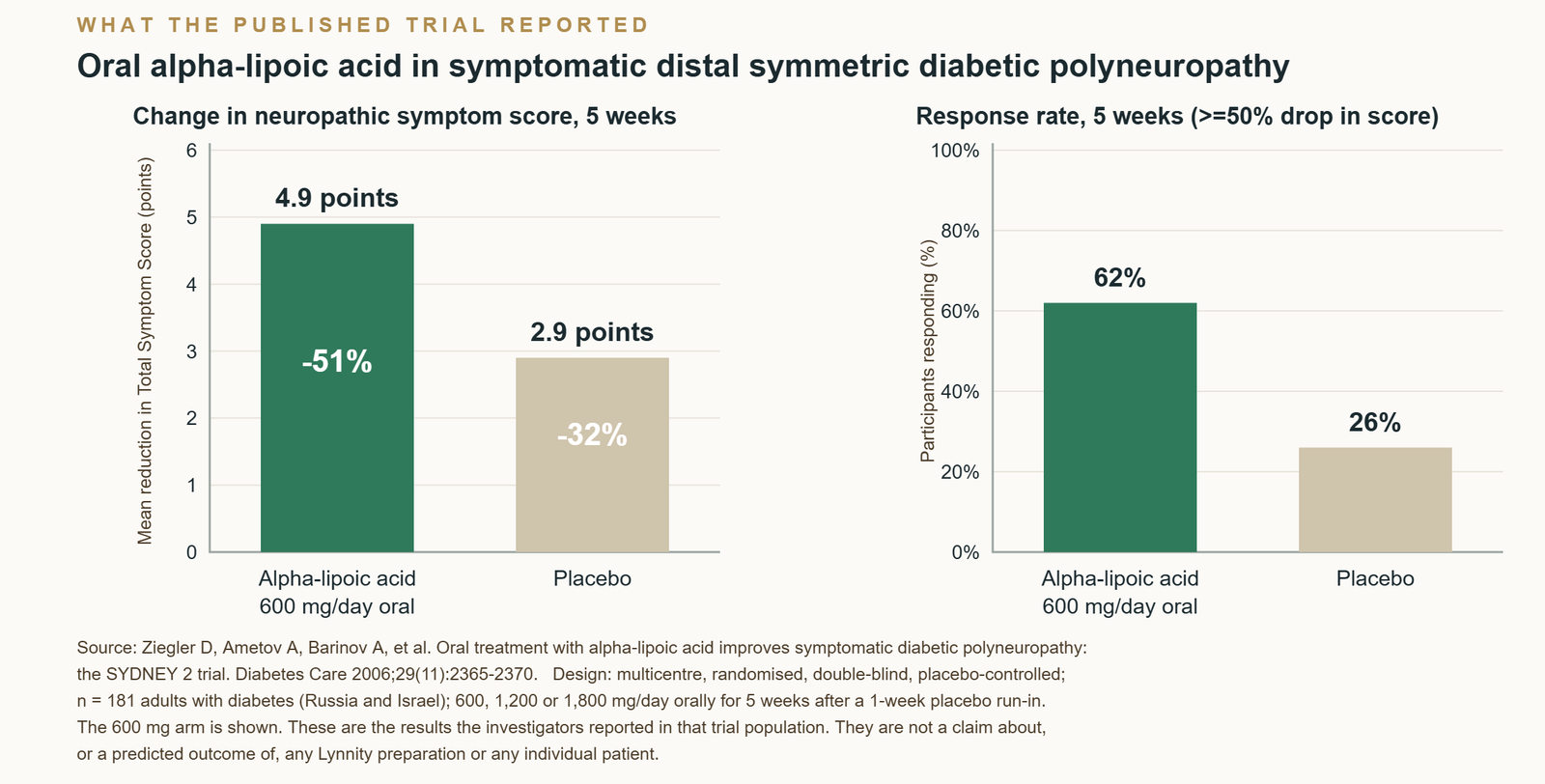
Two things are worth flagging honestly. First, the placebo arm also improved substantially — a reminder of how much symptom-score endpoints move on their own. Second, five weeks is a short window, and later analyses of the wider alpha-lipoic acid literature have been more equivocal than the headline figures suggest. Studies suggest a benefit in this setting; they do not establish one for any individual, and nothing here should be read as a claim that a compounded preparation treats or cures any condition.
The safety signal: insulin autoimmune syndrome
Insulin autoimmune syndrome, also called Hirata disease, is a rare cause of hypoglycaemia in which the body produces autoantibodies against its own insulin. It was first described in Japan in 1970 and is classically triggered by compounds containing a sulphhydryl group. Alpha-lipoic acid contains exactly that group.
Since the first alpha-lipoic acid–associated cases were reported in Japan in 2006, the case literature has grown steadily and now includes European, Korean and Indian reports. The pattern in most published cases is consistent: hypoglycaemia with inappropriately high measured insulin and detectable insulin autoantibodies, resolving after the alpha-lipoic acid is withdrawn.
The part that matters most in this region: susceptibility is strongly HLA-linked. In Japanese patients the association is with HLA-DRB1*04:06; in European patients the reported association is with HLA-DRB1*04:03 instead. Those alleles are not evenly distributed across populations. Practitioners serving Chinese-Malaysian, Japanese, Korean and other East Asian patients in the Klang Valley and Singapore are working with a population in which the classical susceptibility allele is more prevalent than in the European populations most Western supplement guidance is written for. Nobody is genotyping patients before a supplement — but knowing which of your patients sits in the higher-prior group changes how carefully you counsel and monitor.
Symptoms to brief patients on are the ordinary ones of hypoglycaemia: sweating, pallor, chills, headache, dizziness, tremor, confusion. The instruction is simple — stop the preparation and contact the prescriber.
Why alpha-lipoic acid is genuinely hard to formulate
This is where compounding earns its place, and it is not marketing. Alpha-lipoic acid is an awkward molecule.
| Property | Consequence for the preparation |
|---|---|
| Polymerisation on heating | Alpha-lipoic acid and its pure optical isomers polymerise readily when warmed, forming a sticky, tough mass that can no longer be processed. Process temperature is not a detail — it is the whole game. |
| Melting point | The pure enantiomers melt at roughly 47–49 °C, against 58–61 °C for the racemic compound. In an un-airconditioned store room in KL that margin is uncomfortably thin. |
| R vs racemic | The R-enantiomer is the biologically active form and shows better pharmacokinetics — but it is also the less stable one. The presence of the S-enantiomer in a racemic mixture appears to physically hinder polymerisation, which is one reason most commercial material is racemic. |
| Bioavailability | Roughly 30–40% of an oral dose of racemic material is absorbed, with rapid hepatic clearance and a short half-life. Food matters: taking it with food has been reported to lower peak plasma concentration by about 30% and total exposure by about 20%. |
| Liquid vs solid | Liquid presentations have been associated with higher plasma concentrations than solid dosage forms — relevant when a patient’s absorption is already compromised. |
Note the paradox buried in that table: a badly made pure-R product can perform worse than a well-made racemic one, because instability eats the advantage. “R-ALA” on a label is a claim about chemistry, not about what survived to the patient. This is exactly the kind of question a prescriber can put to a compounding pharmacy and get a straight answer to.
What Lynnity can prepare — and what it cannot
Lynnity compounds to a doctor’s prescription in capsule, liquid, cream, tonic and serum forms, under Good Compounding Practice (GCP). For alpha-lipoic acid the practical options are:
- Capsule — the workhorse. Dose set by the prescriber rather than by whatever strength a brand happened to choose, which matters when you want to start low and review.
- Oral liquid — useful where swallowing is difficult, where a slow upward titration is wanted, or where the prescriber wants the absorption profile associated with liquid presentations.
- Tonic — where alpha-lipoic acid sits inside a wider prescribed plan alongside compatible nutrients.
A measured powder dispersed into a liquid is also workable. What Lynnity does not make is a compressed tablet or a softgel — and in this specific case that limitation is barely a limitation at all. Commercial softgels and tablets come in fixed strengths chosen for a mass market, and pressing pure R-lipoic acid into tablets is difficult and costly precisely because of that low melting point. Dose flexibility and gentle processing are the two things this molecule actually needs.
Practical notes for prescribers
- Timing. Absorption is meaningfully better away from food; most trial dosing is a single daily dose. Where daytime glucose handling is the aim, roughly 30 minutes before the first meal is the conventional instruction.
- Concurrent glucose-lowering therapy. Patients on insulin or sulphonylureas warrant closer monitoring, and it is worth stating the hypoglycaemia counselling explicitly in the notes.
- Baseline. Where hypoglycaemia later occurs, having a pre-treatment picture makes the differential far cleaner.
- Stop rule. Give every patient an unambiguous one: hypoglycaemic symptoms mean stop and call. In the published cases, withdrawal was what resolved it.
- Storage. Cool and dark, and take shelf life seriously. This is not a molecule that forgives a hot car boot.
Working with Lynnity
Lynnity Compounding Pharmacy is based in Kuala Lumpur and works with clinics across the Klang Valley and with practitioners in Singapore. Every preparation — including nutritional and supplement formulations — is made only against a prescription from a registered doctor. Lynnity does not hold MAL registration for compounded preparations, does not sell direct to patients without a prescription, and does not do contract manufacturing.
Practitioners who want to discuss an alpha-lipoic acid formulation — strength, form, stability, or how to structure a cautious trial in a patient with concurrent glucose-lowering therapy — can contact the pharmacy directly to talk it through with a compounding pharmacist before writing.
Frequently asked questions
Is alpha-lipoic acid banned in Malaysia?
No. It is not banned. Malaysia’s Drug Control Authority directed in April 2022 (Directive No. 2 of 2022, issued under Regulation 29 of the Control of Drugs and Cosmetics Regulations 1984) that health supplement products containing alpha-lipoic acid must carry added warning statements on labels, package inserts and consumer leaflets. It remains available, with mandated warnings.
Why does alpha-lipoic acid need a prescription at Lynnity?
Every Lynnity preparation requires a prescription from a registered doctor, supplements included. In alpha-lipoic acid’s case there is an added clinical argument: a recognised hypoglycaemia signal, an interaction concern with insulin and sulphonylureas, and a genetic susceptibility that is more common in East Asian populations.
What is insulin autoimmune syndrome?
Also called Hirata disease, it is a rare autoimmune cause of hypoglycaemia in which the body forms autoantibodies against its own insulin. It is classically triggered by sulphhydryl-containing compounds, of which alpha-lipoic acid is one. Susceptibility is HLA-linked: HLA-DRB1*04:06 in reported Japanese cases and HLA-DRB1*04:03 in reported European cases. Published cases have generally resolved after the alpha-lipoic acid was stopped.
Is R-alpha-lipoic acid better than the racemic form?
The R-enantiomer is the biologically active form and shows better pharmacokinetics in principle, but it is also less stable and polymerises more readily. A poorly formulated R product can underperform a well-made racemic one. Formulation and handling matter at least as much as which enantiomer is named on the label.
What dose of alpha-lipoic acid is used in the published research?
Most human trials have used 600 mg per day of racemic alpha-lipoic acid orally, often as a single dose. The SYDNEY 2 trial tested 600, 1,200 and 1,800 mg per day. Dose for an individual patient is a prescriber’s decision, not something to take from a trial protocol.
Should alpha-lipoic acid be taken with or without food?
Studies suggest absorption is better on an empty stomach. Taking it with food has been reported to reduce peak plasma concentration by around 30% and total exposure by around 20%. Where daytime glucose handling is the objective, dosing roughly 30 minutes before the first meal is the conventional approach, but the prescriber’s instruction governs.
Can Lynnity supply alpha-lipoic acid as a tablet or softgel?
No. Lynnity compounds in capsule, liquid, cream, tonic and serum forms only. For alpha-lipoic acid a capsule or an oral liquid is generally the better route in any case, since the molecule’s low melting point makes tablet pressing difficult and compounding allows the prescriber to set the strength.
Clinically reviewed by the Lynnity compounding team, Kuala Lumpur. This article is written for registered healthcare practitioners and is provided for professional information only. It is not medical advice, not a treatment recommendation, and not a claim that any compounded preparation treats, prevents or cures any disease. All Lynnity preparations, including nutritional and supplement formulations, require a prescription from a registered doctor. Compounded to Good Compounding Practice (GCP). Last reviewed 15 August 2026.