
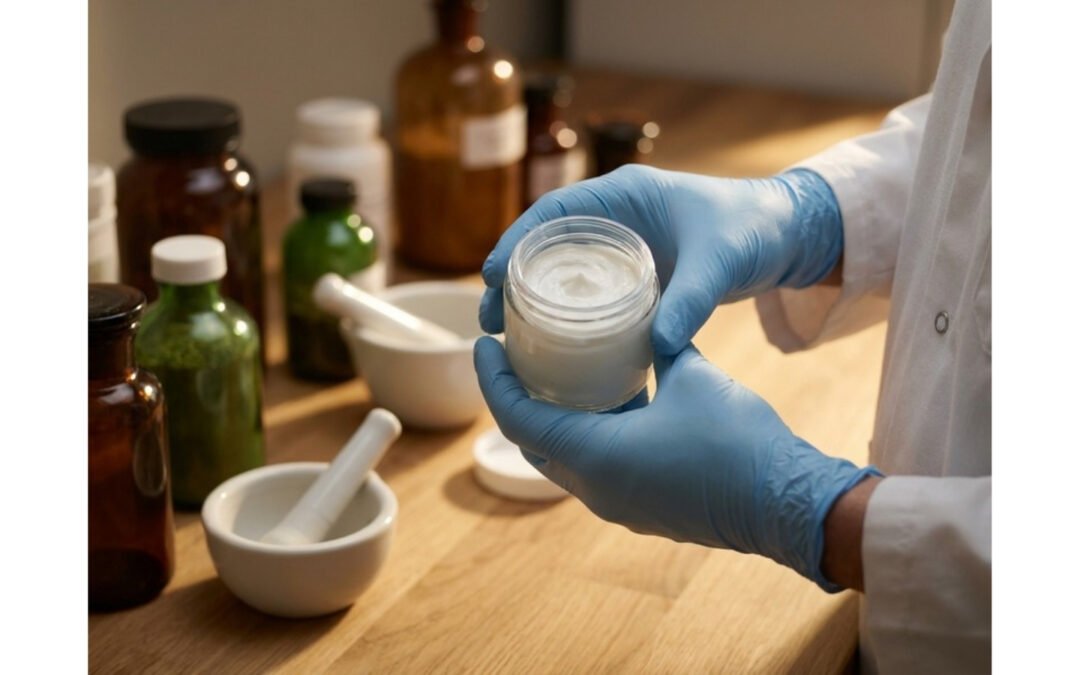
Short answer: A clinical decision pathway for compounded eczema creams starts with standard dermatology assessment — confirm the diagnosis, grade severity, and address triggers and infection first. Compounding enters the conversation when a patient’s needs fall outside what off-the-shelf products serve well: specific excipient exclusions, a vehicle mismatch with the treatment site, or a regimen too complex for reliable adherence. A network meta-analysis of topical anti-inflammatory treatments for eczema confirms that choice of active, potency and vehicle all influence outcomes, while a Cochrane review of emollients and moisturisers found that product performance varies substantially across formulations.12 A clinical trial comparing different emollient creams demonstrated diverse physiological effects on the skin barrier in adults with atopic dermatitis, reinforcing that vehicle selection is a clinical decision, not an afterthought.3
Step 1 — Standard assessment before considering compounding
Before compounding is discussed, the prescriber should complete the same assessment that applies to any eczema presentation. This includes confirming the diagnosis of eczema (rather than a mimicker such as contact dermatitis or a fungal infection), grading severity, and reviewing modifiable triggers — soaps, irritants, heat, stress and known allergens. Secondary infection should be considered when a flare is unusually severe or prolonged, because untreated infection can mimic a treatment failure that compounding will not solve.
The clinical literature consistently positions topical anti-inflammatory therapy and regular emollient use as the foundation of eczema management. A 2024 Cochrane network meta-analysis examined topical anti-inflammatory treatments across studies and reported differences in efficacy and tolerability among treatments, underscoring that the choice of active and potency belongs to the prescriber’s clinical judgement rather than a single default.1
Step 2 — Identify the formulation problem compounding could solve
Compounding is a formulation tool, not a therapeutic upgrade. The decision to compound should be triggered by a specific, identifiable formulation problem — not by dissatisfaction with standard therapy in general. Three categories of problem most commonly justify a compounded preparation.
Excipient intolerance
When a patient reacts to a fragrance, preservative or other non-active component in a commercial product, compounding allows that ingredient to be excluded. This is one of the most practical and clinically rational uses of a compounded eczema cream. The aim is to reduce avoidable irritant burden while maintaining the prescribed treatment plan.
Vehicle mismatch with the anatomical site
The same active ingredient can perform differently depending on the vehicle. A heavy ointment may be appropriate on thickened, lichenified skin but impractical on the face or hands. A clinical trial demonstrated that different emollient cream formulations produce diverse physiological effects on the skin barrier in adults with atopic dermatitis, which means vehicle choice is clinically meaningful, not merely cosmetic.3 A Cochrane review of emollients and moisturisers for eczema found that while emollients are a useful part of care, product performance varies and the evidence does not uniformly favour one base over another.2
Regimen complexity undermining adherence
When a patient is juggling multiple products with unclear timing, simplification through a single compounded preparation can improve adherence. The value here is operational — reducing friction in daily use — not a claim that compounding makes the active ingredient more effective.
Step 3 — Specify the formulation brief for the compounding pharmacy
Once the formulation problem is identified, the prescriber should communicate a concise brief to the compounding pharmacy. Useful details include the diagnosis and anatomical site, the intended active ingredient and potency, any known excipient exclusions, previous product tolerability issues, and the treatment goal (simplification, barrier support, or excipient avoidance). This allows the pharmacy to assess whether the requested cream format is practical within non-sterile compounding scope.
Compatibility and stability questions should be discussed with the pharmacy before the formulation is finalised. A clinically reasonable idea may require adjustment if the requested combination, concentration or base is not suitable for reliable preparation. Prescribers should treat this as a collaborative discussion rather than a purely administrative step.
Step 4 — Set the review plan
A compounded eczema cream does not replace the need for structured follow-up. The prescribing plan should set out where the cream is to be used, how often, and when the patient should return for review. Clear directions remain essential: a good formulation paired with a vague plan is still a weak combination. The plan should also specify what signs should trigger reassessment — spreading rash, worsening symptoms, or signs of infection — so that patients and clinic staff know when to return before the next scheduled review.
Step 5 — Know when compounding is not the answer
Compounding does not bypass standard eczema assessment, nor does it create evidence beyond what the published literature supports. If the underlying problem is misdiagnosis, untreated infection, or a need to escalate to systemic therapy, a compounded cream will not address it. The decision pathway should therefore include explicit criteria for when to refer back to standard treatment, escalate, or seek specialist input — rather than assuming compounding will resolve a treatment failure that has a different root cause.
Published studies support emollient use, barrier-focused care and topical anti-inflammatory treatment in eczema, but they do not validate every possible compounded formulation.123 Evidence describes the active ingredient or formulation principle studied, not a Lynnity preparation of it.
How this fits the Lynnity practice context
Lynnity Pharma operates as a non-sterile compounding pharmacy in Kuala Lumpur serving the Klang Valley, with enquiries also coming from Singapore. Across its published materials, the service focus is patient-specific compounding under Good Compounding Practice (GCP), including topical preparations prepared for a named individual on prescription.A An eczema-related referral is best framed as a practitioner-to-pharmacy discussion about formulation fit, excipient constraints and quality considerations, rather than as a claim that compounding is automatically superior to commercial care.
Frequently asked questions
When should a prescriber consider a compounded eczema cream?
Consider compounding when a patient has a specific formulation problem: excipient intolerance, a vehicle mismatch with the treatment site, or a regimen too complex for adherence. Compounding is a formulation decision, not a substitute for standard eczema assessment or a therapeutic upgrade.
Does the vehicle base affect clinical outcomes in eczema?
Yes. A clinical trial showed that different emollient cream formulations produce diverse physiological effects on the skin barrier in adults with atopic dermatitis. A Cochrane review found that emollient performance varies across products. Vehicle choice is therefore a clinical decision, not an afterthought.23
What information should a prescriber include in a compounding referral for eczema?
Include the diagnosis, anatomical site, intended active and potency, known excipient exclusions, previous product tolerability issues, and the treatment goal. Discuss compatibility and stability with the pharmacy before finalising. A collaborative brief produces a more reliable formulation than a diagnosis alone.
Can a compounded eczema cream replace standard topical anti-inflammatory therapy?
No. Compounding is a formulation tool, not a replacement for evidence-based eczema care. A 2024 Cochrane network meta-analysis confirms that topical anti-inflammatory treatments differ in efficacy and tolerability. The decision to compound should sit within, not replace, the standard treatment framework.1
Reviewed by Vitthia Rama Murti, RPh (RPh 15632)
For practitioner enquiries, clinicians can discuss a patient-specific non-sterile topical formulation with the Lynnity team and provide the prescribing brief needed for pharmacy review, including the intended vehicle, active plan and any excipient exclusions.
References
- Lax SJ et al. Topical anti-inflammatory treatments for eczema: network meta-analysis. The Cochrane database of systematic reviews. 2024. PMID: 39105474. https://pubmed.ncbi.nlm.nih.gov/39105474/
- van Zuuren EJ et al. Emollients and moisturisers for eczema. The Cochrane database of systematic reviews. 2017. PMID: 28166390. https://pubmed.ncbi.nlm.nih.gov/28166390/
- Danby SG et al. Different types of emollient cream exhibit diverse physiological effects on the skin barrier in adults with atopic dermatitis. Clinical and experimental dermatology. 2022. PMID: 35167133. https://pubmed.ncbi.nlm.nih.gov/35167133/
Grounding source A: Lynnity Pharma blog post ID 374325, https://www.lynnitypharma.com/blog/compounded-eczema-sensitive-skin-topicals-malaysia/