
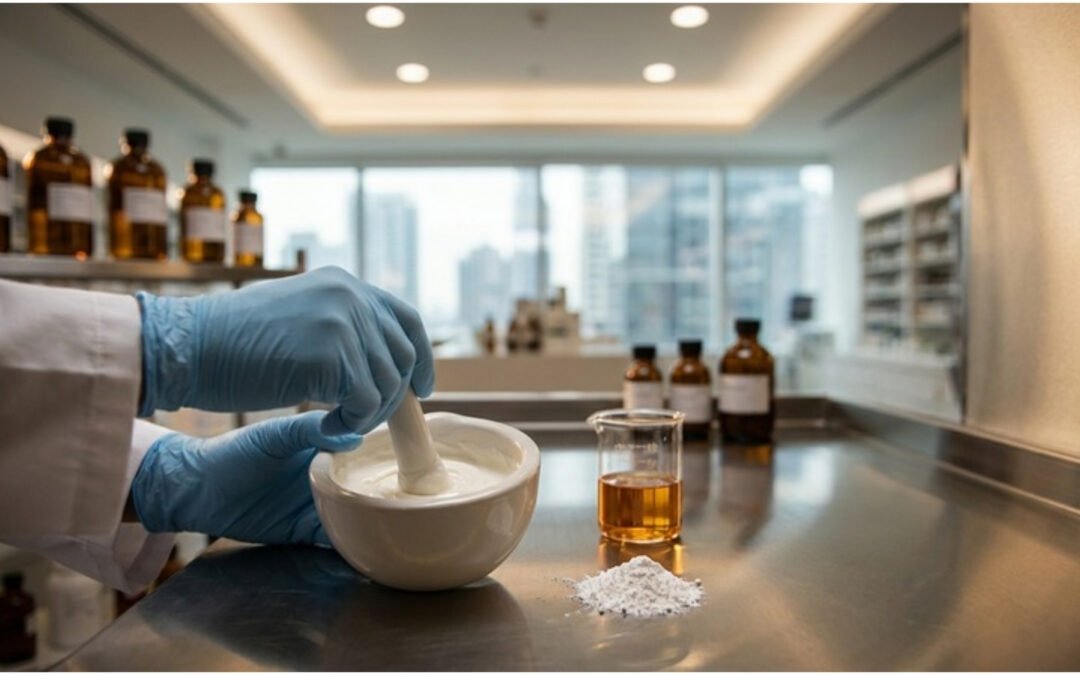
Short answer: Many expatriate women in Kuala Lumpur find that bioidentical progesterone is not stocked as a standard pharmacy product in Malaysia, and the registered products available may not match the strength or form their prescriber recommends. A compounding pharmacy can prepare bioidentical progesterone to a doctor’s prescription in forms such as capsules, creams, gels or oral liquids, individualised to the patient. Access still begins with a registered prescriber — compounding is the formulation route, not a self-service purchase.
The Access Problem for Expat Women in Kuala Lumpur
Women who arrive in Kuala Lumpur from countries where bioidentical progesterone was part of their hormone therapy often discover that continuing their regimen is not straightforward. The barriers are practical and regulatory, not clinical — but they are real enough to interrupt continuity of care.
Product Registration and Availability Gaps
Malaysia’s pharmaceutical market carries registered hormone therapy products, but the specific bioidentical progesterone preparation a woman was using overseas — a particular strength, a particular delivery form, a particular combination — may not be among them. Registered products are manufactured to fixed specifications: set strengths, set forms, set excipient profiles. When a prescriber needs something outside those specifications, the standard pharmacy shelf does not carry it.
For expats, this can mean arriving at a KL pharmacy with a familiar prescription only to learn that the exact product is not registered or stocked locally. Some women turn to online imports, but importing hormone preparations into Malaysia is subject to regulatory controls, and grey-market purchases carry quality and authenticity risks that a registered prescriber would not endorse.
Prescribing Practices and Health-System Navigation
Expats new to the Malaysian health system may also face a prescribing-side gap. A GP or gynaecologist in Kuala Lumpur can prescribe hormone therapy, but a woman who was working with a specialist overseas may need to re-establish that clinical relationship locally — bringing medical records, recent hormone panels, and a clear history of what was previously prescribed. Language is rarely a barrier in KL’s private healthcare sector, but navigating which clinics handle bioidentical hormone therapy and which pharmacies can prepare it is a practical question that takes time to answer.
What Bioidentical Progesterone Actually Is
Bioidentical progesterone is progesterone that is structurally identical to the hormone the human body produces naturally. The term “bioidentical” describes molecular structure, not a proven superiority over synthetic progestins. Some bioidentical progesterone products are registered, manufactured pharmaceuticals; others are custom-compounded to a prescription. Both require a doctor’s assessment and prescription. The choice between a registered product and a compounded preparation is a clinical decision made with a prescriber — not a self-selected preference.
A systematic review of micronized progesterone’s impact on the endometrium concluded that micronized progesterone, the bioidentical form, has been studied in the context of endometrial safety during hormone therapy (Stute et al., Climacteric, 2016. PMID 27277331). A separate systematic review examined its impact on breast cancer risk, reporting that the evidence base, while growing, remains less extensive than for some synthetic progestins (Stute et al., Climacteric, 2018. PMID 29384406). These reviews describe the active ingredient and the published literature — not any specific compounded preparation.
How Compounding Addresses the Access Gap
When a registered product does not match what a prescriber wants — because the strength, form or excipient profile is wrong for the individual patient — a compounding pharmacy can prepare bioidentical progesterone to the prescriber’s specification. This is the core of how compounding fills an access gap: it does not replace registered medicines, but it provides a route when the standard options do not fit.
Forms a Compounding Pharmacy Can Prepare
Under non-sterile compounding, bioidentical progesterone can be prepared in several dosage forms, each selected on clinical grounds by the prescriber:
- Capsules — oral delivery at a prescribed strength
- Creams and gels — transdermal delivery for application to the skin
- Oral liquids and suspensions — for patients who cannot swallow capsules or need a dose that falls between available capsule strengths
- Tonics and serums — additional non-sterile vehicles where clinically appropriate
Each of these forms may be prepared in a liposomal or an ordinary vehicle, depending on the prescriber’s formulation brief and the pharmacy’s assessment of stability and compatibility. A pharmacokinetic evaluation of compounded bioidentical hormones, conducted as a randomised clinical trial, examined absorption characteristics of compounded preparations — providing a reference point for prescribers considering this route (Sood et al., Maturitas, 2013. PMID 23384975).
For transdermal delivery specifically, a clinical trial examined hormonal absorption of progesterone cream used alongside transdermal oestrogen, reporting measurable serum progesterone levels — though the authors noted variability in absorption that prescribers should weigh (Vashisht et al., Gynecological Endocrinology, 2005. PMID 16109596). An earlier randomised study evaluated serum and urinary hormone levels following short- and long-term administration of progesterone cream in postmenopausal women, contributing to the evidence base on transdermal progesterone pharmacokinetics (Carey et al., BJOG, 2000. PMID 10847226).
The Prescription Pathway
Compounding is not a self-service process. The pathway is:
- See a registered doctor — a GP, gynaecologist, endocrinologist or anti-ageing physician in Kuala Lumpur — for an assessment that typically includes symptom review, medical history and, where appropriate, hormone testing.
- Receive a patient-specific prescription if the doctor decides a compounded bioidentical progesterone preparation is suitable. The prescription names the patient, the active ingredient, the strength and the requested dosage form.
- The compounding pharmacy prepares the formulation under Good Compounding Practice (GCP), for that one named patient only.
- Review and adjust with the prescriber over time, because hormone needs change and monitoring is part of responsible therapy.
No compounded preparation is made without a valid prescription. This is the regulatory and clinical foundation of the process.
Evidence: What the Clinical Literature Reports
The evidence base for bioidentical progesterone is real but should be read with care. A phase 3 randomised controlled trial — the REPLENISH study — was designed to evaluate a combination capsule of 17β-estradiol and natural progesterone for menopausal hormone therapy, providing trial-level data on the bioidentical progesterone molecule in a registered product format (Mirkin et al., Maturitas, 2015. PMID 25835751). This study informs the broader evidence picture for bioidentical progesterone, though it examined a specific registered product rather than a compounded preparation.
The honest position is this: bioidentical progesterone has been studied in human clinical trials and systematic reviews, the evidence supports its use in appropriate clinical contexts as judged by a prescriber, and compounded preparations offer a formulation route when registered products do not meet the individual’s needs. The evidence describes the active ingredient — not any specific pharmacy’s preparation of it.
Practical Steps for Expat Women Seeking Bioidentical Progesterone in KL
If you are an expatriate woman in Kuala Lumpur looking to continue or start bioidentical progesterone therapy, the practical route is:
- Bring your medical records — recent hormone panels, your previous prescription history, and any correspondence from your overseas specialist. This gives your new KL prescriber the clinical context to make an informed decision.
- Book with a registered doctor — a gynaecologist, endocrinologist, or GP with an interest in women’s hormone health. Private clinics in the Klang Valley are well-accustomed to expatriate patients and English-language consultation is standard.
- Ask about compounding — if the specific strength or form you need is not available as a registered product, ask your prescriber whether a compounded preparation is appropriate. The prescriber writes the prescription; the pharmacy prepares it.
- Do not import hormones without medical oversight — grey-market online purchases bypass quality controls and clinical monitoring. A prescriber-supervised route through a regulated compounding pharmacy is the safer path.
- Plan for follow-up — hormone therapy is monitored over time. Agree a review schedule with your prescriber so adjustments can be made as needed.
Discussing a Bioidentical Progesterone Preparation with Lynnity
Lynnity Pharma is a non-sterile compounding pharmacy in Kuala Lumpur that prepares bioidentical progesterone on a registered doctor’s prescription, under Good Compounding Practice (GCP). The dosage forms prepared include capsules, oral liquids and suspensions, creams, gels, tonics and serums — each available in a liposomal or an ordinary form, depending on the prescriber’s formulation brief. Every preparation is made for one named patient only; no compounded hormone preparation is supplied without a valid prescription.
For prescribers referring a patient, the process is collaborative: the prescription names the active, strength and dosage form, and the pharmacy can advise on vehicle selection, excipient compatibility and stability before finalising the formulation. Lynnity also prepares compounded bioidentical oestrogen and testosterone formulations where a prescriber’s referral covers a broader hormone therapy plan. Clinicians can find referral guidance and prescription requirements on the Lynnity blog.
Frequently Asked Questions
Can I buy bioidentical progesterone over the counter in Kuala Lumpur?
No. Bioidentical progesterone is a prescription-only preparation in Malaysia. Whether supplied as a registered product or as a compounded formulation, it requires a prescription from a registered doctor after a clinical assessment. A compounding pharmacy prepares it on the prescriber’s order — it is not an off-the-shelf purchase.
What forms can a compounding pharmacy prepare bioidentical progesterone in?
Under non-sterile compounding, bioidentical progesterone can be prepared as capsules, oral liquids or suspensions, creams, gels, tonics or serums. Each form may be prepared in a liposomal or an ordinary vehicle. The choice of form is a clinical decision made by the prescriber based on the patient’s needs and the evidence for each route.
Do I need to bring my overseas prescription to a KL doctor?
Your overseas prescription is useful as a record of what was previously prescribed, but a Malaysian doctor will conduct their own assessment before issuing a prescription valid locally. Bring your medical records, recent hormone panels and treatment history to give your new prescriber the fullest clinical picture.
Is compounded bioidentical progesterone the same as a registered product?
No. A registered product is mass-manufactured to fixed specifications with established regulatory approval. A compounded preparation is custom-made to a prescription for one named patient. Both contain bioidentical progesterone, but the manufacturing pathway and regulatory status differ. Your doctor advises which route suits your situation.
Can I import bioidentical progesterone into Malaysia myself?
Importing hormone preparations into Malaysia is subject to regulatory controls, and purchasing hormones from unregulated online sources carries quality and authenticity risks. The safer route is to consult a registered doctor in Kuala Lumpur who can assess your needs and, if appropriate, prescribe a compounded preparation prepared under Good Compounding Practice.
Reviewed by Vitthia Rama Murti, RPh (RPh 15632)
To discuss a bioidentical progesterone preparation or refer a patient for compounded hormone therapy, consult Lynnity’s compounding pharmacists, including Lead Pharmacist Vitthia Rama Murti, RPh (RPh 15632), at the compounding facility in MWE Commercial Park, Kepong, Kuala Lumpur.