
Short answer: Liposomal quercetin is a formulation in which the flavonoid quercetin is encapsulated within phospholipid vesicles to address its poor oral bioavailability — low water solubility, rapid first-pass metabolism and fast elimination. For patients with suspected histamine intolerance, quercetin is of interest because of its proposed mast-cell-stabilising mechanism, though human clinical trials specific to histamine intolerance are lacking. A compounding pharmacy prepares a liposomal quercetin oral liquid or capsule on a doctor’s prescription under Good Compounding Practice (GCP), for one named patient.
Why Quercetin’s Delivery Problem Matters for Histamine Intolerance
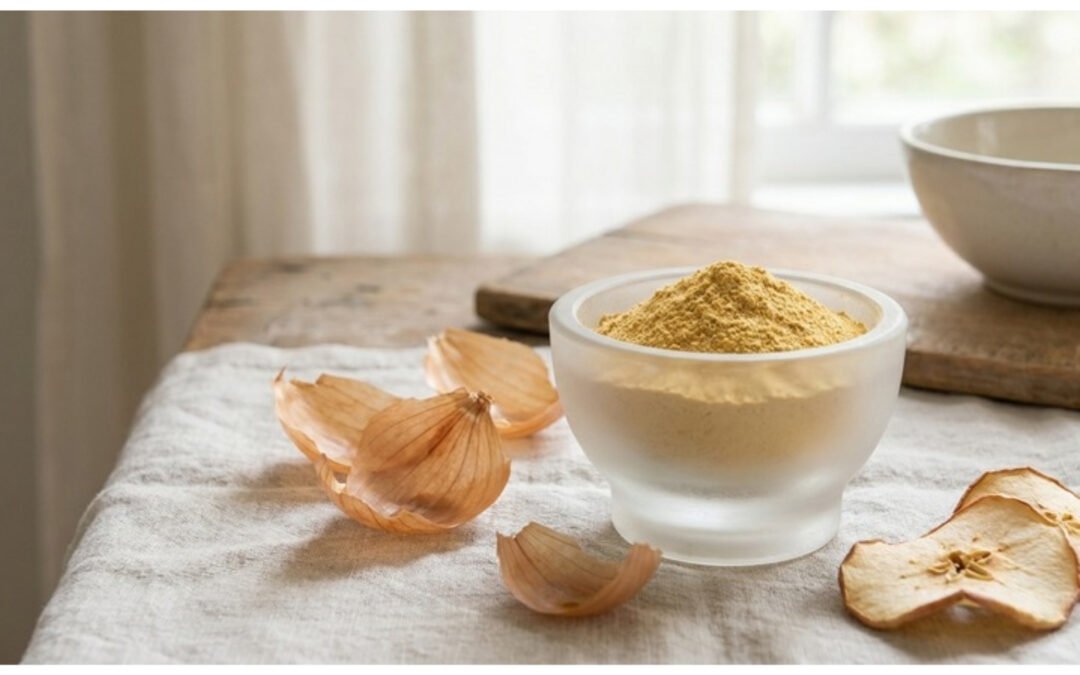
Quercetin is a polyphenolic flavonoid found in onion skin, apples and capers. Its pharmacological interest in the histamine intolerance context is mechanistic: laboratory studies describe quercetin as a stabiliser of mast cells — the immune cells that release histamine — but this evidence is predominantly in vitro, and no human clinical trial has specifically examined quercetin for histamine intolerance as a defined condition. The honest framing is that quercetin’s mast-cell mechanism is biologically plausible but clinically unproven in this population.
The delivery problem is real regardless of the clinical context. Quercetin dissolves poorly in water, undergoes extensive glucuronidation and sulfation in the gut wall and liver, and is cleared rapidly. A comparative pharmacokinetic study of quercetin following oral supplementation in humans demonstrated that formulation differences meaningfully affect plasma exposure (Kaushik et al., Journal of Food Science, 2012; PMID 23094941). A randomised controlled trial of quercetin glycoside pharmacokinetics and bioavailability in humans confirmed that the form of quercetin supplied determines how much is absorbed (Graefe et al., Journal of Clinical Pharmacology, 2001; PMID 11361045).
The Liposomal Delivery Rationale
Liposomal encapsulation addresses quercetin’s bioavailability problem by enclosing the active within phospholipid vesicles. Quercetin is lipophilic, so it associates with the phospholipid bilayer rather than sitting in the aqueous core — a natural fit for this particular flavonoid. A randomised controlled trial demonstrated that a lecithin-based delivery system (Quercetin Phytosome) produced improved oral absorption of quercetin compared with unformulated quercetin (Riva et al., European Journal of Drug Metabolism and Pharmacokinetics, 2019; PMID 30328058). A randomised controlled trial also found that dietary fat increases quercetin bioavailability in overweight adults, underscoring that the lipid environment of the delivery vehicle influences absorption (Guo et al., Molecular Nutrition & Food Research, 2013; PMID 23319447).
These studies describe the active ingredient and the delivery concept — not any specific compounded preparation. The evidence supports the rationale for a liposomal vehicle for quercetin; it does not establish that a liposomal quercetin preparation treats histamine intolerance.
What the Human Evidence Shows for Quercetin and Allergy
One human trial is directly relevant to the allergy context that overlaps with histamine intolerance. A randomised, placebo-controlled, double-blind parallel-group study examined the effects of repeated oral intake of a quercetin-containing supplement on allergic reaction, reporting data on symptom measures in subjects with seasonal allergy symptoms (Yamada et al., European Review for Medical and Pharmacological Sciences, 2022; PMID 35776034). This trial provides human data on quercetin in an allergy-related setting, though it does not specifically study histamine intolerance as a diagnosis.
The gap between the mechanistic rationale and the human evidence is important for prescribers to acknowledge. Laboratory work on quercetin’s mast-cell-stabilising properties is extensive, but translating that to a clinical outcome in histamine intolerance requires trials that have not yet been conducted. A prescriber considering liposomal quercetin for a patient with suspected histamine intolerance should weigh the mechanistic plausibility against the absence of condition-specific human data.
Formulation Design for Liposomal Quercetin
Lipid selection
The phospholipid system is the foundation of the liposomal vehicle. Common choices include soy or sunflower lecithin, which provide phosphatidylcholine as the primary bilayer-forming lipid. The lipid-to-active ratio influences entrapment efficiency and vesicle stability. For quercetin, which partitions into the bilayer, a sufficient lipid fraction is needed to accommodate the active without destabilising the vesicle.
Target particle size and entrapment efficiency
Particle size in the nanometre-to-low-micrometre range is typical for oral liposomal preparations. Smaller vesicles generally present a larger surface area for absorption. Entrapment efficiency — the percentage of the active successfully incorporated into the vesicles — varies with the lipid system, the active’s properties and the preparation method. The pharmacy documents the entrapment efficiency for each formulation.
Water vs oil dispersion
A liposomal quercetin oral liquid is typically an aqueous dispersion — vesicles suspended in a water-based vehicle. An alternative approach uses a phospholipid complex dispersed in an oil base. The choice depends on the active’s solubility profile, the desired dose concentration and the patient’s tolerance.
Excipient and Solvent Considerations
For patients with suspected histamine intolerance, excipient selection is particularly important. Some excipients may be poorly tolerated by sensitive patients. The prescriber’s formulation brief should specify any excipient exclusions, and the pharmacy selects compatible alternatives. Common considerations include:
- Avoiding alcohol-based solvents where the patient is sensitive
- Selecting preservative systems compatible with the liposomal vehicle
- Choosing flavouring agents that do not trigger symptoms in histamine-sensitive patients
Suggested Dose Presentation — Prescriber-Facing Reference
The following ranges are drawn from the published pharmacokinetic and clinical literature and presented as prescriber-facing reference, not as a mandatory protocol:
- Typical quercetin dose in studies: 150–500 mg per day, though doses vary widely across trials
- Liposomal form: The dose is specified as the quercetin content per mL of oral liquid or per capsule
- Titration: Some prescribers start at a lower dose and titrate upward based on clinical response
Prescribers should check local regulatory requirements and individual patient factors. Quercetin is not a registered medicine in Malaysia; a compounded preparation is made on a doctor’s prescription under GCP.
Storage, Stability and Shelf-Life
Liposomal oral liquids are typically less stable than solid dosage forms. The beyond-use date is assigned by the compounding pharmacy based on the specific formulation. General principles:
- Refrigeration: May extend the beyond-use date for liposomal oral liquids
- Light protection: Quercetin is light-sensitive; the preparation should be stored in an opaque or amber container
- Shake before use: For liposomal dispersions, the label should instruct the patient to shake gently before each dose
Common Formulation Pitfalls and Mitigation
- Low entrapment efficiency: If the lipid-to-active ratio is insufficient, a significant fraction of quercetin remains unencapsulated and subject to the same poor bioavailability as a standard form. The pharmacy optimises the ratio and documents entrapment.
- Vesicle instability: Liposomal preparations can aggregate or leak over time. The pharmacy selects stabilisers and assigns a conservative beyond-use date.
- Excipient intolerance: In histamine-sensitive patients, an excipient that triggers symptoms undermines the preparation’s purpose. The prescriber should document exclusions in the formulation brief.
- Overstated bioavailability claims: A liposomal label does not guarantee absorption. The evidence supports the rationale, but the specific formulation determines the outcome. The pharmacy should not make definitive efficacy statements about a liposomal quercetin preparation.
Discussing a Liposomal Quercetin Preparation with Lynnity
Lynnity prepares non-sterile compounded liposomal quercetin as an oral liquid or capsule on a registered doctor’s prescription, under Good Compounding Practice (GCP), for one named patient. A prescriber in Kuala Lumpur, the Klang Valley or Singapore can send a formulation brief specifying the active, strength, dosage form, excipient constraints and clinical rationale for liposomal delivery. Lynnity also prepares other liposomal flavonoid preparations, including liposomal luteolin, which prescribers may consider for related mast-cell-focused applications. To start the conversation, the prescriber’s clinic can send the formulation brief, and the pharmacy will confirm feasibility, entrapment documentation, beyond-use dating and collection or delivery arrangements.
Frequently Asked Questions
Is there human clinical evidence for quercetin in histamine intolerance?
No human clinical trial has specifically examined quercetin for histamine intolerance as a defined condition. Laboratory studies describe quercetin as a mast-cell stabiliser, and one randomised trial has examined a quercetin supplement in an allergy-related setting. The mechanistic rationale is plausible, but condition-specific human evidence is lacking. Prescribers should weigh this gap honestly.
Why use a liposomal delivery for quercetin?
Quercetin has poor oral bioavailability due to low water solubility, rapid first-pass metabolism and fast elimination. A randomised controlled trial demonstrated that a lecithin-based delivery system improved quercetin absorption compared with unformulated quercetin. Liposomal encapsulation addresses the delivery problem by protecting the active during passage through the gut and facilitating absorption.
What dose of liposomal quercetin is typically prescribed?
Doses in the published literature range from approximately 150 to 500 mg per day, though the specific dose depends on the prescriber’s clinical judgement, the patient’s presentation and the formulation’s quercetin content per unit. These ranges are prescriber-facing reference, not a mandatory protocol.
What excipient considerations apply for histamine-sensitive patients?
Patients with suspected histamine intolerance may react to certain excipients. The prescriber’s formulation brief should specify any exclusions — for example, alcohol-based solvents or specific flavouring agents. The compounding pharmacy selects compatible alternatives and documents the excipient profile of the finished preparation.
Reviewed by Vitthia Rama Murti, RPh (RPh 15632)
To discuss a patient-specific liposomal quercetin preparation — including strength, delivery form and excipient constraints — consult Lynnity’s compounding pharmacists, including Lead Pharmacist Vitthia Rama Murti, RPh (RPh 15632), at the compounding facility in MWE Commercial Park, Kepong, Kuala Lumpur.