
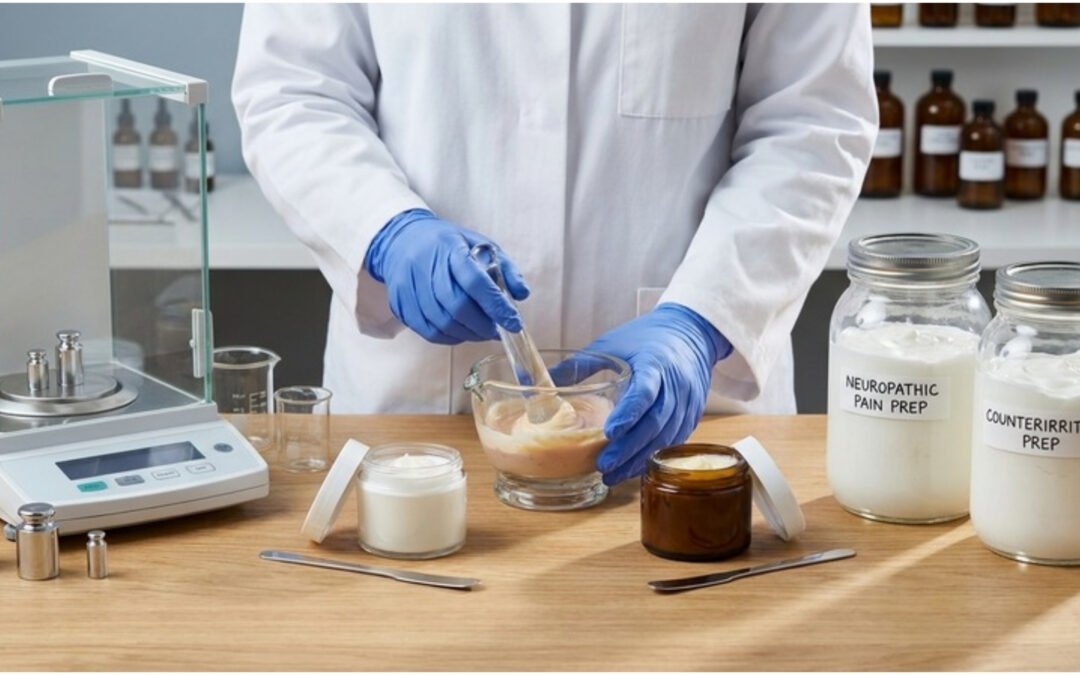
Short answer: Two distinct compounded topical preparations — a capsaicin-counterirritant cream (capsaicin 0.025%, methylsalicylate 15%, camphor 3.6%) for localised musculoskeletal pain, and a gabapentin-hormone cream (gabapentin 6%, estriol 0.1%, testosterone 0.1%) for neuropathic pain with a hormonal component — address different pain mechanisms at strengths and combinations no commercial product offers. Each is prepared as a non-sterile cream for a named patient on a doctor’s prescription under Good Compounding Practice (GCP). The gabapentin-hormone combination requires explicit clinical justification, as no published evidence supports this specific three-actives combination as a unit.
Why these two formulations belong in one discussion
Both preparations are compounded topical creams prescribed for pain, but they operate through entirely different pharmacological routes. The capsaicin-counterirritant cream targets peripheral pain receptors and counter-irritation for musculoskeletal conditions. The gabapentin-hormone cream targets neuropathic pain pathways alongside a hormonal component. Prescribers in Kuala Lumpur and the Klang Valley may encounter both in clinical practice, and understanding the formulation, safety and documentation requirements for each is essential before referring to a compounding pharmacy.
Formulation A — Capsaicin 0.025%, Methylsalicylate 15%, Camphor 3.6%
Clinical indication and target patients
This formulation combines a TRPV1 receptor agonist (capsaicin) with two counterirritants (methylsalicylate and camphor) in a single topical preparation. It is typically prescribed for localised musculoskeletal pain — muscle strains, joint discomfort, overuse injuries — where a multi-mechanism topical approach is preferred over oral analgesia. A randomised, double-blind, placebo-controlled, multicentre study of a topical methyl salicylate and menthol patch in adult patients with mild to moderate muscle strain demonstrated efficacy for this class of counterirritant combination (Higashi et al., Clinical Therapeutics, 2010; PMID 20171409). A Cochrane review of topical rubefacients (which include methylsalicylate and camphor) for acute and chronic pain noted that the evidence is limited compared with topical NSAIDs, but the class is widely used in clinical practice (Matthews et al., Cochrane Database of Systematic Reviews, 2009; PMID 19588430).
Capsaicin at 0.025% is a low-dose concentration intended for repeated daily application. A systematic review of topical capsaicin for chronic pain concluded that capsaicin has a role in chronic pain management, with the number needed to treat depending on concentration and condition (Mason et al., BMJ, 2004; PMID 15033881). A Cochrane review of high-concentration capsaicin for chronic neuropathic pain noted that capsaicin’s evidence base is strongest for neuropathic conditions, though the 0.025% concentration in this formulation targets musculoskeletal rather than neuropathic pain (Derry et al., Cochrane Database of Systematic Reviews, 2017; PMID 28085183).
Dosing and application guidance
The cream is applied as a thin layer to the painful area, typically 3–4 times daily. A practical amount is approximately 1–2 g per application to a localised area (e.g., a knee or shoulder). Patients should be counselled that the capsaicin effect builds over days of consistent use — onset is not immediate. Hands must be washed thoroughly after application, and contact with eyes and mucous membranes must be avoided.
Formulation notes
Methylsalicylate at 15% is within the range used in commercial counterirritant products. Camphor at 3.6% provides additional counterirritant activity through a cooling-warming sensation. The base should be an emollient cream that tolerates the lipophilic actives; a PLO or anhydrous base may be considered. Capsaicin is a skin irritant — the formulation should account for the burning sensation that commonly occurs in the first one to two weeks of use. A preservative system appropriate to the water content of the base should be included. The BUD is typically assigned at 30–90 days for a non-sterile cream.
Safety and counselling
Salicylate systemic absorption is a consideration with 15% methylsalicylate, particularly when applied to large areas or broken skin. Patients taking oral anticoagulants or with salicylate sensitivity should be identified before prescribing. Camphor is toxic if ingested and should be stored safely away from children. Local irritation — burning, redness — is common with capsaicin, particularly in the first one to two weeks. Patients should be advised not to apply heat to the treated area, as heat increases absorption unpredictably.
Formulation B — Gabapentin 6%, Estriol 0.1%, Testosterone 0.1%
Clinical indication and target patients
This combination requires clear clinical justification and carries specific safety considerations that prescribers should document in the formulation brief. Gabapentin 6% is a standard compounded topical concentration for localised neuropathic pain. A randomised controlled study of 6% gabapentin topical formulation for chronic kidney disease-associated pruritus demonstrated that topically applied gabapentin at this concentration produces measurable clinical effects (Aquino et al., International Journal of Dermatology, 2020; PMID 32459016). A separate randomised controlled trial of topical gabapentin cream in treating pruritus in dialysis patients confirmed effectiveness (Faghihi et al., Hemodialysis International, 2024; PMID 39164806).
The addition of estriol 0.1% and testosterone 0.1% introduces hormonal actives alongside the neuropathic agent. The clinical rationale for combining these actives in a single preparation should be explicitly documented. One plausible scenario is a patient with localised neuropathic pain in a context of vulvovaginal or perineal tissue atrophy, where the prescriber intends to address both nerve-mediated pain and tissue trophism in a single topical application. Ultra-low-dose topical estriol has been studied for vulvovaginal atrophy, with clinical evidence supporting its local effects (Villa et al., Gynecological Endocrinology, 2020; PMID 31847628). A randomised, double-blind, placebo-controlled trial of topical estriol in the treatment of vaginal atrophy in postmenopausal women confirmed local efficacy (Cruz et al., Menopause, 2018; PMID 28763401). Topical testosterone has been studied in postmenopausal women — a randomised controlled trial of vaginally applied testosterone on sexual function in postmenopausal women demonstrated local effects (Fernandes et al., Journal of Sexual Medicine, 2014; PMID 24612478), and a double-blind, randomised, placebo-controlled trial of testosterone cream on sexual motivation in menopausal hysterectomised women confirmed measurable effects (El-Hage et al., Climacteric, 2007; PMID 17653960).
Dosing and application guidance
The cream is applied to the affected area, typically 1–2 times daily, in a thin layer. The amount per application depends on the anatomical site — for a localised area such as the vulvar or perineal region, approximately 0.5–1 g per application is typical. The prescriber should specify the exact amount, frequency and duration, and document the clinical rationale for the combination.
Formulation notes
Gabapentin is water-soluble, while estriol and testosterone are lipophilic — this solubility difference requires careful vehicle selection. A PLO or emulsion base that can accommodate both hydrophilic and lipophilic actives is typically chosen. The hormonal components require accurate weighing at low concentrations (0.1%), and the preparation should be clearly labelled as containing hormones. The BUD is typically assigned at 30–90 days for a non-sterile cream with preservative.
Safety and counselling — combination and hormone-specific flags
Flag: No published clinical evidence supports this specific three-actives combination as a unit. The prescriber should document the clinical rationale for combining a neuropathic agent with two hormones in a single preparation. Key safety considerations:
- Testosterone transfer: Testosterone in a topical cream can transfer to others through skin contact. Patients should be counselled to cover the application site and wash hands thoroughly. Partners and household contacts should avoid contact with the treated area.
- Hormone contraindications: Hormone-sensitive conditions should be assessed before prescribing. The prescriber should document the patient’s hormone status and any contraindications.
- Monitoring: The prescriber should establish a monitoring plan appropriate to the hormonal components, including any baseline and follow-up hormone panels.
- Regulatory status: The preparation should be labelled clearly as containing hormones, and the prescriber should confirm the regulatory status of testosterone in compounded topical preparations under Malaysian regulation.
Documentation checklist for prescribers
For each formulation, the prescription and formulation brief should include:
- Named patient and prescriber details
- Active ingredients and exact strengths — as specified above
- Dosage form: cream (specify base preference)
- Clinical rationale: why compounding is preferred over a commercial product; for Formulation B, the specific rationale for combining gabapentin with estriol and testosterone
- Anatomical site and application area
- Amount per application and frequency
- Known excipient exclusions or sensitivities
- Safety monitoring plan: salicylate exposure (Formulation A); hormone monitoring and partner-transfer counselling (Formulation B)
- Review plan: follow-up timing and reassessment triggers
Discussing topical pain and hormone preparations with Lynnity
Lynnity prepares non-sterile compounded topical formulations — creams and gels, including liposomal delivery forms — for named patients on a registered doctor’s prescription, under Good Compounding Practice (GCP). Both formulations above fall within this scope. The pharmacy can advise on vehicle selection for the solubility differences in the gabapentin-hormone preparation, on excipient compatibility for the capsaicin-counterirritant combination, and on stability and beyond-use dating for each. Where a prescriber is considering a related preparation — for example, a compounded pain cream incorporating ketamine or amitriptyline for neuropathic pain, or a bioidentical hormone cream at a different strength — the pharmacy can prepare these on prescription as well. The conversation begins with the prescription and formulation brief sent to the pharmacy; the pharmacists can then advise on practicality and any compatibility or stability concerns before proceeding.
Frequently asked questions
Why combine gabapentin with estriol and testosterone in a single cream?
No published clinical evidence supports this specific three-actives combination as a unit. The prescriber should document the clinical rationale — for example, localised neuropathic pain in a context of tissue atrophy where both nerve-mediated pain and tissue trophism are being addressed. Topical gabapentin 6% has clinical trial evidence for pruritus (Aquino et al., 2020; PMID 32459016), and topical estriol has been studied for vulvovaginal atrophy (Villa et al., 2020; PMID 31847628). The combination is a prescriber’s clinical decision, not a standard formulation.
What are the main safety concerns with the capsaicin-counterirritant cream?
Salicylate systemic absorption from 15% methylsalicylate is the primary systemic concern, particularly with large application areas or broken skin. Patients on oral anticoagulants or with salicylate sensitivity should be identified. Local burning and redness from capsaicin is common in the first one to two weeks. Camphor is toxic if ingested. Patients should wash hands after application and avoid contact with eyes and mucous membranes.
Can testosterone in the gabapentin-hormone cream transfer to a partner?
Yes. Testosterone in a topical cream can transfer to others through skin contact with the application site. Patients should be counselled to cover the application site after the cream has absorbed and to wash hands thoroughly. Partners and household contacts should avoid direct contact with the treated area. This counselling point should be documented in the patient’s care plan.
What base is used for these compounded creams?
Vehicle selection depends on the actives. For the capsaicin-counterirritant cream, an emollient cream or PLO base that tolerates lipophilic actives is typical. For the gabapentin-hormone cream, the solubility difference between water-soluble gabapentin and lipophilic hormones requires an emulsion or PLO base that accommodates both profiles. The pharmacy advises on the appropriate base for each formulation based on compatibility and stability data.
Reviewed by Vitthia Rama Murti, RPh (RPh 15632).
To discuss a patient-specific topical pain or hormone preparation — or to flag a formulation concern before prescribing — consult Lynnity’s compounding pharmacists, including Lead Pharmacist Vitthia Rama Murti, RPh (RPh 15632), at the compounding facility in MWE Commercial Park, Kepong, Kuala Lumpur.