
For healthcare professionals. Compounded preparations are dispensed on a doctor’s prescription.
Short answer: Human evidence of benefit for whole-extract black ginger (Kaempferia parviflora) as a single active in longevity and wellness is not established. The 2017 systematic review (PMID 27694558) describes the clinical findings as inconclusive because small studies were included. Strength, quantity and directions are set by the prescriber for one named patient.
Reviewed by Vitthia Rama Murti, RPh (RPh 15632).
The clinical question and the formulation problem
Kaempferia parviflora, known as black ginger, is a medicinal plant of the ginger family (Zingiberaceae). Its rhizome has been used as folk medicine for many centuries, and the clinical literature on it is small (Journal of evidence-based complementary & alternative medicine, 2017; PMID 27694558). For a prescriber, the practical question is which constituents a preparation carries and what the clinical record shows for the extract as it was actually studied.
The human records do not describe one product. One pharmacokinetic study used a Kaempferia parviflora extract at two daily amounts and tracked two methoxyflavones in blood (PMID 31130666). Another tested a purified polymethoxyflavone fraction, which is a different preparation from a whole extract (PMID 33475663). A prescriber who writes for black ginger has to name which preparation is intended before the strength can be set.
What the human records show
| Design | Population or setting | Preparation | Finding as reported | PMID |
|---|---|---|---|---|
| Systematic review of clinical trials (2017) | Seven studies included; the review notes that small studies were included | Krachaidum (Kaempferia parviflora) extracts | Positive benefits reported but “remained inconclusive since small studies were included” | 27694558 |
| Randomised controlled trial with pharmacokinetic and glucose tolerance endpoints (2019) | Healthy subjects | Kaempferia parviflora extract at 90 and 180 mg/day, or placebo | Glucose metabolism via oral glucose tolerance test not affected by KP extract; only TMF and PMF, but not DMF, detected in human blood | 31130666 |
The 2017 systematic review reports that Krachaidum “showed positive benefits but remained inconclusive since small studies were included” (PMID 27694558). The same review states that no adverse events were reported in the studies it included (PMID 27694558).
Human evidence of benefit for whole-extract Kaempferia parviflora as a single active in longevity and wellness use is not established (Journal of evidence-based complementary & alternative medicine, 2017; PMID 27694558).
Dose comparison caveats
The daily amounts in the human records cannot be carried from one study into a prescription. The pharmacokinetic study in healthy subjects gave Kaempferia parviflora extract at 90 and 180 mg/day or placebo, used 3,5,7,3′,4′-pentamethoxyflavone (PMF) and 5,7,4′-trimethoxyflavone (TMF) as markers, and performed oral glucose tolerance tests at baseline and at 28 days of administration (PMID 31130666). The abstract reports that “glucose metabolism via oral glucose tolerance test was not affected by KP extract” (KP = Kaempferia parviflora), and that only TMF and PMF, but not 5,7-dimethoxyflavone (DMF), could be detected in human blood (PMID 31130666). The dose figures from this study are pharmacokinetic findings and carry no outcome claim beyond that.
A randomised, double-blind, placebo-controlled study in Japanese overweight adults tested a purified polymethoxyflavone fraction of Kaempferia parviflora, not the whole extract (Food & Function, 2021; PMID 33475663). The abstract reports that “VFA significantly reduced after 12 weeks in the active group and was significantly lower than in the placebo group at 8 and 12 weeks”, where VFA is visceral fat area. That result belongs to the purified fraction alone. It is not a result for whole-extract Kaempferia parviflora, and it does not show that any Lynnity preparation reduces fat.
The marker compound
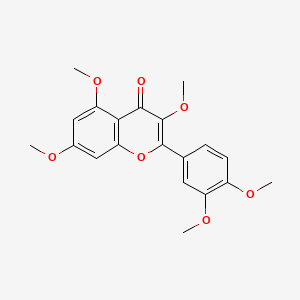
Pentamethoxyflavone is one of the two methoxyflavones measured in human blood in the pharmacokinetic study, and 5,7-dimethoxyflavone was not detected (PMID 31130666). The figure below shows that marker compound on its own. It is not the whole extract, and its structure does not establish the activity of the extract.
Non-sterile forms for black ginger extract
Black ginger extract sits in Lynnity’s supplement stock. Lynnity prepares it in the permitted non-sterile forms of its formulary row: capsule, oral liquid (including a suspension), liposomal solution and powder in a container.
| Form | What it is | What the prescription must specify |
|---|---|---|
| Capsule | Two-piece hard capsule | Fill per capsule, number of capsules, extract content required |
| Oral liquid (including suspension) | Measured liquid for oral use | Volume per dose, concentration, vehicle |
| Liposomal solution | Extract carried in phospholipid vesicles in an oral solution | Volume per dose, concentration, carrier system named by the prescriber |
| Powder in a container | Measured powder in a labelled container | Weight per dose, container size, directions |
A liposomal solution encapsulates the extract in phospholipid vesicles. The human records cited here do not compare a liposomal black ginger preparation with a standard form, so no absorption or delivery advantage is stated for the liposomal form.
What the prescription must state
- The named patient, and the active as black ginger (Kaempferia parviflora) extract
- The extract content or standardisation the prescriber requires
- The form, chosen from the table above
- Strength per unit, quantity and directions, as set by the prescriber
- The prescriber’s clinical reason, recorded in the patient notes
Safety and monitoring
The 2017 systematic review reports no adverse events in the studies it included (PMID 27694558). That is a statement about those studies, not about any compounded preparation. The prescriber assesses interactions and suitability for each patient before prescribing.
How to prescribe
The prescription names the patient, the active, the form, the strength per unit, the quantity and the directions. Lynnity prepares non-sterile black ginger extract only on a registered doctor’s prescription for a named patient, under Good Compounding Practice (GCP) in its laboratory at https://www.lynnitypharma.com/gcp-laboratory/.
Send the signed prescription through the contact route on the contact page, addressed to Vitthia Rama Murti, RPh (RPh 15632). For the wider liposomal delivery principle, read the guide to liposomal compounding for Malaysian prescribers and the liposomal polyphenol guide.
Speak to a Lynnity pharmacist through the contact page, or explore the custom wellness pathways, to start a prescription for one named patient.
Frequently asked questions
Is black ginger proven to help with longevity?
The clinical record for black ginger in longevity is small and inconclusive. A 2017 systematic review of Krachaidum (Kaempferia parviflora) trials describes the findings as inconclusive because small studies were included (PMID 27694558). Any discussion with a patient should reflect that limit.
Which forms of black ginger extract can a prescriber specify?
A prescriber can specify a capsule, an oral liquid including a suspension, a liposomal solution or a powder in a container, all non-sterile. The choice depends on the patient’s ability to take each form and on the prescriber’s specification. The table above lists what each form requires on the prescription.
Why do study doses not transfer to a prescription?
The human records use different daily amounts and different preparations. A pharmacokinetic study tested 90 and 180 mg/day of a Kaempferia parviflora extract and measured blood levels of two markers (PMID 31130666). A purified polymethoxyflavone fraction is a separate product (PMID 33475663). An amount from either study is not a dosing instruction for any patient.
Can a compounded black ginger preparation be supplied without a prescription?
No. Compounded preparations are dispensed on a doctor’s prescription and prepared for one named patient. The prescription states the active, the form, the strength per unit, the quantity and the directions, and the prescriber sets each of them.