
Spermidine is the polyamine that switches on autophagy. Why its mixed evidence and a defined safety ceiling make it a prescriber’s ingredient — not a shelf buy.
Short answer: Spermidine is a naturally occurring polyamine — concentrated in wheat germ, aged cheese, natto and mushrooms, and made by our own cells — that acts as one of biology’s most reliable switches for autophagy, the cellular “self-cleaning” process that declines with age. Clinician interest is real and the mechanism is unusually clean, but the human clinical picture is deliberately worth stating plainly: an early small trial hinted at a memory benefit, a larger twelve-month trial did not confirm it, and the strongest human data remain epidemiological rather than interventional. That combination — a promising, well-tolerated active whose evidence rewards honesty and whose safe intake has a defined ceiling — is exactly where prescription-led, dose-controlled compounding earns its place over a shelf purchase. Every Lynnity preparation, spermidine included, requires a prescription from a registered doctor.
Why spermidine is drawing clinic questions now
For a decade the longevity conversation in this region has moved through NAD precursors, resveratrol, urolithin A and the antioxidant actives. Spermidine is the name that keeps surfacing next, and for a defensible reason: it targets a process — macroautophagy — that most of the other popular actives touch only indirectly.
Patients read about it; practitioners in the Klang Valley and Singapore are increasingly asked about it by name. The useful clinical posture is neither dismissal nor enthusiasm, but precision: what the molecule does, what the human evidence does and does not show, and how to prescribe it sensibly if a patient and their doctor decide to proceed.
The mechanism: autophagy, and why the biology is unusually clean
Spermidine is a small aliphatic polyamine — chemically N-(3-aminopropyl)butane-1,4-diamine — carrying three amino groups. At body pH it is polycationic, which is why it binds avidly to DNA, RNA and membranes, and why the free base is hygroscopic and bitter. Those are not trivia; they shape how it has to be compounded.
Its headline action is the induction of autophagy, and it gets there by at least two well-characterised routes:
- EP300 inhibition. Spermidine inhibits EP300 (also written p300), an acetyltransferase that normally brakes autophagy. Inhibiting it releases that brake and simultaneously dampens mTORC1 signalling — the central nutrient-sensing pathway that suppresses cellular clean-up when fuel is abundant (Pietrocola et al., Cell Death & Differentiation, 2015).
- eIF5A hypusination. Spermidine is the obligate substrate for hypusination of the translation factor eIF5A, a modification that supports production of TFEB — a master transcriptional regulator of autophagy genes — and of a subset of mitochondrial proteins (Zhang et al., Molecular Cell, 2019).
There is a satisfying consistency to this. Fasting itself raises endogenous spermidine, and spermidine appears necessary for fasting-induced autophagy (Nature Cell Biology, 2024) — which is one reason it is sometimes described as a “caloric-restriction mimetic.” In animal models, the downstream effects have been striking: dietary spermidine improved cardiac function and extended lifespan in mice in an autophagy-dependent manner, alongside an epidemiological link to lower blood pressure in humans (Eisenberg et al., Nature Medicine, 2016).
A note on register. Everything in the paragraph above is mechanism and animal or observational data. None of it establishes that a supplement treats, prevents or reverses any disease in people. The honest translation is: the biology is real and coherent; the human clinical proof is a separate, thinner question — which is the next section.
What the human evidence actually shows
Three strands, in decreasing order of how much weight they can bear.
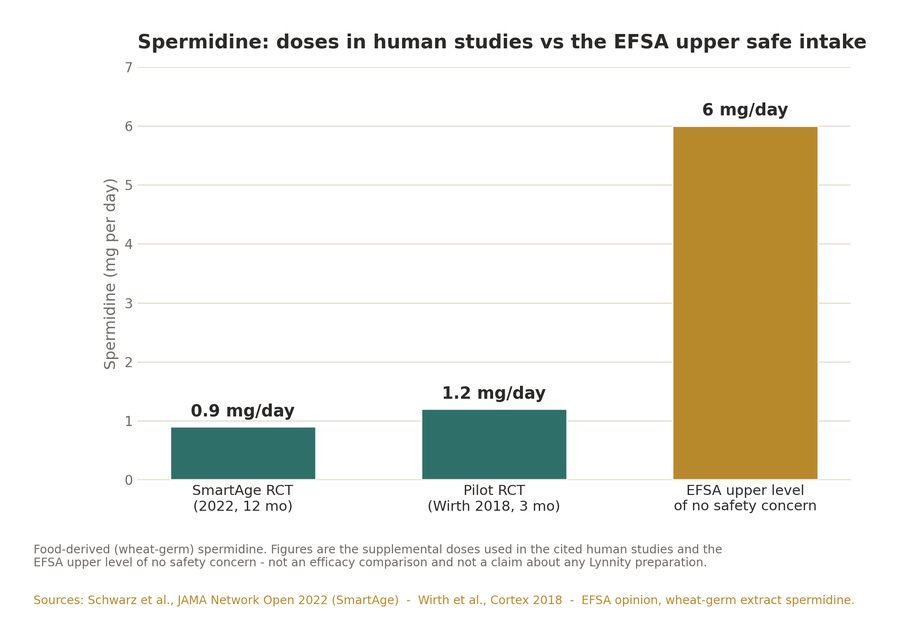
A small interventional signal, not yet replicated. A three-month randomised, placebo-controlled trial in around thirty older adults at risk of dementia, using 1.2 mg/day of a wheat-germ-derived spermidine extract, reported a preliminary improvement in memory performance (Wirth et al., Cortex, 2018). It was encouraging — and small.
The larger trial that did not confirm it. The SmartAge trial then took the question seriously: a twelve-month, double-masked, placebo-controlled study of 100 adults aged 60–90 with subjective cognitive decline, comparing 0.9 mg/day of wheat-germ spermidine against placebo. On its primary endpoint — change in memory performance over twelve months — spermidine was not significantly different from placebo (Schwarz et al., JAMA Network Open, 2022). The supplement was safe and well tolerated; it simply did not deliver the cognitive benefit the pilot had hinted at. A prescriber should know that before setting a patient’s expectations.
The strongest human data are observational. In the Bruneck study — an Italian population cohort of 829 adults followed for two decades — dietary spermidine showed the strongest inverse association with all-cause mortality of 146 nutrients examined; those in the highest third of intake carried a mortality risk comparable to being roughly 5.7 years younger than those in the lowest third, a pattern echoed in a separate Austrian cohort (Kiechl et al., American Journal of Clinical Nutrition, 2018). A large US dietary survey of nearly 24,000 people similarly linked higher spermidine intake to lower cardiovascular and all-cause mortality (2022). These are associations in people who ate more spermidine-rich food — not proof that a capsule reproduces the effect.
The caveats, stated honestly
Three, because a prescriber deserves them up front:
- Association is not causation. The mortality and cardiovascular findings are epidemiological. People who eat more wheat germ, legumes and mushrooms differ in many ways from those who do not.
- The one large cognitive RCT was null on its primary endpoint. Anyone positioning spermidine as a proven memory aid is ahead of the evidence.
- Polyamine biology is genuinely double-edged. Spermidine is dietary-protective in the cohort studies, yet polyamines also feature in tumour-cell metabolism. For a patient with an active or recent malignancy, this is a specialist conversation, not a shelf decision — and a reason a prescriber should be in the loop.
Why dose discipline is the whole game
Here is where a compounding pharmacy is not marketing itself but doing something a retail shelf structurally cannot.
| Property of spermidine | Consequence for the preparation |
|---|---|
| Narrow, defined studied range | Human trials clustered at 0.9–1.2 mg/day; the EFSA upper level of no safety concern for food-derived spermidine is about 6 mg/day. The useful, evidence-anchored window is tight — so an exactly set, assayed dose matters more than with a forgiving vitamin. |
| Label-versus-assay variability | Independent testing of polyamine supplements has repeatedly found actual content differing from the label. Compounding to an assayed specification removes that guesswork. |
| Wheat-germ origin | Most spermidine is a standardised wheat-germ extract, which carries a wheat/gluten consideration. A compounding pharmacy can select and document a defined-purity source for allergen-aware patients. |
| Hygroscopic, bitter free base | Moisture pick-up and taste push strongly toward an enclosed capsule or a properly formulated flavoured liquid rather than a loose powder. |
| Polycationic and basic | Attention is needed to compatibility with any co-formulated actives, and to pH when it sits in a liquid. |
The throughline: this is a molecule where how much actually reaches the patient, reliably, every dose is the difference between the studied intervention and something merely adjacent to it. That is a prescriber-and-pharmacist question, not a front-of-pack claim.
What Lynnity can prepare — and what it cannot
Lynnity compounds to a doctor’s prescription in capsule, liquid, cream, tonic and serum forms, under Good Compounding Practice (GCP). For spermidine the practical routes are:
- Capsule — the workhorse. It encloses a hygroscopic, bitter powder, protects it from moisture, and lets the prescriber set an exact strength within the studied range rather than accepting whatever a commercial product chose.
- Oral liquid or tonic — useful for gentle upward titration, for patients who prefer not to swallow capsules, or where spermidine sits inside a wider prescribed longevity plan alongside compatible nutrients.
- Liposomal (phospholipid) liquid — an emerging delivery option that can help protect a sensitive molecule and improve palatability. It is offered where a prescriber judges it appropriate; the human comparative data specific to liposomal spermidine are still limited, and it should be presented that way rather than oversold.
A measured powder dispersed into a liquid is also workable. What Lynnity does not make is a compressed tablet or a softgel — and here that is no real loss. Commercial tablets and softgels arrive in fixed strengths chosen for a mass market; the entire clinical argument for spermidine is dose precision and a documented source, which are exactly what compounding provides and a fixed-strength retail format does not.
Practical notes for prescribers
- Frame it as personalised, not curative. Spermidine is a doctor-prescribed, individualised formulation. It is not a treatment for dementia, heart disease or ageing, and is best offered with that framing intact.
- Stay inside the evidence-anchored range. Absent a specific reason, keeping to roughly the studied 0.9–1.2 mg/day, and below the ~6 mg/day EFSA ceiling for food-derived spermidine, is the conservative default.
- Ask about wheat and gluten. Because most spermidine is wheat-germ-derived, screen for wheat allergy or coeliac disease and specify the source on the prescription.
- Take special populations seriously. Human safety data in pregnancy and breastfeeding are limited; the polyamine–oncology question above warrants specialist input. When in doubt, defer.
- Set expectations explicitly. The strongest human data are observational and the largest cognitive RCT was null. A patient who understands that is a patient who will not be disappointed by the wrong thing.
Working with Lynnity
Lynnity Compounding Pharmacy is based in Kuala Lumpur and works with clinics across the Klang Valley and with practitioners in Singapore. Every preparation — nutritional and supplement formulations included — is made only against a prescription from a registered doctor. Lynnity does not hold MAL registration for compounded preparations, does not sell direct to patients without a prescription, and does not do contract manufacturing.
Practitioners who want to discuss a spermidine formulation — strength within the studied range, source and allergen documentation, capsule versus liquid, or how it might sit alongside other prescribed longevity actives — can contact the pharmacy directly to talk it through with a compounding pharmacist before writing.
Frequently asked questions
What does spermidine actually do?
Spermidine is a naturally occurring polyamine that induces autophagy — the process by which cells clear and recycle damaged components — chiefly by inhibiting the acetyltransferase EP300 (which dampens mTORC1 signalling) and by driving hypusination of the translation factor eIF5A, which supports the autophagy regulator TFEB. This mechanism is well characterised in laboratory and animal models. Whether it produces specific clinical benefits in people is a separate, more limited question.
Does spermidine improve memory or extend lifespan?
The honest answer is that this is not established in humans. A small three-month trial suggested a memory benefit, but a larger twelve-month randomised trial (SmartAge, 2022) found no significant memory improvement over placebo. Lifespan and mortality findings come from observational cohort studies of dietary intake, which show association, not proof of cause. No compounded preparation should be presented as extending lifespan or treating any disease.
Why would spermidine need a prescription at Lynnity?
Every Lynnity preparation requires a prescription from a registered doctor — supplements included. Spermidine adds specific reasons for a prescriber in the loop: a tight evidence-anchored dose range, a wheat-germ allergen consideration, limited safety data in some populations, and a nuanced relationship with cancer biology that warrants clinical judgement.
How much spermidine is considered safe?
Human studies have used roughly 0.9–1.2 mg/day of wheat-germ-derived spermidine, and the European Food Safety Authority concluded that intakes up to about 6 mg/day of spermidine from wheat-germ extract raise no safety concern. The dose for any individual patient is a prescriber’s decision, and one advantage of compounding is that the strength can be set and assayed rather than assumed.
Is spermidine suitable for a patient with a wheat or gluten allergy?
It needs care. Most commercial and compounded spermidine is derived from wheat germ, so it carries a wheat/gluten consideration. A compounding pharmacy can select and document a defined-purity source, but wheat allergy or coeliac disease should be screened for and noted on the prescription before dispensing.
Can Lynnity supply spermidine as a tablet or softgel?
No. Lynnity compounds in capsule, liquid, cream, tonic and serum forms only — not tablets or softgels. For spermidine a capsule or a properly formulated liquid is the better route in any case, because the whole clinical value here is an exact, assayed dose and a documented source, which fixed-strength retail tablets and softgels cannot offer.
Can spermidine be combined with other longevity actives in one capsule?
Where a prescriber directs it and the ingredients are compatible, yes. Spermidine addresses macroautophagy, which complements actives working on other pathways — but combining actives makes dose precision and stability more important, not less, which is exactly the kind of formulation question to put to a compounding pharmacist before writing the script.
Clinically reviewed by the Lynnity compounding team, Kuala Lumpur. This article is written for registered healthcare practitioners and is provided for professional information only. It is not medical advice, not a treatment recommendation, and not a claim that any compounded preparation treats, prevents or cures any disease. All Lynnity preparations, including nutritional and supplement formulations, require a prescription from a registered doctor. Compounded to Good Compounding Practice (GCP). Last reviewed 16 August 2026.
Blog-hub card (Step B on publish)
<a class="lyn-jcard" data-cat="supplements" href="https://www.lynnitypharma.com/blog/compounded-spermidine-malaysia/"><span class="lyn-figure"><img src="COVER_URL" width="1000" height="625" alt="Spermidine: The Autophagy Longevity Active — and Why Its Dose Is a Prescriber's Question" loading="lazy" decoding="async"></span><span class="lyn-jkicker">Supplements</span><h3>Spermidine: The Autophagy Longevity Active — and Why Its Dose Is a Prescriber's Question</h3><span class="lyn-blog-excerpt">Spermidine is the polyamine that switches on autophagy. Why its mixed evidence and a defined safety ceiling make it a prescriber's ingredient, not a shelf buy…</span><span class="lyn-jmore">Read the guide</span></a>
Blog-schema entry (Step C on publish)
{"@type":"BlogPosting","headline":"Spermidine: The Autophagy Longevity Active — and Why Its Dose Is a Prescriber's Question","url":"https://www.lynnitypharma.com/blog/compounded-spermidine-malaysia/"},
Sources
- Schwarz C, Benson GS, Horn N, et al. Effects of spermidine supplementation on cognition and biomarkers in older adults with subjective cognitive decline (SmartAge): a randomized clinical trial. JAMA Network Open 2022;5(5):e2213875. https://www.ncbi.nlm.nih.gov/pmc/articles/PMC9136623/
- Wirth M, Benson G, Schwarz C, et al. The effect of spermidine on memory performance in older adults at risk for dementia: a randomized controlled trial. Cortex 2018;109:181-188. https://pubmed.ncbi.nlm.nih.gov/30388439/
- Kiechl S, Pechlaner R, Willeit P, et al. Higher spermidine intake is linked to lower mortality: a prospective population-based study. Am J Clin Nutr 2018;108(2):371-380. https://www.sciencedirect.com/science/article/pii/S0002916522029306
- Pietrocola F, Lachkar S, Enot DP, et al. Spermidine induces autophagy by inhibiting the acetyltransferase EP300. Cell Death Differ 2015;22(3):509-516. https://www.nature.com/articles/cdd2014215
- Zhang H, Alsaleh G, Feltham J, et al. Polyamines control eIF5A hypusination, TFEB translation, and autophagy to reverse B cell senescence. Mol Cell 2019;76(1):110-125. https://www.cell.com/molecular-cell/fulltext/S1097-2765(19)30621-5
- Eisenberg T, Abdellatif M, Schroeder S, et al. Cardioprotection and lifespan extension by the natural polyamine spermidine. Nat Med 2016;22(12):1428-1438. https://www.nature.com/articles/nm.4222
- Schwarz C, Stekovic S, Wirth M, et al. Safety and tolerability of spermidine supplementation in mice and older adults with subjective cognitive decline. Aging (Albany NY) 2018;10(1):19-33. https://www.ncbi.nlm.nih.gov/pmc/articles/PMC5807086/
- Senesi P, et al. The association of dietary spermidine with all-cause and CVD mortality: NHANES 2003-2014. 2022. https://www.ncbi.nlm.nih.gov/pmc/articles/PMC9554131/
- Liang Y, et al. Spermidine is essential for fasting-mediated autophagy and longevity. Nat Cell Biol 2024. https://www.nature.com/articles/s41556-024-01468-x
- EFSA Panel — Safety of synthetic and wheat-germ-derived spermidine (assessment underpinning an upper level of no safety concern of about 6 mg/day for food-derived spermidine). https://www.efsa.europa.eu/en/efsajournal/pub/4691