
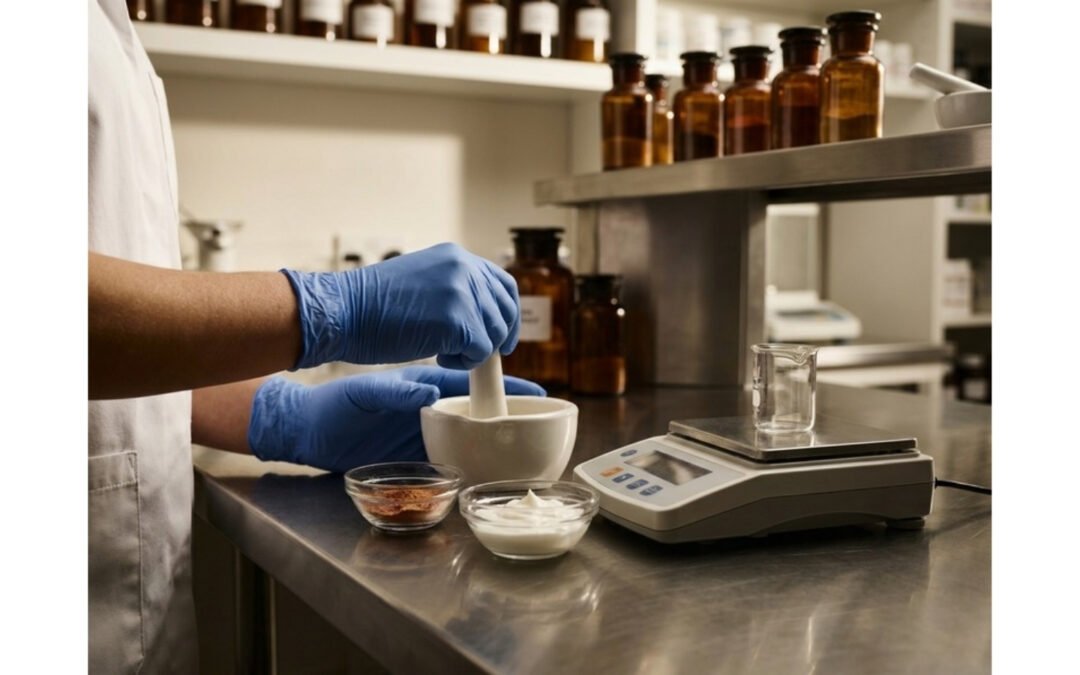
Short answer: Compounded brightening creams for pigmentation work because a prescriber can combine actives that each have their own published human evidence in melasma or post-inflammatory hyperpigmentation, at strengths and in a vehicle no off-the-shelf product offers. Melatonin has no human evidence as a depigmenting agent — its topical evidence is antioxidant and photoprotective — so it belongs in such a preparation as a supportive component, not as the primary brightening active. The prescriber’s task is to match the combination to the patient’s pigmentation type, skin tolerance, and the pharmaceutical stability constraints of the chosen actives, under a named-patient prescription and Good Compounding Practice (GCP).
Why combination matters: the compounding rationale
Off-the-shelf brightening products typically carry one or two actives at concentrations constrained by cosmetic regulation and mass-market tolerability. A compounded preparation allows a prescriber to combine multiple mechanisms of action — tyrosinase inhibition, melanocyte transfer blockade, antioxidant photoprotection, and epidermal turnover acceleration — in a single vehicle at therapeutic strength. A systematic review of topical melasma treatments concluded that combination therapy is more effective than monotherapy, supporting the rationale for multi-active formulations rather than relying on a single agent [1].
The combination approach does not mean adding every available active. It means selecting actives whose evidence supports their use in the target condition, at concentrations the literature reports as effective, in a vehicle that keeps them stable and tolerable. The sections below summarise what the published human evidence supports for each active and the practical formulation considerations.
Actives with human clinical evidence in melasma and hyperpigmentation
Tranexamic acid (topical and oral)
Tranexamic acid (TXA) inhibits plasmin-mediated melanocyte stimulation. A systematic review and meta-analysis of randomised controlled trials confirmed that both oral and topical TXA reduce melasma severity, with topical formulations generally better tolerated [2]. A randomised, double-blind, placebo-controlled study of oral TXA in moderate-to-severe melasma demonstrated significant improvement versus placebo [3]. A randomised clinical trial comparing oral versus topical TXA found both routes effective, with topical application showing comparable benefit and fewer systemic concerns [4].
Topical TXA is commonly formulated at 2–5% in a cream or serum base. It is relatively stable and generally well tolerated, making it a practical anchor active for a combination preparation. Oral TXA is a prescription-only systemic option that the prescriber considers separately; it is not part of a compounded topical but may be discussed as an adjunct in the clinical plan.
Niacinamide
Niacinamide (nicotinamide) reduces melanosome transfer from melanocytes to keratinocytes and has anti-inflammatory properties. A randomised controlled trial comparing a niacinamide and tranexamic acid combination against prescription depigmenting agent found the combination effective for melasma [5]. A randomised controlled trial evaluating a serum containing niacinamide, tranexamic acid, vitamin C, and hydroxy acid demonstrated efficacy comparable to the prescription comparator used in the study in melasma management [6]. Niacinamide is typically used at 2–5% and is stable, well tolerated, and compatible with most other actives, making it one of the easiest actives to incorporate into a combination preparation.
Azelaic acid
Azelaic acid inhibits tyrosinase and is particularly relevant for patients where prescription depigmenting agent is contraindicated, including in pregnancy and breastfeeding. A double-blind randomised comparison of azelaic acid and prescription depigmenting agent in melasma found azelaic acid 20% effective, with efficacy comparable to the prescription comparator used in the study in the study population [7]. A randomised trial of 20% azelaic acid alone versus a prescription comparator confirmed azelaic acid as a viable first-line option [8]. More recently, a randomised split-face trial combined 755-nm picosecond laser with topical 20% azelaic acid, reporting improved outcomes with the combination [9]. Typical concentrations are 15–20%. Azelaic acid can cause mild irritation, particularly at higher strengths, and the vehicle should be selected for tolerability.
Ascorbic acid and its stable derivatives
L-ascorbic acid (vitamin C) inhibits melanin synthesis through antioxidant action and tyrosinase inhibition. A double-blind randomised trial of 5% ascorbic acid versus a prescription comparator in melasma found ascorbic acid effective, with good tolerability [10]. Magnesium ascorbyl phosphate, a stable derivative, has also shown clinical benefit in refractory melasma in Asian patients [11].
The principal formulation challenge is oxidation: ascorbic acid degrades rapidly on exposure to air and light, turning brown and losing activity. A clinical study on ascorbic acid formulation noted that optimising pH (typically below 3.5 for L-ascorbic acid) is essential for percutaneous absorption [12]. A topical antioxidant solution combining vitamins C and E stabilised by ferulic acid demonstrated photoprotection in human skin, illustrating that antioxidant stability can be improved by co-formulation [13]. For a compounded preparation, an airless pump or tube is essential, and the beyond-use date should reflect the known oxidation profile of ascorbic acid in the chosen vehicle.
Kojic acid
Kojic acid inhibits tyrosinase and is frequently combined with other actives. A randomised clinical trial of kojic acid in a gel containing prescription depigmenting agent and glycolic acid reported improvement in melasma [14]. A clinical evaluation of a serum containing tranexamic acid, kojic acid, and niacinamide found improvement in facial dyschromia [15]. Kojic acid is typically used at 1–4%. It can cause contact dermatitis in some patients, and its stability is sensitive to pH and light. It is compatible with niacinamide and TXA but should be patch-tested, particularly in Fitzpatrick III–V skin.
Arbutin and deoxyarbutin
Arbutin and its more potent derivative deoxyarbutin inhibit tyrosinase. A double-blind randomised controlled trial comparing 2% deoxyarbutin and 4% prescription depigmenting agent found deoxyarbutin effective as a depigmenting agent [16]. A comparative study of deoxyarbutin as a tyrosinase-inhibiting agent reported favourable tolerability [17]. A randomised controlled trial evaluating a prescription depigmenting agent alternative for topical skin lightening that included arbutin-based approaches found clinically meaningful results [18]. Deoxyarbutin is more stable than arbutin but still requires protection from light and oxidation. Typical concentrations reported are 1–3% for arbutin and 1–2% for deoxyarbutin.
Cysteamine
Cysteamine hydrochloride is a depigmenting agent that has emerged as an alternative to prescription depigmenting agent, particularly for prescription depigmenting agent-resistant melasma. A systematic review and meta-analysis of randomised controlled trials found cysteamine 5% cream effective and safe for melasma management [19]. A randomised controlled trial comparing 5% cysteamine with 4% prescription depigmenting agent reported comparable efficacy [20]. A randomised controlled trial compared cysteamine 5% with a ascorbic-acid combination combination, finding cysteamine effective [21]. A clinical study of stabilised cysteamine for hyperpigmentation disorders, including post-inflammatory hyperpigmentation and lentigines, supported its broader applicability [22].
Cysteamine has a strong sulphurous odour and can cause irritation, which limits tolerability. It is typically applied as a short-contact wash-off preparation at 5%. Stabilised formulations address the odour and oxidation issues but still require careful patient counselling.
Regulatory check required — Malaysian status of restricted depigmenting agents and prescription retinoids must be confirmed before compounding.
Topical retinoids as an adjunct
Tretinoin accelerates epidermal turnover and is a component of the Kligman triple combination. A systematic review of melasma treatments notes tretinoin’s role as both a monotherapy and an adjunct in combination formulations [25]. Tretinoin is prescription-controlled and contraindicated in pregnancy. It can cause irritation, dryness, and photosensitivity, so it is typically started at a low strength and titrated. In a compounded brightening preparation, tretinoin is usually incorporated at 0.025–0.05% as an adjunct rather than as the primary depigmenting agent.
Topical glutathione
Glutathione inhibits tyrosinase and shifts melanin synthesis from eumelanin to phaeomelanin. A systematic review of glutathione as a skin-lightening agent in melasma concluded that evidence remains limited, with most studies small and of variable quality [26]. A controlled clinical trial of a complex skin cream containing glutathione in Asian women reported improvement in skin tone [27]. The evidence for topical glutathione is thinner than for the actives above; the prescriber should weigh this honestly and not present glutathione as a first-line depigmenting agent.
Melatonin’s place: antioxidant and photoprotective component, not depigmenting agent
Melatonin has no human evidence as a depigmenting agent. Its topical evidence is antioxidant and photoprotective. A randomised controlled trial found that topical melatonin in combination with vitamins E and C protected skin from ultraviolet-induced erythema [28]. A follow-up study showed that topical antioxidants, including melatonin, reduced UV-induced erythema even when administered after exposure [29].
Two randomised controlled trials of topical melatonin cream for radiation dermatitis in breast cancer patients reported reduced severity of acute radiation dermatitis, supporting melatonin’s role as a topical photoprotective and anti-inflammatory agent [30, 31]. A phase II randomised trial similarly found melatonin effective for preventing radiation dermatitis [32].
In a compounded brightening preparation, melatonin can serve as an antioxidant and photoprotective component that supports the depigmenting actives — but it is not itself the agent that reduces pigmentation. The prescriber should be explicit with patients that melatonin’s role is adjunctive, and the clinical expectation of depigmentation comes from the actives with human evidence in melasma or post-inflammatory hyperpigmentation.
Which combinations the literature supports
The evidence supports several practical pairings. Tranexamic acid and niacinamide are compatible and well-evidenced together in multiple studies [5, 6, 15]. prescription depigmenting agent and tretinoin in triple combination is the most established pairing in the literature [23, 24]. Cysteamine can be used as a prescription depigmenting agent alternative or substitute, and has been compared directly with prescription depigmenting agents/ascorbic acid combinations [21]. Ascorbic acid pairs with prescription depigmenting agents and with ferulic acid/vitamin E for stability [13]. Azelaic acid is typically used as a standalone active or paired with a retinoid for turnover.
Some combinations are pharmaceutically awkward. Ascorbic acid requires a low pH (below 3.5) for optimal penetration, which may be incompatible with actives that prefer a higher pH. prescription depigmenting agent and ascorbic acid can be combined but the formulation must address both agents’ oxidation sensitivity. Kojic acid can increase the risk of contact dermatitis and needs careful tolerability monitoring. Cysteamine’s odour and short-contact application method make it poorly suited to a leave-on combination cream with other actives.
Vehicle, pH, stability, and packaging
The vehicle determines penetration, tolerability, and stability. For a brightening preparation, common choices include a cream base for general facial use and a serum base for lighter application or layered regimens. Key considerations include:
- pH compatibility: Ascorbic acid requires pH below 3.5; other actives such as niacinamide and TXA tolerate a broader pH range. If actives with incompatible pH requirements are prescribed, the pharmacy may recommend separating them into a morning and evening preparation.
- Oxidation: Ascorbic acid and glutathione are all oxidation-sensitive. Airless pump dispensers or opaque tubes minimise exposure. The beyond-use date should reflect the shortest stability window of any active in the combination.
- Photostability: Retinoids and kojic acid are light-sensitive. Packaging must be opaque, and patient counselling should emphasise evening application for photosensitive actives.
- Temperature: In Malaysia’s tropical climate, heat can accelerate degradation. Patient counselling on storage away from direct heat is essential.
Beyond-use dating for a compounded topical
A compounded topical carries a beyond-use date (BUD), not a factory expiry. The BUD is assigned based on the stability of the actives in the chosen vehicle, the water activity of the base, and the packaging. For a multi-active brightening cream containing oxidation-sensitive actives such as ascorbic acid or glutathione, a conservative BUD of 30–90 days from preparation is typical, with the shorter end applicable to preparations containing unstable actives or water-rich bases. The prescriber should confirm the assigned BUD with the pharmacy and plan the patient’s review within that period.
Sun protection, patch testing, monitoring
Sun protection is non-negotiable in any pigmentation management plan. UV exposure drives melanogenesis, and without strict photoprotection any active’s benefit will be partially or fully negated. Patients should use a broad-spectrum SPF 50+ sunscreen daily, with reapplication during sun exposure. Iron-oxide-containing sunscreens provide additional protection against visible light, which is increasingly recognised as a trigger for pigmentation in darker skin types.
Patch testing before full application is advisable, particularly for preparations containing kojic acid or cysteamine. The prescriber should counsel patients to apply a small amount behind the ear or on the inner forearm for several days before full facial use.
Expected time course: most actives require 8–12 weeks of consistent use before clinically visible improvement. The prescriber should set realistic expectations and schedule review at 8–12 weeks to assess response and tolerability. Monitoring for irritation, contact dermatitis, and paradoxical darkening (including ochronosis with prolonged prescription depigmenting agent use) is essential. If paradoxical darkening occurs, the preparation should be discontinued and the patient reassessed.
What a prescriber should put on the formulation brief
When sending a compounding referral for a brightening preparation, the formulation brief should include:
- Diagnosis and pigmentation type: melasma, post-inflammatory hyperpigmentation, or other; epidermal, dermal, or mixed (if known).
- Actives and strengths requested: specify each active and its concentration, referencing the clinical evidence for the chosen combination.
- Vehicle preference: cream, serum, or as advised by the pharmacy based on stability and site.
- Excipient exclusions: any known sensitivities, fragrance intolerance, or previous reactions to preservatives.
- Prescription details: named patient, prescription-only actives clearly identified (tretinoin), prescriber’s signature and date.
- Review plan: follow-up at 8–12 weeks, with triggers for earlier review (irritation, paradoxical darkening).
Pharmacies operating under GCP prepare each formulation for one named patient on a doctor’s prescription. The pharmacy can advise on compatibility, stability, and vehicle selection before finalising the preparation, so treat the formulation brief as a starting point for a prescriber-to-pharmacist discussion rather than a fixed order.
Clinicians in Kuala Lumpur, the Klang Valley, and Singapore who wish to discuss a patient-specific brightening formulation — including active selection, concentration, vehicle, and stability considerations — can contact the Lynnity compounding team with the formulation brief above. Each preparation is made on a named-patient prescription under Good Compounding Practice.
Medically reviewed by Vitthia Rama Murti, RPh (RPh 15632)
Frequently asked questions
Can melatonin reduce pigmentation on its own?
No. Melatonin has no human clinical evidence as a depigmenting agent. Its topical evidence supports antioxidant and photoprotective effects, including reduction of UV-induced erythema and radiation dermatitis severity. In a brightening preparation, it serves as a supportive antioxidant component, not the primary depigmenting active. The depigmentation effect comes from actives such as tranexamic acid, niacinamide, azelaic acid, or cysteamine, each of which has published human evidence in melasma.
Which actives can be combined in one compounded cream?
Tranexamic acid and niacinamide are well-supported in combination and pharmaceutically compatible. Tretinoin-based combination therapy is an established prescription approach. Ascorbic acid can be combined with prescription depigmenting agents but requires careful pH and oxidation management. Cysteamine is generally used as a standalone wash-off rather than in a leave-on combination. The pharmacy can advise on compatibility and stability before finalising a multi-active preparation.
How long does a compounded brightening cream last?
A compounded topical carries a beyond-use date (BUD), not a factory expiry. For a multi-active preparation containing oxidation-sensitive actives such as ascorbic acid or glutathione, a conservative BUD of 30–90 days is typical. The exact BUD depends on the actives, vehicle, water activity, and packaging, and should be confirmed with the pharmacy. The prescriber should schedule the patient’s review within the BUD period.
What monitoring does a patient on a compounded brightening cream need?
Patients should be reviewed at 8–12 weeks to assess response and tolerability. Monitoring should include checking for irritation, contact dermatitis, and paradoxical darkening — particularly with prolonged prescription depigmenting agent use, which carries a risk of ochronosis. Sun protection compliance should be reinforced at every visit. If paradoxical darkening or persistent irritation occurs, the preparation should be discontinued and the formulation reassessed.