by Darren ng | Oct 18, 2026 | Compounding Pharmacy
For healthcare professionals. Compounded preparations are dispensed on a doctor’s prescription.Short answer: NAD+ is a coenzyme central to cellular energy and DNA repair; its levels decline with age. Oral NAD+ is poorly absorbed, so strategies use precursors —...
by Darren ng | Aug 13, 2026 | Compounding Pharmacy
Short answer: A compounded supplement does not carry a factory expiry date — it carries a beyond-use date (BUD): the last day the pharmacy can stand behind its quality after preparation. A BUD is deliberately shorter and more conservative than a mass-produced...
by Darren ng | Aug 3, 2026 | Compounding Pharmacy
Short answer: When a patient reacts to a medicine or supplement, the active ingredient is not always the culprit. The reaction may be to an excipient — a filler, dye, preservative, binder or coating the manufacturer added for reasons that have nothing to do with the...
by Darren ng | Aug 3, 2026 | Compounding Pharmacy
Short answer: In a topical preparation, the base is not inert packaging around the active — it is the single biggest determinant of whether the active ever reaches its target. The skin is built to keep things out, and its outermost layer, the stratum corneum, is a...
by Darren ng | Aug 3, 2026 | Compounding Pharmacy
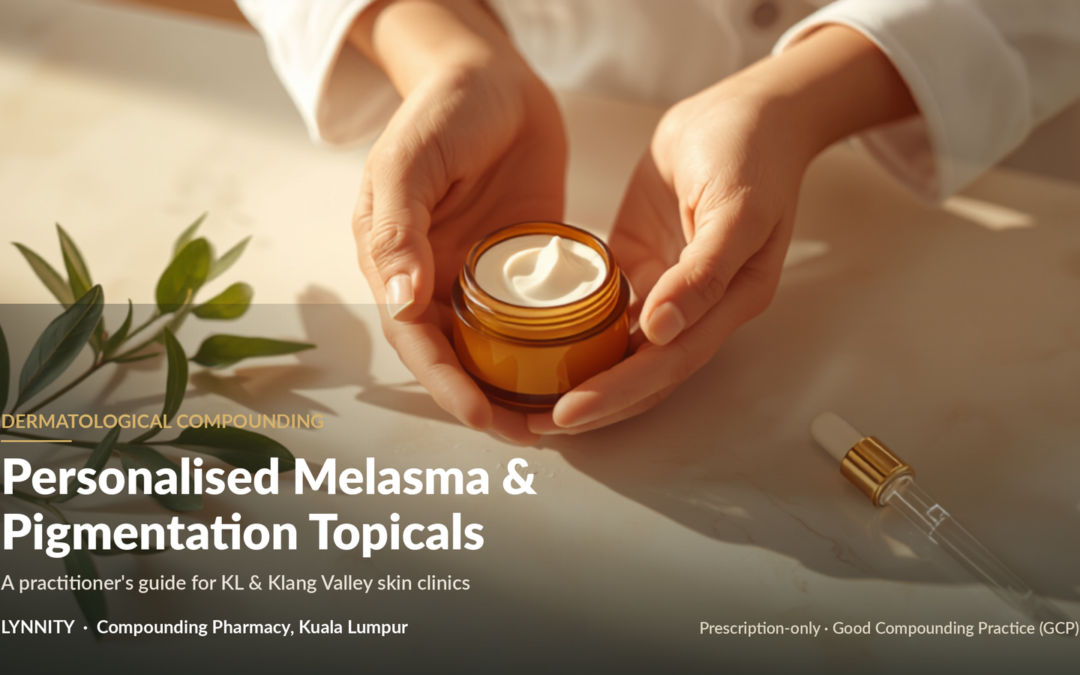
Short answer: Melasma and stubborn facial pigmentation are usually managed with a combination of topical actives — hydroquinone, tretinoin and a mild corticosteroid in the classic triple combination, plus alternatives such as tranexamic acid, azelaic acid, kojic acid,...
by Darren ng | Aug 3, 2026 | Compounding Pharmacy
Compounded Eczema & Sensitive-Skin Topicals: Barrier‑Repair and Excipient‑Aware Formulations for Clinics Short answer: Compounded topicals let a prescriber set the exact active strength and choose a base free of known irritants. In eczema management the dual task...