
For healthcare professionals. Compounded preparations are dispensed on a doctor’s prescription.
Short answer: Betamethasone 17-valerate 0.1% has been studied in atopic dermatitis. In a 2025 randomised trial of 36 adults (PMID 39078120), AD severity decreased significantly in both the betamethasone and tacrolimus groups, and betamethasone was more effective in decreasing inflammation. Whole-body corticosteroid treatment leads to systemic exposure (PMID 36824052), so strength, duration and review remain prescriber decisions.
The question and the condition
The question is what the trial record shows for betamethasone in eczema and dermatitis, and what that record means for a prescriber deciding on a patient-specific preparation. The eczema in the studies below is atopic dermatitis (AD). A 2025 randomised trial describes AD as “mainly driven by type 2 inflammation and often treated with topical agents” (Gether et al., 2025; PMID 39078120). A 2014 trial records that “Topical corticosteroids are safe and effective treatments for AD, when used in short courses. Prolonged use is associated with skin barrier damage” (Danby et al., 2014; PMID 24328907).
The corticosteroid and the comparator in these trials
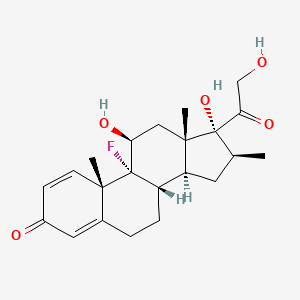
The three trials below compare betamethasone with tacrolimus 0.1%. The 2014 trial describes topical calcineurin inhibitors as “alternative immune-modulating treatments for AD” (PMID 24328907). The corticosteroid in each trial is betamethasone valerate or betamethasone 17-valerate at 0.1%. The trials compare the two agents; they do not set a dose for any patient.
What the trials show
The table below lists each study with its design and population, outcome as reported, and PMID.
| Study | Design and population | Outcome as reported | PMID |
|---|---|---|---|
| Danby et al., 2014 | Randomised observer-blind study; 20 volunteers with quiescent AD | “BMVc significantly reduced skin barrier function, integrity and cohesion” | 24328907 |
| Gether et al., 2025 | Randomised, parallel-group, double-blind, double-dummy active-comparator study; 36 adults with AD | AD severity decreased significantly in both groups; betamethasone “was more effective in decreasing inflammation” | 39078120 |
| Gether et al., 2023 | Randomised, double-blind, double-dummy non-corticosteroid-based active comparator study; 36 non-obese, non-diabetic adults with AD | AD severity improved with both treatments; the bone formation marker P1NP decreased after betamethasone at 2 and 6 weeks | 36824052 |
How the three trials were designed
The 2014 trial enrolled twenty volunteers with quiescent AD, defined in its abstract as no active signs for 6 months. Its authors reported that “BMVc significantly reduced skin barrier function, integrity and cohesion”, while tacrolimus 0.1% “preserved skin barrier function, integrity, cohesion” (PMID 24328907). The abstract also concludes that 4 weeks of BMVc treatment “adversely affected the biophysical properties of the skin” (PMID 24328907).
The 2025 trial was a randomised, parallel-group, double-blind, double-dummy active-comparator study of 36 adults with AD. Mean AD severity at baseline corresponded to moderate disease, and it decreased significantly in both groups. The trial reported that “Betamethasone was more effective in decreasing inflammation, but tacrolimus improved skin hydration (NMF levels) more than betamethasone” (Gether et al., 2025; PMID 39078120).
The 2023 trial was a randomised, double-blind, double-dummy non-corticosteroid-based active comparator study of 36 non-obese, non-diabetic adults (PMID 36824052). Its betamethasone arm was intensive daily whole-body treatment over 2 weeks, followed by twice weekly application for 4 weeks. Its abstract reports that AD severity improved with both treatments and that systemic inflammation was reduced.
Read side by side, the three trials differ in population, comparator, vehicle and schedule. The 2014 trial used a short cream course in volunteers without active disease, the 2025 and 2023 trials used whole-body treatment in adults with active AD, and none of them compares betamethasone with a corticosteroid other than itself. A reader should not treat their outcomes as one pooled answer.
Strengths and schedules in the cited trials
The strengths and schedules below are those each study reports for the product it tested.
| Study | Strength and vehicle | Schedule | PMID |
|---|---|---|---|
| Danby et al., 2014 | 0.1% betamethasone valerate cream | Twice daily for 4 weeks | 24328907 |
| Gether et al., 2025 | 0.1% betamethasone 17-valerate ointment, whole-body | Once daily for 2 weeks, then twice weekly for 4 weeks | 39078120 |
| Gether et al., 2023 | 0.1% betamethasone 17-valerate, whole-body | Once daily for 2 weeks, then twice weekly for 4 weeks | 36824052 |
Systemic exposure and bone
Whole-body use is the setting in which systemic effects were measured. In the 2023 trial, the corticosteroid arm was betamethasone 17-valerate 0.1%, given as intensive daily whole-body treatment over 2 weeks, followed by twice weekly application for 4 weeks. The authors wrote about topical corticosteroids in general: “Whole-body treatment with TCS leads to systemic exposure but appears not to compromise glucose metabolism during short-term use” (Gether et al., 2023; PMID 36824052).
The same abstract reports that the bone formation marker P1NP “decreased after betamethasone treatment after both 2 and 6 weeks”, while the bone resorption marker CTX was unchanged. The authors add that “The negative impact on bone formation could be regarded an adverse effect of TCS” (PMID 36824052).
The same 2023 abstract also reports that AD severity improved with both treatments and that systemic inflammation was reduced (PMID 36824052). Those are the outcomes it measured alongside the systemic and bone markers, and they should be read together with the bone finding rather than in place of it.
Limits of the evidence
The trials are small, with 20 to 36 participants each (PMID 24328907, PMID 39078120, PMID 36824052). The 2014 study enrolled volunteers with quiescent AD. Each trial compares betamethasone with tacrolimus, so the findings describe that comparison and do not establish betamethasone against other corticosteroids.
The treatment periods in these abstracts run from four to six weeks, and none of them addresses long-term use. Strengths, vehicles and schedules differ between the trials, so comparisons across them are limited.
The trials describe the study products named in each abstract, not compounded preparations. Their findings should not be read as a result for any prepared formulation.
What this means for prescribing
For a prescriber, the trial record supports three practical points. First, betamethasone 0.1% has been studied in atopic dermatitis in three trials, each with a short-course design. Second, systemic exposure occurs with whole-body use, and the bone-formation signal reported in PMID 36824052 is one the authors suggest could be regarded as an adverse effect of topical corticosteroids. Third, the trials reviewed here do not establish a long-term regimen, so duration, potency step-down and review interval remain the prescriber’s decision.
Before the prescription is written
Before a prescription is written, the prescriber can record the baseline the trials measured: the severity of atopic dermatitis, the skin barrier condition and any whole-body use. A result at review is best compared with the prescriber’s own baseline for the same patient, rather than with a figure taken from these abstracts.
Where a patient has used a topical corticosteroid before, the prescriber can note the strength, the area treated and the duration of each earlier course. The cited trials describe short courses, so any longer or repeated use falls outside the abstracts reviewed here, and the decision on it rests with the prescriber.
Points to record at review
- The atopic dermatitis severity at each review, using the scale the prescriber already applies.
- The areas treated and the duration of each course, as the prescription states them.
- The skin barrier condition at each review, as the prescriber assesses it.
- Any whole-body use and the interval between courses, since systemic exposure is the setting in which the 2023 trial measured it.
Readers working on the same condition may also find our guides to choosing a compounded cream for eczema and compounded eczema and sensitive-skin topicals useful for the wider decision about vehicle and excipients.
Compounded preparations are made under Good Compounding Practice (GCP). The laboratory standards are set out on our GCP laboratory page.
Reviewed by Vitthia Rama Murti, RPh (RPh 15632).
How to prescribe
A compounded preparation is made only on the prescription of a registered doctor, for one named patient, under Good Compounding Practice (GCP). The prescription should state the active (the corticosteroid the prescriber names), the strength, the form, the quantity and the directions for use, including the area of application and the duration the prescriber intends.
Send the signed prescription through our contact page. Vitthia Rama Murti, RPh (RPh 15632), can be contacted through the same page, and our pharmacists team page sets out the team.
Frequently asked questions
Can a compounded preparation for eczema be supplied without a prescription?
No. A compounded preparation is made for one named patient on a registered doctor’s prescription, under Good Compounding Practice (GCP). The prescription should state the active, strength, form, quantity and directions, so the preparation matches the prescriber’s specification.
What strength did the eczema trials use?
The cited trials used 0.1% betamethasone, as valerate or 17-valerate. The 2014 trial used a 0.1% betamethasone valerate cream (PMID 24328907), and the 2025 trial used a 0.1% betamethasone 17-valerate ointment (PMID 39078120). The 2023 abstract (PMID 36824052) does not state the base. The strength and schedule for each trial are listed in the table above.
Does betamethasone affect bone formation?
A 2023 adult trial reported that the bone formation marker P1NP decreased after betamethasone 17-valerate 0.1% at 2 and 6 weeks, while the bone resorption marker CTX was unchanged (PMID 36824052). The authors wrote that the negative impact on bone formation “could be regarded an adverse effect of TCS”. The finding relates to whole-body use over a short course.
Is the evidence for betamethasone in eczema strong?
The cited trials are small, with 20 to 36 participants each (PMID 24328907, PMID 39078120, PMID 36824052), and each compares betamethasone with tacrolimus. They support the statements their abstracts make, and they do not establish a long-term regimen. The prescriber decides the strength, duration and review interval for each patient.