
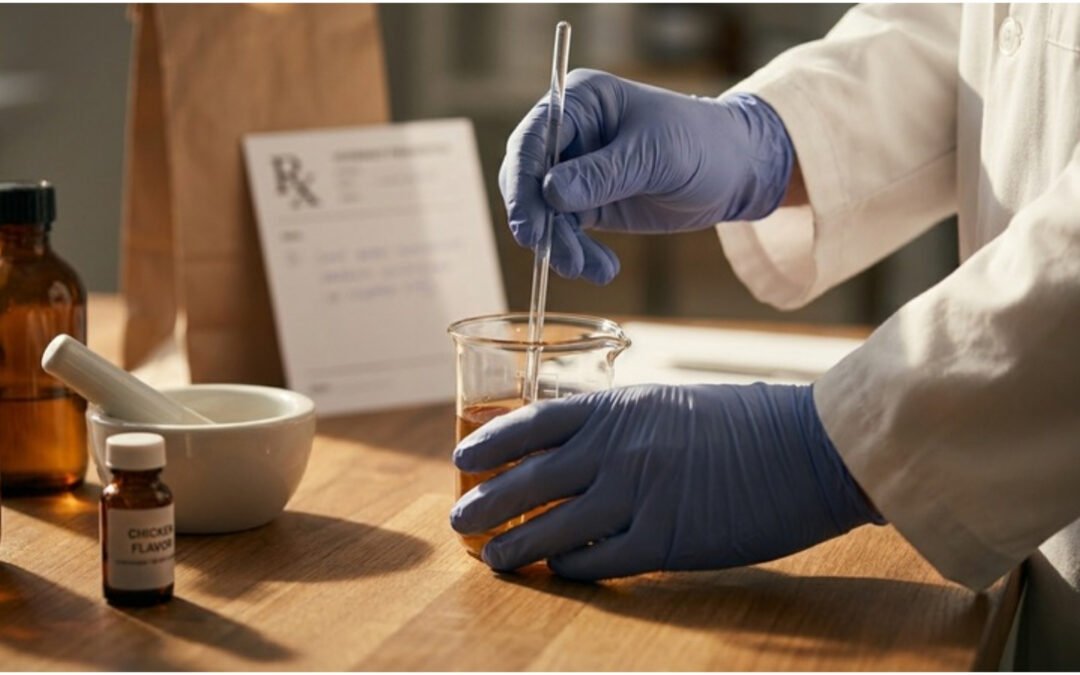
Short answer: When a companion animal will not accept a tablet, non-sterile compounding offers formulation alternatives — flavoured oral liquids, dose-precise preparations, and alternative vehicles — that can improve acceptance and dose accuracy. The central clinical considerations are species-specific excipient hazards, dose precision across a wide range of body weights, and the regulatory distinction between licensed veterinary products and compounded preparations made for a named animal patient on a veterinarian’s prescription. A review of veterinary compounding regulation, challenges and resources summarises the practical and regulatory framework clinicians should be aware of.1
Why compounding matters in veterinary practice
Veterinary patients span multiple species with different metabolic pathways, body sizes and tolerances for excipients commonly used in human medicine. A tablet designed for a human adult cannot simply be cut into smaller pieces to dose a small dog or a cat — the resulting dose is imprecise, and the excipients may not be suitable for the species. Compounding allows dose precision, palatable flavours and appropriate vehicles for the intended route of administration, prepared for a named animal patient on a veterinarian’s order.
A review published in Pharmaceutics summarises the regulatory and practical challenges around veterinary compounding, noting that compounding is an important tool when licensed products do not meet a patient’s needs, but that it requires careful attention to species-specific safety and quality standards.1 Limitation: the regulatory context described is primarily from a US perspective; Malaysian and regional regulations may differ.
Species-specific pharmacology and excipient safety
Several well-known species differences have direct prescribing implications for compounded formulations.
Cats and glucuronidation limitations
Cats conjugate certain drugs poorly and can form toxic metabolites. Cat sensitivity to some excipients and to drugs that undergo glucuronidation requires careful selection of both active and vehicle. This means that a formulation acceptable for a dog or a human may not be appropriate for a cat.
Xylitol and dogs
Xylitol causes rapid insulin release and hypoglycaemia in dogs and can lead to hepatic injury. A review of xylitol toxicity in dogs describes the mechanism and clinical consequences, and an updated review in the Veterinary Clinics of North America reinforces the risks.23 Inclusion of xylitol as a sweetener in a compounded veterinary product would be dangerous for dogs. Limitation: reviews summarise case series and toxicology data rather than randomised trials.
Propylene glycol and cats
Propylene glycol can cause Heinz-body haemolytic anaemia and D-lactic acidosis in cats when exposures are substantial. A toxicological review of the propylene glycols describes the mechanism and the species-specific risk.4 High concentrations of propylene glycol-containing vehicles should be avoided in feline formulations. Limitation: older toxicology data and experimental dosing.
Formulation options for non-sterile veterinary compounding
Within non-sterile compounding scope, formulation options that may be discussed with the compounding pharmacy include flavoured oral liquids to improve acceptance, dose-precise preparations matched to the animal’s body weight, and alternative vehicles where standard formats are unsuitable. The veterinarian should specify the active, dose, species and body weight, and any known excipient sensitivities or contraindications for the species.
Compounded veterinary preparations should be made for a named animal patient on a veterinarian’s prescription, with the review plan set by the prescribing veterinarian. The preparation should carry a beyond-use date that reflects the formulation’s stability.A
When to compound vs when to use a licensed product
Compounding is not a first-line substitute for a licensed veterinary product that meets the patient’s needs. The decision to compound should be triggered by a specific gap: no licensed product at the required dose, no suitable formulation for the species, or an excipient in the licensed product that is contraindicated for the patient. When a licensed product exists and is appropriate, it should be used. The veterinarian should document the clinical rationale for compounding in the patient’s record.
Regulatory considerations
Veterinary compounding operates under separate regulatory considerations from human compounding. The review by Davidson notes that veterinary compounding regulations vary by jurisdiction and that prescribers should be familiar with the requirements in their practice context.1 In Malaysia, veterinary compounding may be subject to additional regulatory requirements that differ from human compounding. Prescribers should confirm the regulatory framework applicable to their practice before referring.
How this fits the Lynnity practice context
Lynnity Pharma operates as a non-sterile compounding pharmacy in Kuala Lumpur serving the Klang Valley. Its published materials include a practitioner-facing guide to veterinary compounding that addresses species-specific excipient hazards and formulation considerations.A Veterinary compounding referrals should be framed as a veterinarian-to-pharmacy discussion about formulation, excipient safety and quality — with the veterinarian retaining responsibility for species-specific prescribing decisions.
Frequently asked questions
When should a veterinarian consider compounding for an animal that won’t take a tablet?
Consider compounding when no licensed product meets the patient’s dose, formulation or excipient needs — for example, when a flavoured liquid would improve acceptance, or when dose precision for a small species requires a customised preparation. Document the clinical rationale and use a licensed product where one is suitable.
Which excipients are dangerous for specific species?
Xylitol is dangerous for dogs, causing hypoglycaemia and potential hepatic injury. Propylene glycol can cause Heinz-body anaemia in cats. Cats also have limited glucuronidation, making some excipients and drugs poorly tolerated. The veterinarian should specify any species-specific exclusions when referring.24
Does veterinary compounding require a prescription?
Yes. Compounded veterinary preparations should be made for a named animal patient on a veterinarian’s prescription, with the review plan set by the prescribing veterinarian. The preparation should carry a beyond-use date that reflects the formulation’s stability.A
What should a veterinarian include when referring for a compounded veterinary preparation?
Include the species, body weight, prescribed active and dose, any known excipient contraindications for the species, and the preferred formulation format. This allows the compounding pharmacy to assess whether the requested preparation is practical within non-sterile compounding scope.
Reviewed by Vitthia Rama Murti, RPh (RPh 15632)
For practitioner enquiries, veterinarians can discuss species-specific formulation needs with the Lynnity team, providing the prescribing brief needed for pharmacy review.
References
- Davidson G. Veterinary Compounding: Regulation, Challenges, and Resources. Pharmaceutics. 2017. PMID: 28075379. https://pubmed.ncbi.nlm.nih.gov/28075379/
- Piscitelli CM et al. Xylitol toxicity in dogs. Compendium (Yardley, PA). 2010. PMID: 20473849. https://pubmed.ncbi.nlm.nih.gov/20473849/
- Murphy LA et al. Xylitol Toxicosis in Dogs: An Update. The Veterinary clinics of North America. Small animal practice. 2018. PMID: 30064708. https://pubmed.ncbi.nlm.nih.gov/30064708/
- Fowles JR et al. A toxicological review of the propylene glycols. Critical reviews in toxicology. 2013. PMID: 23656560. https://pubmed.ncbi.nlm.nih.gov/23656560/
Grounding source A: Lynnity Pharma blog post ID 374690, https://www.lynnitypharma.com/blog/veterinary-compounding-in-malaysia-what-prescribing-vets-should-know-about-customised-animal-formulations-non%e2%80%91sterile-only/